Sunday Sep 27, 2026
Sunday Sep 27, 2026
Monday, 10 August 2026 00:24 - - {{hitsCtrl.values.hits}}
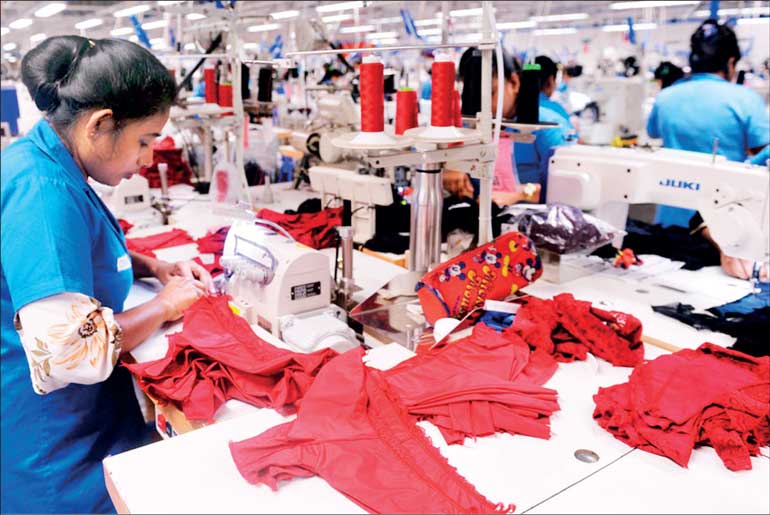

The European Union (EU) is one of Sri Lanka's most valuable trading partners. This market supports billions of dollars in exports, thousands of businesses, and hundreds of thousands of jobs. It buys Sri Lankan apparel, rubber products, tea, and seafood. Much of this success relies on the Generalised Scheme of Preferences Plus (GSP+). This scheme grants Sri Lanka duty-free access for many products.
The trade landscape is now changing. The India–EU Free Trade Agreement concluded in January 2026, marking a major shift in South Asian trade. Once active, Indian exports will gain better access to Europe. This increases competition for countries exporting similar goods. For Sri Lanka, this shift comes at a critical time. The country must apply to renew GSP+ before the current deal ends in late 2027. The outcome will shape Sri Lanka's export competitiveness for years.
Why Europe matters
The EU takes about 24% of the country's total merchandise exports, making it one of Sri Lanka's largest export destinations. In 2025, bilateral trade in goods reached around €3.9 billion. Sri Lankan exports accounted for nearly €3.3 billion of that total. This trade creates a steady surplus and brings in vital foreign exchange.
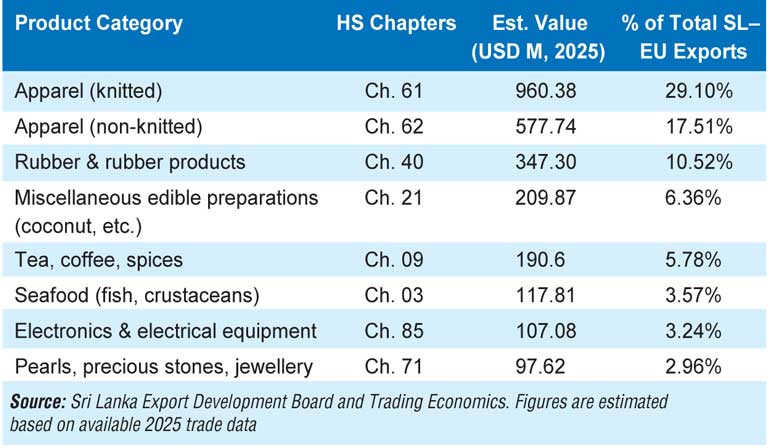
Sri Lanka's exports to Europe focus on a few key sectors. Apparel dominates, making up almost half of all EU exports. Other major exports include rubber products, tea, spices, seafood, electronics, and jewellery. These industries depend heavily on European demand. They also support employment across the country.
Export earnings boost foreign exchange reserves and drive industrial production. They also sustain thousands of small and medium-sized enterprises in export supply chains. As Sri Lanka recovers economically, strong access to European markets is crucial.
Why GSP+ matters
GSP+ is more than a trade preference. It gives Sri Lankan exporters a key competitive edge by allowing duty-free access. This lowers prices for European buyers. It also makes Sri Lankan goods more attractive than competitors paying normal tariffs.
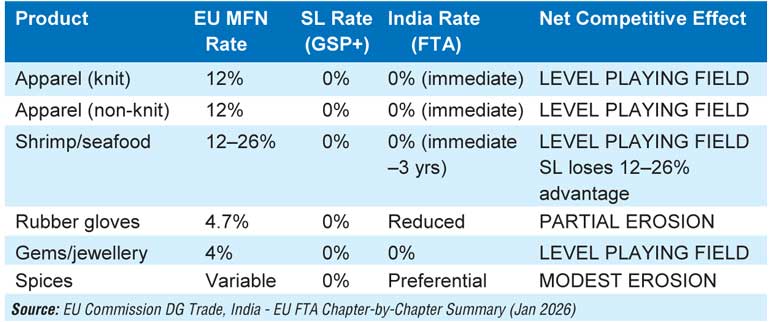
The scheme is vital for the apparel industry. Without GSP+, Sri Lankan garments would face EU tariffs of around 12%. This would raise prices and cut competitiveness. Similar advantages apply to rubber, fisheries, and processed agricultural goods.
Sri Lankan exports are eligible for and utilise GSP+ in the following ways:
For many Sri Lankan exporters, GSP+ is embedded in their business model. It allows them to price products competitively, maintain long-term relationships with European buyers, and compete in sectors where even small tariff differences can influence purchasing decisions.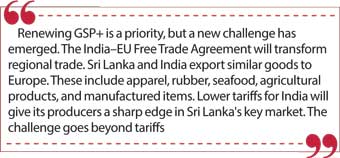
Where Sri Lanka stands today
Sri Lanka regained GSP+ status in 2017 after committing to implement 27 international conventions covering human rights, labour standards, environmental protection, and good governance. Since then, the European Commission has regularly monitored the country's progress through periodic reviews and monitoring missions.
As of 2026, Sri Lanka is preparing its application for the next GSP+ cycle, which must be submitted before the March 2027 deadline. The current arrangement will expire on 31 December 2027.
The EU has signalled a generally positive outlook towards Sri Lanka's renewal. However, continued eligibility will depend on the country's progress in implementing its commitments under the 27 international conventions.
Several reform areas remain under close scrutiny. Reform of counter-terrorism legislation continues to receive significant attention with the proposed Protection of the State from Terrorism Act expected to be assessed against international human rights standards. The EU has also raised concerns regarding amendments to the Online Safety Act and their implications for freedom of expression.
Labour rights remain another important consideration, particularly freedom of association and collective bargaining within export processing zones. At the same time, judicial independence, governance reforms, transitional justice commitments, and compliance with environmental conventions continue to form part of the broader assessment.
Although Sri Lanka has maintained constructive engagement with the European Union, the pace and quality of these reforms will play a decisive role in determining the country's future eligibility.
A new challenge: The India–EU trade agreement
Renewing GSP+ is a priority, but a new challenge has emerged. The India–EU Free Trade Agreement will transform regional trade.
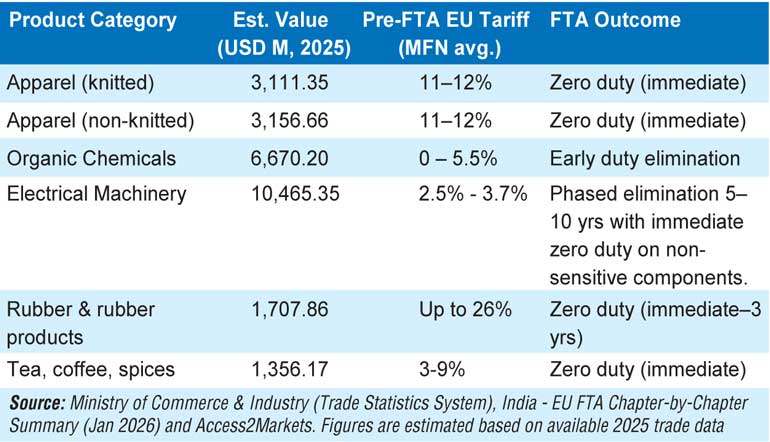
Sri Lanka and India export similar goods to Europe. These include apparel, rubber, seafood, agricultural products, and manufactured items. Lower tariffs for India will give its producers a sharp edge in Sri Lanka's key market.
The challenge goes beyond tariffs. India has a larger manufacturing base, lower production costs, and greater economies of scale. It also boasts stronger logistics and higher foreign investment. Easy European market access will reinforce these strengths.
Sri Lanka will not lose its market presence overnight. The country retains a strong reputation for ethical apparel, premium tea, quality rubber, and high standards. However, competition is growing tougher.
Looking beyond renewal
Securing another GSP+ cycle should remain Sri Lanka's immediate priority, but it cannot be the country's only trade strategy.
Improving competitiveness will require continued investment in productivity, technology, innovation, and value addition. The apparel industry can strengthen its position by expanding sustainable and high-value manufacturing while continuing to uphold strong labour standards and workers' rights. Similarly, Sri Lanka's tea industry can build on its reputation for quality by pairing stronger labour conditions across the plantation sector. Demonstrating compliance with international labour standards is not only important for GSP+ renewal but can also enhance Sri Lanka's reputation among increasingly sustainability-conscious European consumers and buyers.
At the same time, Sri Lanka should diversify export markets beyond Europe by strengthening commercial links with East Asia, the Gulf region, and North America. Reducing dependence on any single export destination will improve resilience against future changes in global trade policies.
The country should also explore the long-term feasibility of negotiating a bilateral trade agreement with the European Union. While preference schemes such as GSP+ provide important short-term advantages, a comprehensive trade agreement could offer greater certainty for exporters over the longer term.
The road ahead
Sri Lanka's GSP+ renewal arrives at a defining moment. The country is emerging from its worst economic crisis in decades while facing an increasingly competitive global trading environment. The India - EU Free Trade Agreement has changed the regional landscape and raised the stakes for Sri Lankan exporters.
Renewing GSP+ will remain essential for protecting export earnings, foreign exchange, and employment. Yet maintaining preferential access alone will not be enough. Sri Lanka must also accelerate reforms, strengthen competitiveness, and prepare for a future in which regional competition will only intensify.
The next 18 months will therefore be about far more than securing another trade preference. They will determine whether Sri Lanka can preserve its position in one of its most important export markets while adapting to a rapidly changing global economy.
(The author is a Program and Research Officer at Arutha, a public policy think tank. His research areas include foreign policy economic governance, and gender)




