Tuesday May 19, 2026
Tuesday May 19, 2026
Monday, 16 March 2026 00:31 - - {{hitsCtrl.values.hits}}
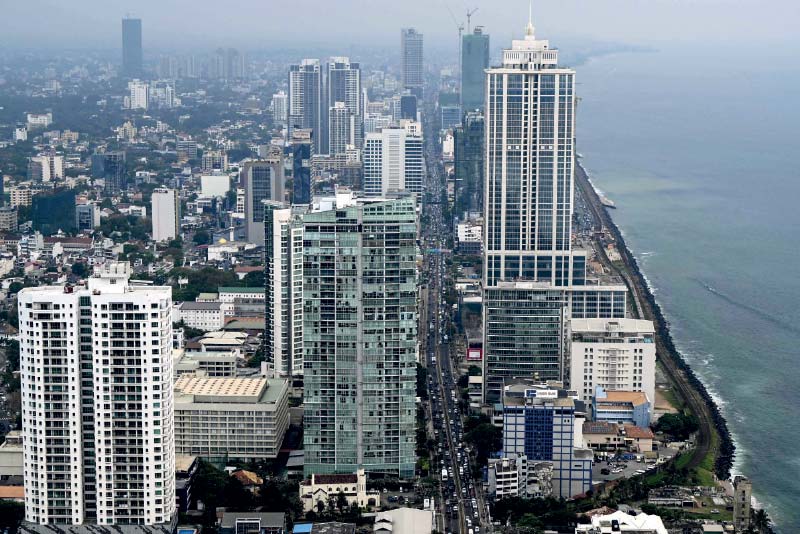
 A changing skyline
Colombo’s skyline is changing in more ways than one. Alongside new buildings and expanding port infrastructure, a light haze increasingly hangs over the city. On many evenings the air-quality index now reaches levels that would trigger concern in other Asian cities.
The causes of Colombo’s air pollution are complex. Traffic, industry, household energy use and regional pollution all play a role. But one source receives far less attention than it deserves: emissions from the international shipping lanes passing just off Sri Lanka’s coast.
Personal observations
I first lived in Colombo from 2012 to 2016. Since retiring in 2022, I return each year for several months during the European winter. Over time I have grown deeply attached to this city — its energy, its people and its remarkable maritime location. But during these visits I have also noticed a gradual change in the air.
On certain evenings you feel it in your throat. You see it settling over the skyline. And more often than before, the air-quality index shows levels considered unhealthy for sensitive groups.
Why air pollution matters
Fine particulate matter — known as PM2.5 — is among the most dangerous forms of air pollution because the particles penetrate deep into the lungs and bloodstream. The World Health Organisation recommends an annual average exposure of no more than 5 micrograms per cubic meter. In many Asian cities — and increasingly on certain days in Colombo — concentrations exceed this level.
Public debate in Sri Lanka often focuses on pollution drifting across the Palk Strait from India. Cross-border pollution certainly exists and deserves careful study. But it is not the entire story.
The overlooked role of shipping
Sri Lanka sits directly on one of the busiest maritime corridors in the world. Thousands of container ships, tankers and bulk carriers travel each year along the East–West shipping route linking Asia, the Middle East and Europe. The Port of Colombo has become one of the region’s most important container hubs, and Sri Lanka rightly takes pride in its strategic maritime position.
Yet many ships passing along these routes burn heavy fuel oil — one of the dirtiest fuels still used in global transport.
A practical policy option
A practical first step would be the introduction of a clean-fuel requirement within Sri Lanka’s territorial sea. Ships approaching ports such as Colombo or Hambantota could be required to switch to low-sulphur marine fuel while operating within twelve nautical miles of the coast or while remaining at berth.
Such a measure would not be unusual. Similar rules already operate successfully in Europe, North America, China and California.
A strategic opportunity
Sri Lanka’s location at the crossroads of global maritime trade is one of its greatest strategic advantages. Addressing ship emissions would not weaken the country’s role as a maritime hub. On the contrary, it would strengthen Sri Lanka’s reputation as a modern and responsible maritime nation.
Cleaner air for Colombo would benefit residents, reduce long-term health risks and demonstrate that economic progress and environmental responsibility can go hand in hand.
(The author is a former German Ambassador to Sri Lanka and former Consul General in Mumbai. He spends several months each year in Colombo)




