Friday Sep 04, 2026
Friday Sep 04, 2026
Friday, 4 September 2026 00:07 - - {{hitsCtrl.values.hits}}
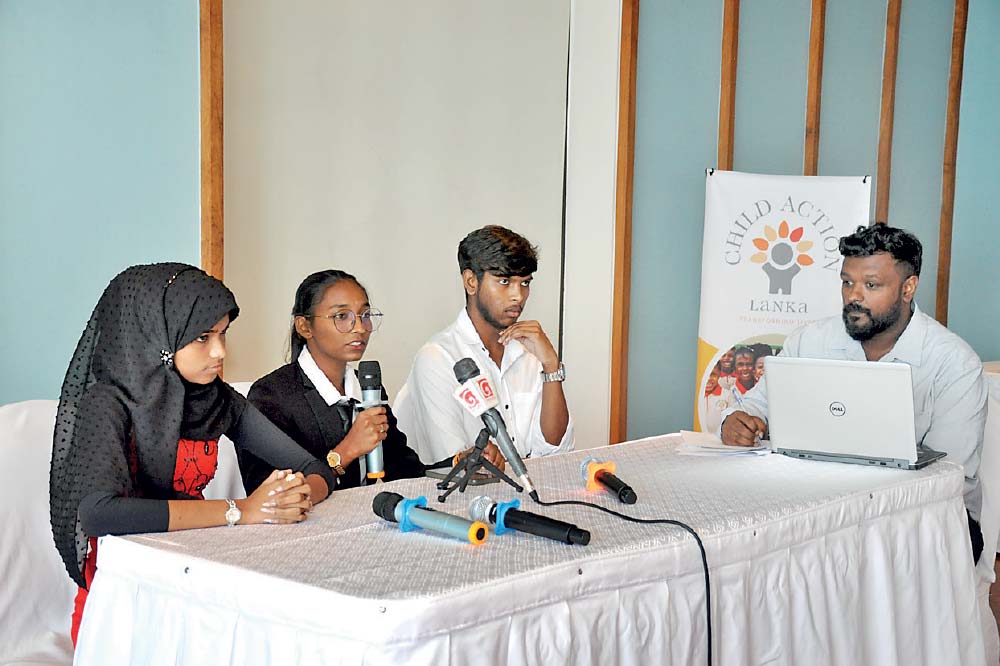
Jim Kennedy (from Bogawantalawa), Maganthirakumar Mithurshika(Batticaloa), Fathima Shakira (from Colombo) and Program Coordinator Balasubramaniam Balasooriya
By Kavinu Cooray
The sentiment at the heart of the Child Rights Council 2026 rejects the age-old proverb ‘children should be seen and not heard’.
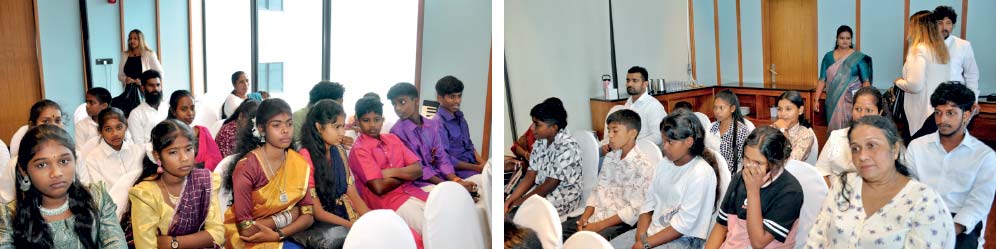
Child Action Lanka recently hosted the second edition of the Child Rights Council (CRC) in partnership with Gateway College and the Sri Lanka Model United Nations (SLMUN). The event saw gathering of underprivileged youth from 9 regions across the country in a structured forum where they could raise and relay the social, economic and humanitarian concerns affecting people in their communities.
In collaboration with the Sri Lanka Model United Nations (SLMUN), the Child Rights Council (CRC) emulated the model used at its inaugural session in April last year. Over the course of 2 days, young delegates acted as formal ambassadors for their own regions and advocated on behalf of their communities in a parliamentary setting. The CRC utilised a mentor-mentee program, with experienced SLMUN delegates serving as pillars of guidance for the children, helping them refine their arguments and prepare to present issues affecting the quality of life in their communities.
By fostering a constructive system of thought exchange, the CRC serves as a necessary platform for the youth to develop leadership, advocacy and diplomacy skills. More than that, it imparts lessons of mutual empathy to the children involved, empowering even the most vulnerable groups in society to be autonomous in the fight for their own rights. The participating children represented communities across 9 underserved regions in Sri Lanka, including Bogawantalawa, Kandy, Galle, Colombo, Nuwara Eliya, Mullaitivu, Batticaloa, Kilinochchi and Akkarayankulam.
Child Action Lanka Founding Director Debbie Edirisinghe said: “Our role needs to be in empowering them. I think the word ‘empower’ is used very freely in the NGO world. The end goal is to essentially put ourselves out of a job, because they should be able to function without us. We run welfare groups where the children are supported by their parents and community members. Through these groups, there are multiple schemes to help families increase their income, strengthen existing businesses, or start new ones. The aim is to build a sustainable community network in which they support one another and, over time, can take ownership of their own development.”
A panel of delegates addressed the press and gathered representatives at Granbell Hotel Colombo as a precursor to the closing ceremony of the Child Rights Council. The panel of youth delegates comprised the following: Jim Kennedy (Bogawantalawa), Maganthirakumar Mithurshika (Batticaloa) and Fathima Shakira (Colombo). Speaking on behalf of their communities, the delegates highlighted the systemic, socio-economic disparities affecting the children in their regions.
Child Action Lanka Program Coordinator Balasubramaniam Balasooriya, who served as the presiding moderator of the panel, provided an English-translated summary of the concerns raised:
n Jim Kennedy (Bogawantalawa) stressed the urgency of the water scarcity issue in his region. Among many examples, he highlighted the major disparity between water supply and demand for plantation workers and their families living in line rooms, with only 1 pipeline connection available for 15 houses. The scarcity has had a devastating effect on residents, with the water supply only worsening over the past year due to the start-up of mineral water factories near water sources.
n Maganthirakumar Mithurshika (Batticaloa) highlighted the socio-economic barriers faced by children in her district. Since the disastrous floods and landslides that affected the country in 2022, many children have dropped out of school to work and support their families. On top of that, she raised concerns over rates of drug use among children, citing that 1.9% use cannabis and 0.6% use heroin.
n Fathima Shakira (Colombo) raised the issue of children’s health in her district. The contaminated waterways and canals in Colombo pose severe threats to children who live near them, as the lack of access to proper sanitation and clean water in underserved communities dramatically increases their risks of contracting water-borne illnesses.
Emphasising the necessity of the CRC initiative, Child Action Lanka Founding Director Debbie Edirisinghe said: “We adults make a lot of decisions for children without ever consulting them. Nobody is there to listen to what they feel about things. A child’s basic right to express themself is not a part of the cultural norm. To achieve the vision of a sustainable community network in Sri Lanka, we need to raise a new generation who can think for themselves.”
The Child Rights Council 2026 serves as a powerful reframing of child advocacy, calling into question traditional top-down models in social policy intervention. With around 12 Child Development Centres across the country, Child Action Lanka is a non-profit that has been active since 2006. It endeavours to protect even the most disadvantaged children by providing holistic education, health and nutrition; promoting their basic needs, rights and interests; and enabling them and their communities to bring about positive change. Among their projects to improve the quality of life for children across the country, they provide crucial resources such as medical screenings, vision camps, access to assistive devices, educational resources and basic food supplies. By empowering disenfranchised children across the nation to advocate for their own development, the Child Rights Council sets the stage for a more equitable and sustainable approach to policy reform in Sri Lanka: one that aims to address on-the-ground systemic disparities in vulnerable communities as they occur.
- Pix by Lasantha Kumara



