Tuesday Oct 06, 2026
Tuesday Oct 06, 2026
Monday, 4 May 2026 06:14 - - {{hitsCtrl.values.hits}}
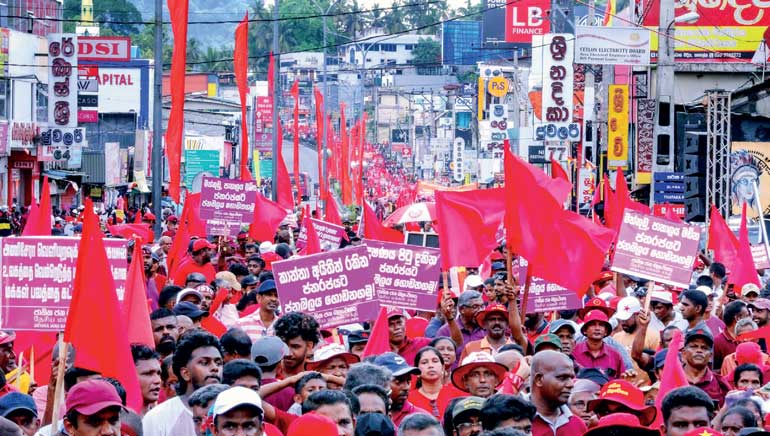
The profligacy of using diesel-powered buses to haul people to bulk up the crowds for the 21 rallies organised by the ruling party as well the rallies organised by Opposition parties suggests that the Government is not taking the warnings seriously
 In Greek mythology, Cassandra was a Trojan priestess dedicated to the god Apollo and fated by him to utter true prophecies, but never be believed. Cassandra warned the Trojans about the famous wooden horse left behind by the Greeks, but was not believed. The horse was pulled into the city. The warriors hiding inside jumped out in darkness, killed the guards and opened the gates to the waiting attackers.
The evidence of its continuation in Sri Lanka is in the photographs of the large numbers of buses used to haul the participants of the various May Day rallies, mostly by the ruling party. Buses use diesel, the fuel that is essential for sustaining the supply chains that keep the people fed and the export economy functioning. The diesel that was used for performative purposes is what is being used to meet peak electricity demand in the context of shortfalls in coal and hydro-generated power. The most recent stocks of what was burnt on May Day cost Ceypetco $268 per barrel, the highest price paid for Diesel worldwide up to that point.
Of the different varieties of fuel, diesel is the one that requires the most attention, according to analysts. The region now blocked by the Hormuz blockades produces grades of medium-sour crude oil well-suited as feedstock for the production of middle distillates, such as jet fuel and diesel. As the war continues, supplies of these refined products, especially diesel, are becoming tighter; US diesel prices have already reached record levels. Australia is securing emergency supplies of diesel.
This information is widely available to anyone with access to the internet. It has been written about in both Sinhala and English and published in hardcopy and online. Among the recommendations made in early April were:
“Prepare and publish credible data on stock availability for all fuels, including diesel and furnace oil. Make contingency plans for both diesel and furnace oil. Regarding diesel, the priorities should be goods transport and power generation. Increasing diesel prices even above cost recovery may be justified. Vehicles that require diesel for productive purposes can pass on the costs. The objective is to sharply depress demand for this fuel.”
I believed the message had got through. This was because the Government announced before the avurudu holidays that rationing restrictions would be temporarily suspended for petrol vehicles, but not for diesel. That discrimination appeared to have been based on knowledge of the stocks of diesel and petrol and the higher priority placed on diesel. I inferred that the Government was partially implementing the above recommendation.
But the profligacy of using diesel-powered buses to haul people to bulk up the crowds for the 21 rallies organised by the ruling party as well the rallies organised by Opposition parties suggests that the Government is not taking the warnings seriously. It appears that Cassandra’s curse is alive and well in 21st Century Sri Lanka.
Cassandra’s curse
Before the 2021-22 economic crisis, those who could see the approaching storm warned of it and recommended measures to prevent Sri Lanka’s descent to the level of Lebanon. These warnings were dismissed. Attacking me by name, an apologist said “ordinary people . . . will be alarmed but deep within they would know that there is no use in comparing us to Lebanon. They will know that there have been Cassandras who say scary things and that they have been in business for a long time.” He thought he was putting me down with the Cassandra analogy. But he was using the analogy correctly. The warning was correct and should have been heeded.
It was Cassandra’s fate to be not believed. It was Troy’s fate to be razed to the ground. The Gotabaya Government did not heed the warnings. His resignation was tendered on the 14th of July, 2022.
What is to be done?
It’s late, but take the warnings seriously. Maybe warnings from Sri Lankans are not enough. The Economist is a prestigious publication. Here is what it says:
“Asia, which used to receive four-fifths of Gulf exports, [is] in a particular bind. Commercial inventories in a few other Asian countries are running out. South Korea is due to taper releases from its strategic reserves in the coming days. Japan’s will be exhausted in May. Crude stocks in Asia excluding China fell by 67m barrels, or 11%, in the month to April 19th, according to Kayrros, a firm that estimates inventories using satellite imaging.
A shortfall of raw materials has forced Asian refiners to cut throughput by over 3m barrels a day (b/d), or 10% of their combined capacity. That could accelerate to 5m b/d in May and, if the strait stays shut, 10m b/d in July, says Neil Crosby of Sparta Commodities, a data firm. China could help by releasing some of the 1.3bn barrels of crude it holds in reserve. Instead it has suspended exports of refined products. A trader familiar with its energy strategy reckons it will not open the taps before a lasting truce. All this compounds shortages created by the loss of Gulf exports of finished fuel, on which Asia also relies.”
The effects on Sri Lanka and on diesel will be disproportionately worse. Most of Sri Lanka’s fuel came through the Strait of Hormuz, directly as refined product or as crude that was processed in India, Singapore, etc. And we lack the purchasing clout of the larger and richer Asian economies.
This is the time to get ready, to build reserves, implement contingency plans, and to rigorously enforce allocations to priorities and rationing and prohibitions to others. Busing supporters to political rallies cannot be a priority. The President could have reached more people through a broadcast or via social media. Let us not repeat the 2022 experience.



