Saturday Oct 17, 2026
Saturday Oct 17, 2026
Thursday, 26 March 2026 00:22 - - {{hitsCtrl.values.hits}}
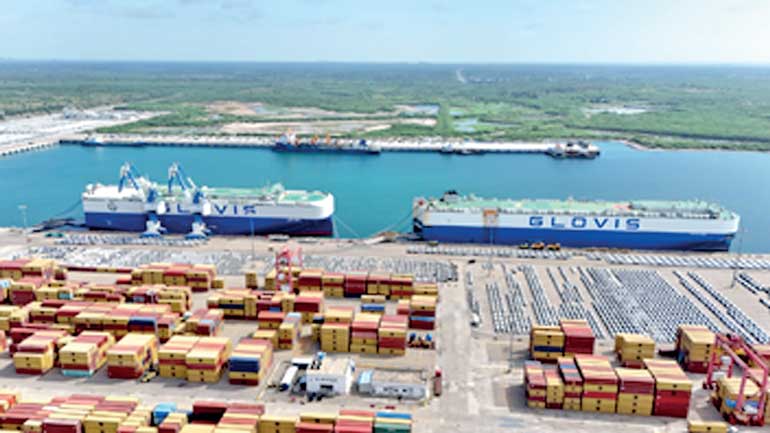
Hambantota International Port
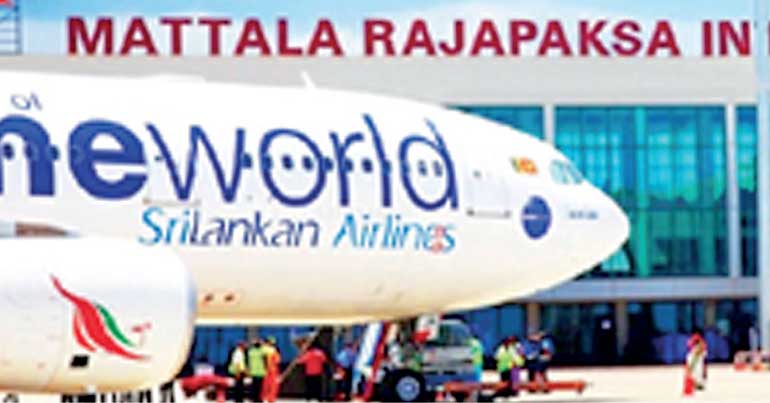
Mattala Rajapaksa International Airport
 For years, the Mattala Rajapaksa International Airport has carried a label that has been hard to shake. It has been called the “world’s emptiest airport,” often cited globally as an example of infrastructure ambition running ahead of demand. But infrastructure stories are rarely static. Context changes. And when it does, so does value.
In today’s world, defined by geopolitical instability, disrupted supply chains and shifting trade routes, assets once dismissed as underutilised are being viewed through a very different lens. Hambantota International Port itself was once labelled a “white elephant,” yet through timely decisions and the entry of strategic partners, it has evolved into a growing industrial and logistics hub. Mattala may well be approaching a similar turning point.
A region in flux, a shift in thinking
The ongoing instability in the Middle East, particularly around key chokepoints such as the Strait of Hormuz, is already reshaping how global logistics players think. Airlines, shipping lines and logistics partners are recalibrating routes, factoring in risk, rising insurance costs and the unpredictability of escalation. At the same time, the Indian Ocean is quietly reasserting itself, not as a zone of conflict, but as one of continuity. And in this evolving map, Sri Lanka is not on the sidelines. It sits at the centre of one of the world’s busiest commercial corridors.
This shift is no longer theoretical. It is being noticed. Recent commentary by aviation analyst Ben Schlappig (reported in local media) described Sri Lanka’s proposal to position Mattala as an alternative hub for major Gulf carriers as “not a bad idea.” His reasoning was simple. A large, underutilised airport in a strong geographic position can offer practical value when traditional hubs come under pressure.
 That observation reframes the narrative. What was once seen as a weakness, Mattala’s low utilisation, may in fact be its greatest strength. In times of disruption, availability becomes an asset. Sri Lanka has already begun exploring this possibility, including positioning Mattala as a temporary operational hub during periods of regional uncertainty. When established hubs are constrained, alternative nodes begin to matter.
Connecting the dots: Hambantota and the missing link
Sri Lanka’s strategic advantage has long been anchored in the Port of Colombo. However, attention is increasingly shifting south, where Hambantota International Port is emerging as a complementary industrial and logistics platform.
Hambantota is not in competition with Colombo. It is an extension of Sri Lanka’s logistical footprint, strengthening the country’s overall position in regional trade.
With deep-water access, proximity to major east–west shipping lanes and growing industrial activity, the port is steadily building relevance. Yet one critical element has remained underutilised in this equation.
2.
That element is Mattala. Modern logistics is no longer just about moving goods. It is about speed, integration, value addition and flexibility. The ability to seamlessly connect sea freight with air cargo is now a competitive necessity, and this is where Mattala’s potential becomes increasingly relevant.
To fully understand this opportunity, it is important to look at the underlying economics. A degree of sea-to-air cargo movement already takes place between Colombo Port and Bandaranaike International Airport, although not in a structured or optimised manner, largely due to the absence of a coordinated policy framework. In the case of Mattala, the primary constraint has been the lack of scheduled flights. However, with Hambantota International Port now handling regular container services, including connections to Bangladesh and China, where a significant share of sea-to-air cargo originates, the maritime component is already in place. The next step is to align other stakeholders, including freight forwarders and customs, to create a more integrated logistics chain.
 Located just a short distance from Hambantota International Port, Mattala offers distinct operational advantages: low congestion, immediate port access and ample space for expansion. More importantly, the connectivity between HIP and Mattala is significantly faster due to their proximity and minimal traffic constraints. Together, these factors form the foundation for an integrated sea-to-air logistics corridor, a model that has already proven successful in other parts of the world.
Of course, turning potential into performance requires work. Scaling Mattala into a functioning hub would mean strengthening ground handling, ensuring reliable aviation fuel supply and developing supporting infrastructure such as crew accommodation, cargo handling facilities and catering. These are real challenges. But they are not insurmountable, particularly if approached as part of a coordinated national logistics strategy rather than a standalone aviation project.
From “White Elephant” to strategic option
Mattala’s “white elephant” narrative reflects a static way of looking at infrastructure, one that assumes value must be immediate. In reality, strategic infrastructure is often built ahead of its time. Its relevance emerges when external conditions shift. Those conditions are shifting now.
Supply chains are fragmenting. Redundancy is becoming essential. Businesses are prioritising resilience over efficiency and diversification over concentration. In that environment, assets like Mattala begin to look less like anomalies and more like options. Sri Lanka also holds a subtle but important advantage. It remains neutral in a time of global tension. For airlines and logistics operators seeking stable diversion points and predictable operating environments, that neutrality matters.
 Within that broader proposition, the Hambantota–Mattala corridor offers something few locations can: connectivity without congestion, and capacity without constraint.
The real opportunity, however, is not simply to activate Mattala. It is to integrate it. That means building a logistics ecosystem around it, including bonded zones, cold chain networks, digital customs systems and seamless port-airport connectivity.
Sri Lanka now finds itself at an interesting intersection. A volatile Middle East. A re-emerging Indian Ocean trade corridor. A functioning deep-sea port in Hambantota, and an underutilised international airport in Mattala. Individually, these are assets. Together, they form a strategic opportunity. The question is no longer whether Mattala was overbuilt. The question is whether Sri Lanka is ready to use what it already has.
In this context, there is also a significant opportunity for Sri Lanka to capture a wider range of marine-related services that are currently concentrated in regions facing instability. Activities such as crew changes, ship supply, bunkering, tank cleaning, surveys and vessel certifications could increasingly shift towards Sri Lankan ports as operators seek safer and more reliable alternatives. These services require the seamless movement of superintendents, owner representatives, technical specialists and crew to and from vessels, making efficient air connectivity essential. The proximity between Mattala and Hambantota International Port creates a natural advantage, offering a practical and integrated solution. Over time, this could transform Hambantota into a more active service anchorage, with vessels calling not only for cargo operations but also for a range of marine services, further strengthening Sri Lanka’s position in the regional maritime ecosystem. This nexus between HIP and the Mattala airport has the potential to extend even to the Galle harbour, creating synergies for developing the southern hinterland into an industrial zone that will support the global supply chain.
Because in a world that increasingly values resilience and optionality, the so-called “white elephant” may yet become one of the country’s most important strategic assets. And this time, the world is waiting for it.
(The author is the Deputy General Manager – Commercial and Marketing at Hambantota International Port Group (HIPG), a role he has held since January 2018, where he leads new business development and manages key partnerships, driving the port’s strategic growth. With over 25 years of experience in the port and logistics sector, he has held senior positions at Transnet Terminals South Africa, X-Press Container Lines, Emirates Shipping, Sharaf Shipping and the Sri Lanka Ports Authority, contributing to expansion and industry development across multiple markets. He holds an MBA in Logistics and Supply Chain Management from Universidad Católica de Murcia, along with professional qualifications in shipping and service management from CINEC Maritime Campus and the University of Colombo. He is a Chartered Member of the Institute of Logistics and Transport)




