Wednesday Aug 26, 2026
Wednesday Aug 26, 2026
Wednesday, 25 March 2026 00:02 - - {{hitsCtrl.values.hits}}
Justice A.H.M.D. Nawaz
Eight consolidated appeals, brought by companies engaged in the supply of bunker fuel and lubricants to vessels calling at
Sri Lankan ports, have been dismissed by the Supreme Court in a judgment that is set to become a defining precedent in the interpretation of export under Sri Lanka’s tax statutes.
 By a Special Legal Correspondent
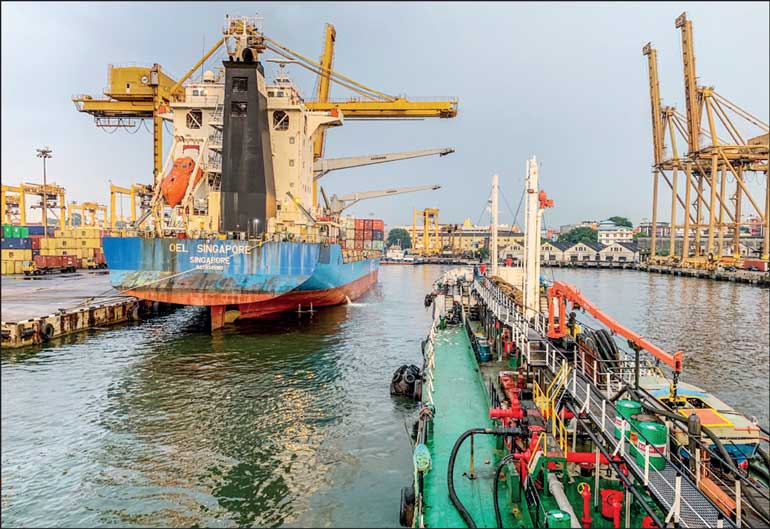
In a landmark split decision, Justice Nawaz of the Supreme Court has recently ruled that the supply of bunker fuel to foreign vessels in Sri Lankan waters is a domestic sale — not an export — closing a long-contested avenue for concessionary tax treatment and reshaping the legal landscape for the island’s bunkering industry.
Eight consolidated appeals, brought by companies engaged in the supply of bunker fuel and lubricants to vessels calling at Sri Lankan ports, have been dismissed by the Supreme Court in a judgment that is set to become a defining precedent in the interpretation of export under Sri Lanka’s tax statutes.
Justice A.H.M.D. Nawaz, writing for the majority alongside Justice Shiran Gooneratne, held unequivocally that the supply of bunker fuel to a foreign vessel within Sri Lankan territorial waters does not constitute an “export” within the meaning of the Inland Revenue Act No. 38 of 2000, the Inland Revenue Act No. 10 of 2006, or the Value Added Tax Act No. 14 of 2002. The assessments of income tax and VAT raised by the Commissioner General of Inland Revenue stand affirmed.
The appellants had argued that their supplies entitled them to either an income tax exemption — available on the export of petroleum products brought to Sri Lanka on consignment and re-exported — or to zero-rated VAT status, which is reserved for the supply of exported goods. In essence, they contended that when a vessel takes on bunker fuel at Colombo harbour and subsequently sails beyond Sri Lankan waters, an “export” has occurred, and the supplier should benefit accordingly. The Supreme Court, by majority, rejected that contention in its entirety.
The “Two-Termini Doctrine”: What “Export” actually means
 Central to Justice Nawaz’s analysis is what he describes as the “twotermini doctrine” — a principle drawn from a body of Indian, comparative, and international authority that establishes that an export is not merely the physical departure of goods from a country’s territory.
An export, in its established legal sense, requires that goods be dispatched from one country to another country as their destination, so that they may be received there as imports. Export and import, the judgment emphasises, are complementary legal concepts: they are the two termini between which the goods are intended to move. Where goods leave a country but have no foreign destination at which they will be received as imports, there is no export in the legal sense.
“Bunker fuel is not cargo. It is not merchandise. It will be consumed and burned in the engines of the ship. It has no destination of its own. It will not arrive anywhere,” said Justice Nawaz.
The cornerstone authority for this principle is the Indian Supreme Court’s 1960 decision in Burmah Shell Oil Storage and Distributing Co. of India Ltd. v. Commercial Tax Officer, decided by Hidayatullah J. for a five-judge bench. That case concerned aviation spirit supplied to aircraft at Calcutta’s Dum Dum Airport for onward foreign journeys, and the court held that the fuel was not exported — it was consumed. The companion case of The State of Kerala v. The Cochin Coal Company Ltd. — which Justice Nawaz describes as “serendipitously stumbled upon” and “the closest in its facts to the present case” — involved the supply of bunker coal to steamers at the port of Cochin and reached the identical conclusion: coal supplied to a vessel for its own use has no foreign destination at which it can be received as an import, and therefore is not exported.
Four reasons bunkering is not an export
Justice Nawaz identifies four legally significant characteristics of the bunkering transaction that, taken together, place it outside the legal definition of an export. First, bunker fuel is supplied for consumption— specifically, for combustion in the engines of the receiving vessel — and not for delivery to a recipient in a foreign country. Second, the fuel has no foreign destination as cargo: there is no bill of lading, no consignee abroad, no address to which the fuel is consigned. Third, there is no corresponding import in any foreign jurisdiction: no foreign customs authority will record the arrival of the fuel; no importer will pay duties upon it. Fourth, and decisively, the transaction is complete within Sri Lanka. The seller supplies, the buyer takes on board, the price is paid, and the transaction ends. What the vessel subsequently does — whether it burns the fuel in Sri Lankan waters or beyond — is entirely at the vessel’s discretion and forms no part of the commercial relationship between supplier and ship.
The appellants’ key arguments and why they failed
 “Taking out” argument: Appellants claimed export simply means physically taking goods out of Sri Lanka. Rejected — the goods are taken out by the vessel’s master, not the supplier, whose contractual role ends at the point of delivery in port.
Customs Ordinance, Section 16: A timing provision for customs duty liability. Cannot enlarge the substantive meaning of “export” in tax statutes with a different purpose.
CUSDECs (Customs declarations): The appellants’ own customs documents listed Sri Lanka as both origin and destination. The court applied the maxim quod approbo non reprobo — you cannot blow hot and cold — and found them estopped from arguing a foreign destination.
Foreign currency and Incoterms: Transacting in foreign currency does not convert a domestic sale into an export. Incoterms are contractual labels, not legal classification tools.
Bunker Nomination clause: The contractual clause stating fuel is for use outside territorial waters merely confirms the technical fact of consumption during the voyage — it does not create a foreign destination. Central Bank classification and “Best Exporter” awards: Administrative and statistical classifications serve macroeconomic purposes and carry no weight in statutory interpretation of tax law.
The chocolate and the antique: Analogies that settle the matter
Perhaps the most vivid and memorable portion of the judgment is Justice Nawaz’s deployment of two analogies that arose in the course of oral argument and which he describes, with characteristic candour, as “irresistible.” Both go to the heart of why the identity of the person who physically moves goods out of a country matters enormously to the legal question of whether an export has occurred.
The first analogy is the airport chocolate. Consider a traveller who, after passing through immigration at Bandaranaike International Airport, purchases a bar of chocolate at the duty-free shop and carries it abroad. The chocolate will be consumed overseas. It will cross an international border. And yet — is the duty-free shopkeeper an exporter? Plainly not. The shopkeeper has made a retail sale within Sri Lanka. It is the traveller, not the shopkeeper, who carries the goods out of the country. The chocolate, moreover, will be consumed personally by the traveller; it will not be delivered to a recipient abroad as a commercial import. Justice Nawaz reinforces this analogy with reference to the VAT Act itself, which — tellingly — places the supply of food and services by restaurants situated beyond the immigration counter at the very same airport in the exempt category, not the zero-rated category. Parliament has, in effect, legislatively confirmed that
supplying goods to outbound passengers is not an export. If an airport restaurant feeding a departing passenger is not an exporter, Justice Nawaz concludes, a fortiori the bunker fuel supplier sending a vessel on its way is not one either.
The second analogy — the antique — is equally arresting. An Indian tourist visits Colombo, enters a department store, and buys a Sri Lankan antique. He packs it in his luggage and carries it home to India. Has the department store exported the antique? The answer, Justice Nawaz states flatly, is that by no conceivable stretch of legal reasoning can this be so. The store has made a retail sale within Sri Lanka. The traveller is the one who carries the goods abroad. The position of the bunker fuel supplier, the judgment holds, is precisely analogous to that department store: both sell within Sri Lanka, and both watch as a third party physically carries the goods across the border. The supplier’s role ends at the point of sale.
Parliament’s architecture: Exempt, not zero-rated
 Independently of the two-termini doctrine, Justice Nawaz finds a second and conclusive ground for the majority’s decision in the structure of the VAT Act itself. The Act distinguishes sharply between zero-rated supplies — where the supplier may recover all input VAT paid on its own purchases — and exempt supplies, where no such recovery is available. The First Schedule to the VAT Act explicitly places the supply of bunker fuel and oil for ships in the exempt category. Zero-rating, by contrast, is the VAT treatment for exports.
This legislative choice, the judgment holds, is not accidental. It reflects a deliberate parliamentary decision that the supply of bunker fuel should receive a lesser fiscal benefit than exports — exemption, not zero-rating. Had Parliament regarded bunkering as an export, there would have been no purpose in placing it in the exempt schedule at all.
By seeking zero-rated status, the appellants were asking the court to grant them a benefit that Parliament had consciously withheld. Justice Nawaz firmly declined: “The Appellants have been accorded by Parliament a significant benefit in the form of VAT exemption on their supplies. They seek a further benefit — zero-rating — that Parliament has not seen fit to grant. This Court cannot supply that benefit in the exercise of judicial power.”
The global consensus: Everywhere else, a separate law was needed
Justice Nawaz’s comparative survey of international practice provides a compelling coda to the judgment. In Singapore, bunker fuel supplied to a foreign-going vessel is zero-rated under the Goods and Services Tax Act — but as a “supply to a qualifying ship,” a domestic supply category expressly created by specific legislation, not as an export. In the United Kingdom, ship’s stores including fuel attract a zero-rated VAT concession under a specific domestic provision, again not because they are classified as exports.
The Court of Justice of the European Union, in Fast Bunkering Klaipeda, similarly proceeded on the basis that bunkering is a domestic supply to a qualifying vessel. The International Tribunal for the Law of the Sea, in the M/V Saiga case, characterised bunkering as a supply and provisioning transaction related to navigation, not a trading or export transaction.
The lesson Justice Nawaz draws is instructive: in every jurisdiction where bunker fuel supplies attract concessionary tax treatment, that treatment has been achieved by specific, tailored legislation expressly addressing the matter. The word “export” alone, across all these legal systems, has never been sufficient. Sri Lanka’s VAT Act, by placing bunker fuel in the exempt category, has made precisely this deliberate legislative choice. If the bunkering industry wishes to enjoy zero-rated status, the judgment makes clear, its recourse lies with Parliament — not the courts.
A dissent, and why it did not prevail
The judgment was not unanimous. Justice S. Thurairaja, PC, dissented, taking the view that the supply of bunker fuel to foreign-going vessels does constitute an export. The dissent reasoned that the export framework should follow the destination of the vessel, that the goods physically leave Sri Lanka and are consumed outside its territorial waters, and that the practical purpose of the legislature in extending export concessions to petroleum products was to benefit transactions generating foreign exchange.
Justice Nawaz engages with each of these grounds directly. He rejects the first on the basis that the two-termini doctrine asks not where the vessel goes, but where the goods go — and the fuel goes nowhere, it is destroyed by combustion. He rejects the second on the basis that physical departure from a country’s territory is, as Hidayatullah J. clearly stated, a necessary but not a sufficient condition for export; the further requirement of a foreign destination for receipt as imports must also be satisfied. And he rejects the third on the basis that legislative purpose in a taxing statute must be ascertained from the text and structure of the statute — and the text and structure of the VAT Act, with its deliberate placement of bunker fuel in the exempt column, make Parliament’s intention clear.
What this means for the industry
The ruling has significant practical implications for Sri Lanka’s bunkering sector. Companies that have been treating bunker fuel supplies as exports — and claiming the consequential income tax concessions and VAT zero-rating — will need to reassess their tax positions. The assessments upheld by the Supreme Court arise from prior years, but the judgment establishes the governing legal framework going forward.
The appellants had urged the court to consider Sri Lanka’s competitive aspiration to become a major international bunkering hub, arguing that an adverse ruling would drive business to rival ports in India and China. Justice Nawaz did not dispute the legitimacy of that aspiration — but held firmly that it was a matter for Parliament, not the judiciary. Article 148 of the Constitution vests full control over public finance in Parliament, and it is Parliament that must decide whether to legislate a specific zero-rating regime for the bunkering sector, as Singapore and the United Kingdom have done. Should it choose to do so, this judgment provides a precise roadmap of the legal gap that such legislation would need to fill.
For practitioners in tax law and maritime commerce alike, SC Appeals 39–46/2023 is essential reading. It is a judgment that does not merely decide a dispute — it authoritatively defines, for the first time in Sri Lankan jurisprudence, what the word “export” means in a taxing statute, and anchors that meaning to a principled legal doctrine that is consistent with the approach of every major common law jurisdiction.
The chocolate may leave the duty-free shop. The antique may leave Colombo in a tourist’s suitcase. And the bunker fuel may leave the harbour in a vessel’s tanks. But in none of these cases, the Supreme Court has now definitively held, is the seller an exporter.




