Tuesday Apr 28, 2026
Tuesday Apr 28, 2026
Wednesday, 31 December 2025 00:24 - - {{hitsCtrl.values.hits}}
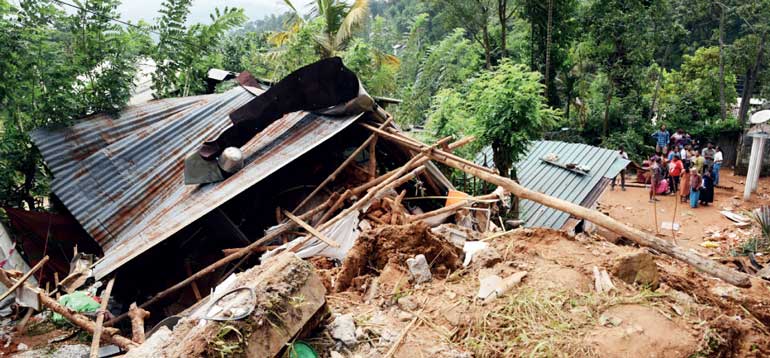
 The events of late November 2025 stand as a watershed moment for our nation—an unprecedented natural disaster that, while shocking in its intensity, reminds us that we are part of a global ecosystem where even the most technologically advanced nations are not immune to nature’s unpredictability. While we acknowledge that previous responses to both man-made and natural calamities have fallen short, we must face a hard truth: the severity of this recent devastation was amplified not just by the hazard itself, but by our collective failure to strictly adhere to scientific settlement planning. The tragedy laid bare the consequences of bypassing local Governments and National Building Research Organisation (NBRO) assessments and the oversight failures that allowed permanent structures to rise in water reservations and disaster-prone zones.
However, this is not the time to dwell on past negligence or assign blame for historical lapses. We now choose to set aside the mistakes of yesterday to focus entirely on a resilient tomorrow. We must commit to a new era of reconstruction defined by scientific rigour and safety, looking forward with optimism to Build Back Better for a thriving life—creating a beautiful, secure nation where the real people emerge as the ultimate winners.
Specific objectives
THE “Zero-Recurrence” doctrine
The new process operates on a fundamental prohibition: “Reconstruction on scientifically identified “Red Zone” (affected or high-risk) lands is strictly prohibited”
The Government shall shift from a model of “horizontal sprawl” to “Vertical Urbanisation,” adopting global best practices (e.g., high-density resilient models used in China and Singapore) to maximise land safety and economic efficiency.
 Sri Lanka confronts a severe limitation in cultivable land resources, a constraint exacerbated by decades of horizontal urban sprawl that has fragmented fertile agricultural zones. The shift to vertical living is therefore not merely a safety measure but an economic imperative. By consolidating human settlements into high-density vertical complexes, we halt the encroachment on arable land, effectively “releasing” these areas for intensive agricultural use. This approach maximises the productivity of every square inch of our island nation, ensuring that fertile soil is dedicated to feeding the population and driving the economy, rather than being consumed by inefficient, low-density housing.
Mandate scientific land-use and settlement planning
1. Green Zone: Safe for high-density, multi-story residential construction.
2.Yellow Zone: Restricted use (Agriculture/Industry only).
3.Red Zone: Total prohibition on human activity (Ecological preservation) unless extra measure is taken for changing the category. It might not be the best to decide this based on an elevation. There are multiple factors to be considered.
Restore and protect ecological buffer zones
Enforce accountability in construction and oversight
Institutionalise disaster-resilient construction standards
Enforce risk-adaptive land utilisation (Non-habitation zoning)
Design for “Thriving,” not just surviving
No cash compensation
To prevent misuse of funds and ensure high-quality reconstruction, the Government adopts an “Asset-for-Asset” investment model.
Prohibition on cash handouts
The Government shall not provide cash compensation to individuals for reconstruction of houses that affected by landslides. Past experience shows cash is often used for consumption or building substandard housing in the same dangerous location.
Concessionary Government housing scheme
Instead of cash, the Government invests in the construction of the Multi-story Complexes. Units are transferred to victims under a Concessionary Ownership Scheme:
The “Digital Citizen” lock
To ensure strict adherence to NBRO guidelines and prevent illegal encroachment, the following Civil Rights Restrictions are enacted:
Denial of public entitlements for illegal structures
Any structure built on NBRO-designated “Red Zones” or without specific technical approval is deemed a “Non-Recognized Entity.” Residents of such structures are ineligible for:
1.National Identity Card (NIC) Registration or any other recognised address for identification: No citizen may register an illegal structure as their permanent address.
2.Utility Connections: The CEB (Electricity) and NWSDB (Water) are prohibited by law from providing connections to these locations.
3.Samurdhi/Welfare Benefits: Government financial assistance is suspended for households occupying illegal, high-risk lands.
4.Voter Registration: Residency in a “Non-Habitation Zone” cannot be used for electoral registration.
The “Safe-Home” digital passport
A centralised, transparent technical system (The “Safe-Home Portal”) will be established.
This approach marks the end of ad-hoc land settlement in Sri Lanka. By centralising reconstruction into safe, modern, multi-story complexes and strictly enforcing land-use science, we must ensure that the tragedy of November 2025 is never repeated. We build not just houses, but a disciplined, safe, and thriving nation under the theme of “Rebuilding Sri Lanka.”
(The author is Former Deputy Director of Livelihood at the Taskforce for Rebuilding the Nation-TAFREN and the Reconstruction and Development Agency-RADA)



