Friday Jul 24, 2026
Friday Jul 24, 2026
Friday, 24 July 2026 00:22 - - {{hitsCtrl.values.hits}}
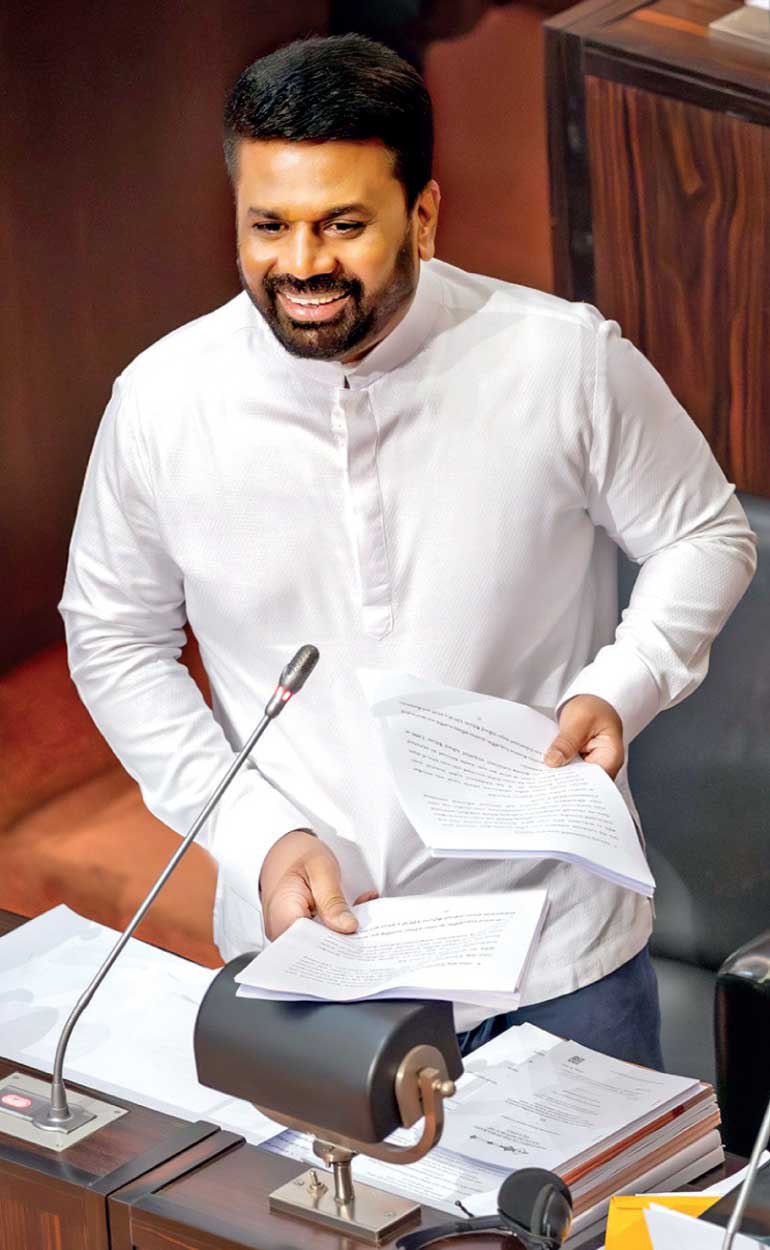
President and Finance Minister Anura Kumara Dissanayake presenting the 2026 Budget in Parliament – File photo
 “The best way to predict the future is to create it.” — Peter Drucker
Introduction
The proposed 2027 Budget presents Sri Lanka with a historic opportunity to move beyond macroeconomic stabilisation and begin genuine economic transformation. While achieving a (i) primary surplus, (ii) reducing inflation, and (iii) restoring fiscal discipline have laid the essential foundations for recovery, these achievements alone cannot deliver long-term prosperity or generate the resources needed to repay external debt.
This article argues that the 2027 Budget should become Sri Lanka’s first Economic Transformation Budget, organised around three national missions: (i) raising productivity, (ii) mobilising investment, and (iii) improving living standards. Rather than being judged by revenue collection or expenditure alone, the Budget should be assessed by its ability to increase productivity, exports, investment, household incomes, and inclusive growth. Such a strategic shift would help Sri Lanka build a stronger, more resilient, and more prosperous economy capable of sustaining growth above 7% while honouring its future debt obligations.
The end of one journey and the beginning of another
Between 2022 and 2026, Sri Lanka traversed an exceptionally difficult road. Following an unprecedented economic crisis characterised by acute foreign exchange shortages, hyperinflation, and severe debt distress, the nation engaged in an intensive stabilisation program supported by the International Monetary Fund (IMF). Through painful fiscal adjustments, aggressive revenue measures, monetary tightening, and complex sovereign debt restructuring, the macroeconomy has undeniably stabilised. Inflation has been brought down to single digits, official foreign reserves have been replenished to workable operational levels, and the central Government has secured a primary budget surplus. These are remarkable institutional milestones achieved through immense sacrifices borne by the public and domestic businesses.
However, a fundamental truth must now be acknowledged by policymakers: these achievements represent the end of economic stabilisation—not the beginning of national prosperity. Stabilisation stops a ship from taking on water, but it does not steer it toward a new destination. While fiscal discipline prevents insolvency, it does not inherently create new industries, generate high-paying jobs, or expand export earnings. Sri Lanka’s stabilisation phase successfully prevented total state breakdown, but relying indefinitely on stabilisation tools without a growth strategy will lead directly to economic stagnation. The nation stands at a pivot point where it must transition from survival mode to dynamic economic expansion.
Why stabilisation alone cannot deliver prosperity
The standard macroeconomic transmission mechanism often assumed by conventional policy models suggests that securing a primary surplus naturally leads to fiscal stability, which builds market confidence and subsequently drives private sector growth. While fiscal discipline builds essential market confidence, the lower half of the growth engine remains missing. Market confidence alone (i) does not automatically build modern logistics corridors, (ii) automate manufacturing processes, (iii) upgrade workforce skills, or (iv) establish technology transfer hubs.
Where do productivity, exports, investment, and innovation actually come from? They do not automatically spring forth simply because inflation is low. They require intentional, structural, and targeted state policies that lower the cost of doing business, eliminate regulatory bottlenecks, and build public infrastructure that crowds in private capital.
The success of Sri Lanka’s 2027 Budget should no longer be measured by how much tax it collects or how much it spends. Those are important, but they are only the means. The true measure of success is whether the Budget (i) raises productivity, (ii) mobilises investment, (iii) expands exports, (iv) creates high-value employment, (v) increases real household incomes, and (vi) lays the foundation for sustained 7% inclusive economic growth.
If Budget 2027 remains a standard accounting document focused solely on marginal tax adjustments and departmental spending allocations, Sri Lanka risks entering a prolonged low-growth trap. To service restructured external debt post-2027 while raising real living standards, the national economy must grow at a real rate of at least 7% annually. That target cannot be reached by fiscal austerity; it demands structural transformation. To achieve and sustain a 7% real growth target, Sri Lanka must move beyond fiscal austerity and execute deep structural transformations across six non-negotiable sectors:
Energy Sector: Transitioning from expensive imported fossil fuels to utility-scale renewables (solar, wind, biomass) and unbundling the grid to lower industrial power tariffs for export competitiveness.
Agriculture and Agribusiness: Moving from passive input subsidies to capital co-investments in agritech (drip irrigation, cold-chain logistics, and high-value export crops) to lift rural productivity.
Industrial Sector: Accelerating the adoption of AI, robotics, and advanced manufacturing to move industrial exports (apparel, tea) up the value chain into high-tech goods.
Institutional and Digital Governance: Implementing “Digital Structuralism” across land registries, customs, and taxation, while creating a true single-window authority for fast-tracked FDI approvals.
Education and Human Capital: Realigning tertiary and vocational training with market demand (STEM and digital skills) and reforming labor laws to boost female labor force participation.
Trade and Logistics: Upgrading deep-water ports and hinterland transport corridors while rationalising tariffs to integrate Sri Lanka into global supply chains as South Asia’s premier maritime hub.
Reimagining the Budget framework: Mission-oriented governance
Traditionally, public budgets in Sri Lanka have been drafted around administrative ministries, prompting a zero-sum game where each ministry defends its historical allocation. This approach creates fragmented siloes, duplicating efforts while ignoring overarching national objectives.
To break this pattern, the 2027 Budget should introduce a major conceptual shift by organising the national budget around three core Economic Missions rather than traditional ministerial line-items. Instead of evaluating ministries on how much money they spend, the Treasury should evaluate how every rupee allocated across line ministries actively drives one or more of three key missions: (i) Raising National Productivity, (ii) Mobilising Strategic Investment, and (iii) Improving Household Living Standards. Under this mission-oriented model, a project in the Ministry of Education or Ministry of Agriculture is no longer viewed as a passive cost centre; it is evaluated as a direct capital input into raising national productivity or improving household incomes. This is indeed crystal clear.
Mission one — Raise national productivity
Productivity is the ultimate engine of long-term real wage growth and international competitiveness. An economy cannot consume what it does not produce, nor can it export competitively if its unit labor costs are inflated by low output per worker. To drive national productivity across all sectors, the 2027 Budget must focus on five strategic pillars:
Digital structuralism and public sector efficiency: A primary bottleneck to private sector productivity in Sri Lanka is state bureaucracy. The 2027 Budget must finance a comprehensive “Digital Structuralism” initiative across Government agencies. Digitising land registries, customs clearance, tax administration, and business licensing will drastically reduce transaction costs, eliminate administrative corruption, and compress approval timelines from months to days. A modern, digital state infrastructure acts as a force multiplier for private sector execution.
Modernising agriculture and agritech adoption: Over a quarter of Sri Lanka’s workforce remains in agriculture, yet the sector contributes under 10% to gross domestic product (GDP). This low output perpetuates rural poverty. Budget 2027 should redirect traditional, wasteful input subsidies toward capital co-investments in high-efficiency technologies: drip irrigation, precision farming, climate-resilient seed stocks, cold-chain logistics, and processing hubs. Transitioning from low-yield subsistence farming to commercial agribusiness will boost rural output, lower urban food inflation, and free up labor for high-value industries.
Industrial automation, AI, and higher-value exports: Sri Lanka’s industrial base, particularly apparel and tea, faces growing competition from lower-cost Asian and African producers. To survive and expand, Sri Lankan industries must move up the value chain. Budget 2027 should introduce targeted fiscal incentives—such as accelerated depreciation allowances and tax credits for research and development (RandD)—for firms investing in industrial automation, robotics, artificial intelligence (AI), and green manufacturing processes.
Logistics and trade infrastructure: Sri Lanka’s strategic geographic position in the Indian Ocean remains underutilised. Raising national productivity requires integrating domestic supply chains with global shipping networks. Budget allocations should prioritise port efficiency, deep-water terminal expansions, hinterland logistics corridors, and seamless customs interconnectivity to establish Sri Lanka as South Asia’s premier maritime and supply-chain hub.
Workforce upskilling and technical education: A severe skills mismatch hampers growth in technology, engineering, advanced manufacturing, and specialised services. Budget 2027 must realign tertiary and vocational education spending with market demand. Establishing specialised technical training institutes, introducing industry-led apprenticeships, and supporting continuous adult upskilling will build a workforce capable of supporting a modern, high-productivity knowledge economy.
By integrating a digital state infrastructure, agricultural technology, industrial automation, advanced logistics, and a skilled workforce into a cohesive productivity engine, Sri Lanka can achieve higher output per hour worked, directly driving real wage expansion and global competitiveness. Indeed real wage expansion is the key for increased household savings. Today, decreasing real wages is a burning issue.
Mission two — Mobilise investment
Macroeconomic stability provides the foundation for investment, but targeted policy mechanisms are required to convert that stability into active physical and intellectual capital. Sri Lanka’s gross domestic capital formation must rise from its post-crisis 24.6% of GDP (2023) to over 30% of GDP to support 7% annual real growth, bridging the gap between macroeconomic stability and sustained expansion through three core pillars: foreign direct investment, SME scale-up, and capital market deepening.
Overhauling the investment climate: Foreign direct investment (FDI) into Sri Lanka has historically lagged behind regional peers due to policy inconsistency, complex land acquisition rules, and overlapping bureaucratic authorities. Budget 2027 should fund a single-window investment clearance authority backed by statutory deadlines. Investors should no longer be forced to navigate dozens of separate Government agencies to launch a business. Indeed, the Colombo Port City Project like environment is the most desired.
SME capital access and scale-up facilities: Small and Medium Enterprises (SMEs) represent the backbone of the domestic economy, generating the majority of non-farm employment. However, high interest rates and collateral requirements have left many capital-starved post-crisis. Budget 2027 should establish a national credit guarantee scheme and partial equity co-investment funds in partnership with commercial banks to finance high-growth, export-oriented SMEs.
Deepening capital markets and non-bank financial intermediation: Over-reliance on commercial bank lending limits long-term, high-risk capital formation. The 2027 Budget should introduce legislative and regulatory measures to deepen domestic capital markets. Encouraging corporate bond issuances, venture capital entry, real estate investment trusts (REITs), and green bond frameworks will allow domestic institutional investors (such as pension funds) to channel capital safely into long-term infrastructure and productive enterprises.
Targeted export-oriented FDI incentives: Rather than granting broad, untargeted tax holidays, Budget 2027 must align fiscal incentives with export performance, local supply-chain integration, and technology transfer. Foreign investors bringing advanced technical capabilities in renewable energy equipment, electronics assembly, pharmaceuticals, or IT services should receive targeted performance-based credits tied to measurable local value addition.
Renewable energy transition as an economic driver: Sri Lanka’s reliance on imported fossil fuels drains foreign exchange reserves and inflates electricity tariffs for domestic industry. Accelerating the transition to renewable energy—solar, wind, biomass, and green hydrogen—is both an environmental imperative and a macro-critical growth strategy. Budget 2027 should incentivise private investments in utility-scale renewable generation and grid modernisation, turning green energy into a competitive advantage for export manufacturers.
Mission three — Improve household living standards
Economic growth is unsustainable if its benefits accrue solely to a small segment of the population. The ultimate goal of economic policy is not to produce abstract statistical metrics, but to improve human well-being. Mission Three ensures that macroeconomic transformation delivers tangible, inclusive benefits to households across the country:
High-value job creation over low-wage employment: Economic development requires moving workers from low-productivity informal labor to high-productivity formal employment. The 2027 Budget must prioritise supporting industries that generate sustainable, skilled jobs—such as software engineering, specialised manufacturing, value-added agriculture, and technical services—raising average real wages naturally through market demand.
Boosting female labor force participation: Female labor force participation in Sri Lanka remains below 35%, representing a major underutilisation of human capital. Budget 2027 should introduce direct fiscal support for early childhood care centers, eldercare facilities, safe public transport infrastructure, and flexible working arrangements. Enabling more women to enter and remain in the formal workforce will raise household incomes while expanding national output.
Youth employment and entrepreneurship: To halt the brain drain of educated young professionals leaving the country, the national budget must offer viable domestic opportunities. Budget 2027 should fund (i) youth startup incubators, (ii) technical innovation grants, and (iii) seed funding programs linked to universities and technical colleges, encouraging young talent to build scalable businesses at home.
Balanced regional development: Economic activity in Sri Lanka has historically concentrated heavily in the Western Province. To promote balanced, inclusive growth, Budget 2027 should allocate infrastructure funding toward regional economic corridors, primary agricultural processing zones, and secondary port cities like Trincomalee and Hambantota, spreading economic opportunity across all provinces.
Strengthening social protection and protecting real incomes: While growth is the best long-term cure for poverty, targeted social safety nets remain vital for protecting vulnerable communities from external shocks. The 2027 Budget must refine and strengthen targeted social transfer schemes (such as Aswesuma) using verifiable, transparent digital databases. Ensuring assistance reaches those who truly need it protects household stability while maintaining overall fiscal discipline.
A new framework for measuring Budget success: The national transformation scorecard
What gets measured gets managed. If the public and parliament evaluate a budget solely by its headline fiscal deficit or total revenue collected, ministers will naturally focus on short-term tax extraction rather than structural economic expansion. To change how policymakers think about public finances, the 2027 Budget should introduce a National Transformation Scorecard that evaluates fiscal success using dual dimensions: traditional fiscal stability metrics paired with long-term structural transformation indicators.
Rather than relying solely on traditional budget indicators such (i) as revenue collected as a percentage of GDP, (ii) headline fiscal deficit,(iii) primary budget surplus, (iv) total public expenditure, (v) debt-to-GDP ratio, (vi) inflation rate(vii) gross sovereign borrowing, and (viii) tax compliance rates, the new framework evaluates public policy against dynamic transformation indicators.
Under this modernised approach, success is measured by the (i) growth rate of labor productivity, (ii) private fixed capital investment as a percentage of GDP, (iii) export growth and diversification, (iv) rankings on the Global Innovation Index, (v) the annual creation of high-value formal jobs, (vi) real median household income growth, (vii) the national household savings rate, and (viii) the multidimensional poverty reduction rate. Evaluating the Treasury against this broader set of indicators forces state institutions to prioritise economic expansion alongside fiscal management.
Reporting progress
It is essential that all Ministries should send well-structured quarterly progressed reports to the Office of the President. Those reports should not focus merely on budget utilisation or expenditure. Instead, they should measure each Ministry’s contribution to the three National Economic Transformation Missions:
Each report should include (i) clearly defined Key Performance Indicators (KPIs), (ii) measurable targets, (iii) achievements, (iv) implementation challenges, (v) and corrective actions. This whole-of-Government performance framework would enable the President and Cabinet to assess, on a quarterly basis, whether Sri Lanka is progressing towards its strategic national objectives of (i) higher productivity, (ii) stronger private investment, (iii) increased exports, (iv) quality employment, (v) rising real household incomes, and (vi) sustained inclusive economic growth.
In this way, the three National Missions would become the anchor of every National Budget, guiding not only the allocation of public resources but also the measurement of national performance. Budget success should no longer be judged primarily by revenue collected, expenditure incurred, or the size of the primary surplus. Instead, it should be evaluated by its contribution to transforming Sri Lanka into a productive, competitive, resilient, and prosperous economy capable of sustaining growth above 7 % while meeting its long-term debt obligations.
Such a performance-based budgeting system would strengthen accountability, improve policy coordination across ministries, and ensure that every public institution works towards a common national vision of economic transformation.
In short, a National Budget should not merely account for how public money is spent; it should demonstrate how public policy is transforming the nation’s future.
Conclusion — The Budget that can shape Sri Lanka›s future
Sri Lanka has travelled a difficult road from economic collapse to macroeconomic stability. Yet stability is not prosperity, and recovery is not transformation. The nation now stands at a historic crossroads.
Budget 2027 can either become another routine annual exercise in balancing revenues and expenditures, or it can become the blueprint for building a productive, investment-driven, and inclusive economy. History will not judge this Budget by the taxes it collects or the money it spends. It will judge it by whether it creates the conditions for stronger productivity, greater investment, rising exports, better jobs, and higher living standards.
As Joel A. Barker famously observed: “Vision without action is merely a dream. Action without vision just passes the time. Vision with action can change the world.”
If Budget 2027 embraces those three national missions—raising productivity, mobilising investment, and improving living standards—it will become far more than a fiscal document. It will become the structural foundation upon which Sri Lanka builds a stronger, more resilient, and more prosperous nation capable of sustaining growth above 7% while honouring its obligations to future generations .In other words, a National Budget should not merely account for how public money is spent; it should demonstrate how public policy is transforming the nation’s future.
(The author, among many, served as the Special Advisor to the Office of the President of Namibia from 2006 to 2012 and was a Senior Consultant with the UNDP for 20 years. He was a Senior Economist with the Central Bank of Sri Lanka (1972-1993). He can be reached via [email protected].)



