Thursday Nov 19, 2026
Thursday Nov 19, 2026
Thursday, 19 November 2026 03:18 - - {{hitsCtrl.values.hits}}
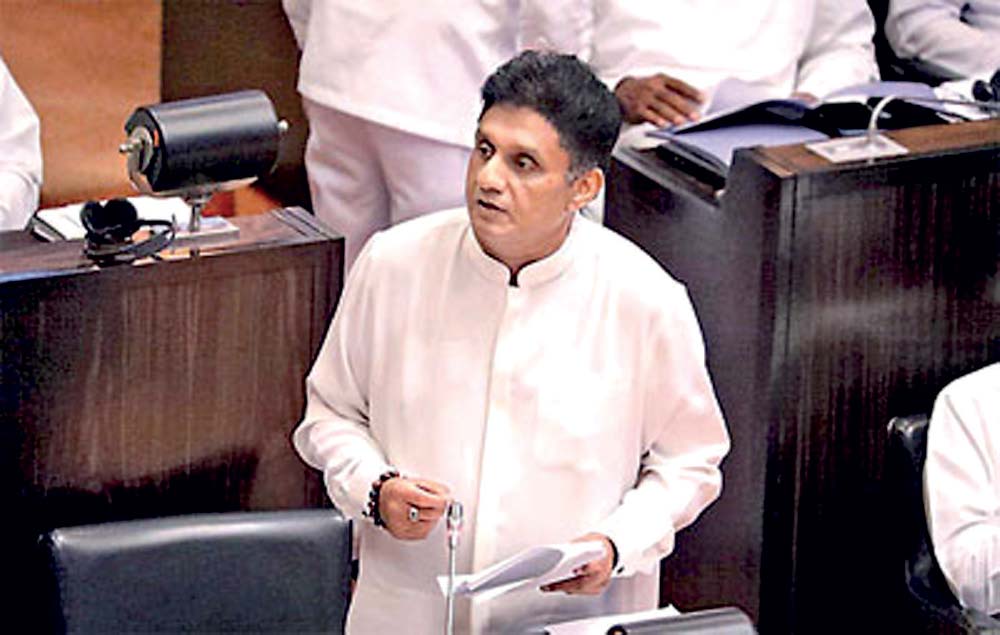
Opposition Leader Sajith Premadasa responding to the 2027 Budget speech in Parliament
 The current Government deserves credit for sustaining the nominal stability that the previous Government achieved. However, having exceeded the IMF fiscal targets, it should now slow the pace of consolidation and move decisively to a credible growth plan, at least 8% growth sustained for a generation, driven by private investment, exports and productivity. With that in mind, the poorest fifth has lost almost a fifth of its real income and support for them is being cut by Rs. 100 billion, and this asks us to rethink, and the valid question raised in Parliament by the Opposition Leader, recovery for whom?
 President Anura Kumara Dissanayake presented Budget 2027 to Parliament on 12 November, with a message of recovery, since the Budget promised growth of 7% or more. The next day, Opposition Leader Sajith Premadasa made a response. This article tests this speech against official figures and my own comments.
Recovery for whom?
The speech’s main argument concerns the distribution of income. “Between 2019 and 2025, income has been redistributed upwards again from the poor to the rich,” the Opposition Leader said. According to the Household Income and Expenditure Surveys, the real household income of the poorest 20% fell by 19.6% over this period, while that of the richest 20% rose by 6.8%. The richest fifth now earns 14.8 times as much as the poorest fifth, up from 11.2 times in 2019. “The poor have been made poorer and the rich richer,” he said.
The exchange rate and the Budget are more stable than in 2022, but real output is only back to roughly its 2018 level. GNI rose from $ 92.4 billion in 2018 to $ 106.8 billion in 2025, yet much of that rise reflects prices and the exchange rate rather than real growth. Upper-middle-income status may be measured in dollars but the household surveys measure how people actually live.
Six in ten below the poverty line
“The World Bank report of October 2026 says that 60% of our people are poor,” the Opposition Leader cites. The World Bank estimates that 61.1% of Sri Lankans lived below the upper-middle-income poverty line of $ 8.30 a day in 2025. He further questions the official poverty line of Rs. 17,742 a month: “Can one person live for 30 days on Rs. 17,000 or 18,000?” Yet subsidies and transfers fall from Rs. 1,572 billion in 2026 to Rs. 1,472 billion in 2027, a cut of Rs. 100 billion.
In 2025, the Government ran a primary surplus of 5.4% of GDP, more than twice the IMF target of 2.3%, partly by leaving capital budgets unspent. Taxes on goods, services and trade will bring in about 76.4% of tax revenue in 2027, and they weigh most on the poor. Over-collecting from consumers while cutting support for the poorest is questionable.
Investment going out, investment not coming in
“Nothing is incoming; everything is outgoing,” the Opposition Leader further states, listing projects that have left, including the China Merchants logistics hub at the Port of Colombo. On garment firms expanding abroad, he asked: “They close one factory here and open 10, 15 or 20 there. How can we create jobs?”
Foreign direct investment reached about $ 1.04 billion in 2025, but only $ 134 million came from new projects. Viet Nam now receives in about two weeks what Sri Lanka receives in a year. With an incremental capital-output ratio of about 4.5, growth of 8% requires investment of about 36% of GDP, against national savings of 31.2%. Sri Lanka therefore needs at least $ 5 billion of FDI a year. Investors seek agreements that are honoured after a change of Government, with any disputes resolved in months rather than years. The Budget offers no FDI target or reforms.
The debt deal and the incentive to grow
The NPP manifesto promised to renegotiate the debt sustainability analysis (DSA) with the IMF. “Where is the promise to change the DSA? This was the greatest deception,” the Opposition Leader asks. On the macro-linked bonds, under which debt relief shrinks if growth exceeds expectations, he asked: “Then what incentive, what motivation, do we have as a country to raise our growth rate?”
The idea that part of the gain from faster growth flows automatically to foreign creditors while reducing gain for the country is correct. However, the pressing issue is financing. The deficit rises to Rs. 1,753 billion, or 4.5% of GDP, and 94% of it is to be borrowed at home. The gross borrowing requirement is Rs. 3,800 billion, almost 10% of GDP. The 91-day Treasury Bill yield has already risen from 8.2% in May to 9.35% in November, crowding out private investment. And the IMF program ends in March 2027; with a Fitch's sovereign rating B−, borrowing abroad would cost around 11%. Where is the plan for life after the IMF?
Farmers, small businesses and the young
“The paddy price that was promised at Rs. 150 a kilo is today 98 or 95,” the Opposition Leader reminded the Parliament, adding that the Budget had given agriculture “not even the weight of a mustard seed”. He noted that about 263,000 small and medium enterprises fell into difficulty in 2022, yet there is still no national development bank and no restructuring of their loans.
The Government’s own Irrigation Minister puts the cost of producing a kilo of paddy at about Rs. 137, while the guaranteed price for Nadu is Rs. 120, and the fertiliser subsidy is frozen at Rs. 30,000 per hectare. Youth unemployment stands at 17.8%, and half of all the unemployed have A/L or higher qualifications. The quickest gains in growth and jobs lie in tourism and ICT, especially AI-based products for world markets, yet the Budget has no jobs target. Young people across Europe have taken to the streets in 2026 over jobs and living costs, and Sri Lanka has experienced such youth unrest before.
Promises and the brain drain
The Opposition Leader listed unfulfilled promises, from a 33% cut in electricity bills to relief for pensioners, and proposed giving vehicle permits to professionals instead of politicians, “we do not want them. Give them to those professionals.”
The NPP promised to raise the PAYE tax-free threshold to Rs. 200,000 a month, however, the Budget raises it only to Rs. 162,500. For a doctor, engineer or senior academic, relief of at most Rs. 15,750 a month will not change a decision to emigrate. As a head of department, I see brain drain in our universities every year. The Budget should have set up a high-level task force to retain skilled people and bring back those abroad, looking into due recognitions and rewards.
Signalling to the left, turning to the right
The Opposition Leader summed up his case by saying the Government has “signalled left and turned right” and playing on the Sinhala word for Budget: “This is not an ayawaya [Budget]; it is a pachawaya [a Budget of tall tales].” As an alternative, he called for “the middle path, social democracy and a social market economy”. A social market economy would let markets drive growth and investment while the State protects the vulnerable, which is exactly the balance Budget 2027 lacks.
I believe the current Government deserves credit for sustaining the nominal stability that the previous Government achieved. However, having exceeded the IMF fiscal targets, it should now slow the pace of consolidation and move decisively to a credible growth plan, at least 8% growth sustained for a generation, driven by private investment, exports and productivity. With that in mind, the poorest fifth has lost almost a fifth of its real income and support for them is being cut by Rs. 100 billion, and this asks us to rethink, and the valid question raised in Parliament by the Opposition Leader, recovery for whom?
In conclusion, the Government owes the country evidence, not promises. By exposing the key weaknesses of Budget 2027, the Opposition Leader has questioned the Government on the principle of social justice, and that questioning deserves to be heard.
(The author is Head of Department of Economics and Statistics, University of Peradeniya)



