Friday Oct 09, 2026
Friday Oct 09, 2026
Friday, 29 May 2026 03:27 - - {{hitsCtrl.values.hits}}
 While child ordination remains celebrated in the country’s popular ‘village’ temple tradition, new Buddhist groups (such as Mahamevnawa, Waharaka, and Umandawa), which emerged during the last phase of the war and thereafter, do not engage in this practice. Since these groups tend to attract educated adults, many of whom have already completed their first degree in STEM subjects, child monastics are completely absent in these communities
 It is one thing to study Buddhism from an academic distance. It is quite a different thing to be a practising Buddhist. Some of us are fated to straddle both these worlds, and it is as such edgewalkers that we write this on the eve of the Vesak poya day.
When the Buddhist monastic order was first instituted by the Buddha, only adults were allowed to become members. In fact, according to the Theravāda Vinaya (monastic code), one has to be at least twenty years old to receive full ordination. A minimum age of fifteen years was set, it is said, when a father-son pair became monks and the presence of this child monk was criticised by the laity.
As recorded in the same Vinaya texts, only under the dire circumstances of a deadly pandemic and the loss of an entire family were two small boys allowed to enter the sangha as novice monks. These background stories seem to indicate that they were measures of last resort and not necessarily templates to be followed with abandon.
There have been child geniuses throughout human history in all cultures. Therefore, it is not entirely surprising to read about children who reached the final goal of Buddhist practice and became arahats, fully-awakened disciples. The most popular among them is Rāhula, Buddha’s own son, who was ordained at a young age. These, however, are extremely rare exceptions. The community of monks and nuns of the ancient past that we get to know through the texts, for the most part, consisted of adults. Renunciation was—and dare we say, should remain—an adult business.
Contemporary practice of child ordination
It is not entirely clear when child ordination became the norm in Sri Lanka. The evidence in commentarial texts indicate that it was not a common practice during the heyday of Mahāvihāra, the great monastery of the Anuradhapura era that is intimately associated with the Theravāda tradition.
There have been child geniuses throughout human history in all cultures. Therefore, it is not entirely surprising to read about children who reached the final goal of Buddhist practice and became arahats, fully-awakened disciples. The most popular among them is Rāhula, Buddha’s own son, who was ordained at a young age. These, however, are extremely rare exceptions
|
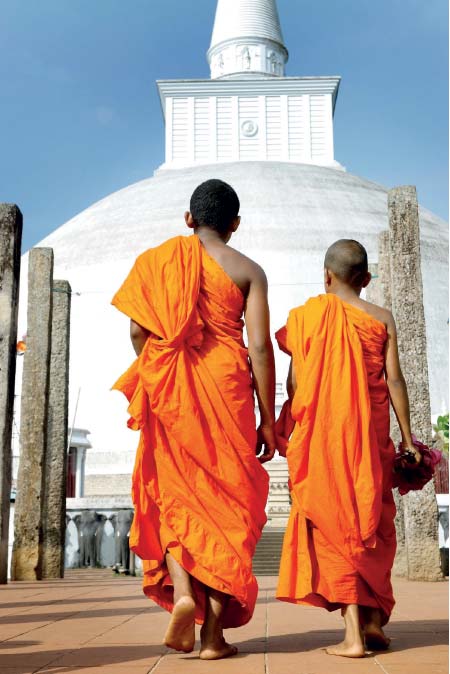
Young monks walking towards the Ruvanveli stupa in the ancient Mahāvihāra complex in Anuradhapura
|
In later centuries the practice seems to have become fairly common, even though it never seems to have been the primary mode of propagating the monastic community. That appears to be a modern phenomenon, at least in part originating from a desire to keep monastic property within a family of blood relatives—a desire that appears to be diametrically opposed to the ethos of renunciation associated with Buddhist monasticism.
There is, of course, an other-worldly dimension to the practice as well. ‘Offering a child to the sāsana,’ it is widely believed, brings blessings to seven generations of relatives and helps propel them to the final goal of nibbāna. Such beliefs probably alleviate some of the pain of parents who let their young children enter the monastic order as a means to escape poverty.
Child ordination, therefore, seems to suffer from two failings when compared to the renunciation and ordination of adults: children lack the knowledge, agency, and autonomy to make such a momentous decision that has far-reaching consequences, and the act is imposed upon them by guardians who are primarily driven by their socioeconomic conditions.
Justifying Child Monks
One of the arguments we have encountered in our fieldwork is that, in order to eventually produce a charismatic monastic leader, the seed must be planted in a child rather than an adult. According to this theory, only those who were ordained as children are truly capable of learning the monastic code properly and can appreciate the nuances of institutional practices. Proponents of this theory further claim that these child monks would have a deeper understanding of the difficulties of monastic life and would learn how to be resilient in the face of inevitable challenges.
In a country like Sri Lanka, where the Buddhist monastic community is intrinsically and historically bound up with the rule of the country, this desire to generate capable monastic leaders is not entirely surprising. Monastics are supposed to fulfill their historical role of serving as moral guides to the nation. Grooming a child from a young age is apparently a necessity for this purpose.
Some also argue that child ordination is a service to the children who are coming from socially and economically disadvantaged backgrounds. As monks, it is said, such children are able to obtain a level of education that they otherwise would not. In such instances, ordination serves as a vital path of upward social mobility. The same logic suggests that, without the opportunity for ordination, these children are destined to become uneducated criminals or drug addicts.
And finally there is a claim that, in the absence of child ordination, the pirivena system of monastic education will collapse. According to this argument, for the worthy cause of sustaining the pirivena system, child ordinations should continue. A related notion is that individuals who ordain later in their life, who lack this pirivena education, are not as adept in monastic practice. Since the sāsana is already facing a crisis with the dwindling number of monks, it is feared that preventing child ordination would lead to a collapse of the entire monastic system.
New Buddhist movements
While child ordination remains celebrated in the country’s popular ‘village’ temple tradition, new Buddhist groups (such as Mahamevnawa, Waharaka, and Umandawa), which emerged during the last phase of the war and thereafter, do not engage in this practice. Since these groups tend to attract educated adults, many of whom have already completed their first degree in STEM subjects, child monastics are completely absent in these communities.
This is because such new Buddhist groups appear to rely on a completely different logic: rather than recruiting children into their ranks, they subscribe to the idea that renouncing lay life should be a conscious and deliberate response to a mature understanding of life’s existential realities. While some might see this as stemming from a liberal and rather Western individualistic understanding of the world, it nonetheless serves the structural prevention of child ordination.
Therefore, even though these new Buddhist groups are often blamed for their ‘radical’ behaviours, which often manifest as critiques of mainstream teachings and rituals, or as adherence to unconventional lifestyles, they cannot be accused of promoting the practice of child ordination.
The community of monks and nuns of the ancient past that we get to know through the texts, for the most part, consisted of adults. Renunciation was—and dare we say, should remain—an adult business
Both of us grew up with temples not far from our homes. Whenever the head monk was away, we could hear the young novice monks playing cricket with the village children. The villagers never had an issue with those playful novices. In fact, they were adored and loved. They were—and are—seen as children first, and monks a rather distant second
The forest tradition
Another community where we hardly encounter any child monks is the forest monastic tradition. For instance, the forest monastic order of the Rāmañña Nikāya, the largest and the most prominent in the country, has a rule of not ordaining anyone under the age of eighteen. Thus, children are completely absent in their forest monasteries too.
This is not to say that there are no attempts. In our many years of association with the forest monasteries, we have met several children who wanted to join the forest sangha of their own accord. In two separate, notable instances, we met a little boy and a girl, neither past the age of ten, who were remarkably gifted meditators and were insistent on becoming members of the monastic community. Even for such savants, however, the path of ordination was not open in the forest sangha, and the meditation teachers encouraged them to continue their practice at home and think of ordination later in life.
Another group of children who sought the refuge of forest monasteries were child monks who were escaping abuse at temples. We had the sad experience of meeting a few of them as well. Here we see the dark, festering underbelly of child ordination that tends to get veiled over by the various arguments mentioned earlier. Even in these cases, the forest monasteries handed over those children to the relevant authorities, as their rule against fostering children in the forest was not up for debate.
Undoubtedly the strongest argument against child ordination has been the repeated failure of monastic institutions to protect child monks from various forms of abuse, including sexual abuse. As Dr. Chandana Namal Rathnayake has amply illustrated in his research work on the topic, this is a serious, systemic, and rampant issue affecting many of the 60,000 children living in over 12,000 monasteries scattered across the country
For Rāhula, this was fairly straightforward. After all, his actual father was the leader of the sangha. Even then, we hear in one Vinaya text that Ven. Rāhula had to spend a night in a toilet instead of a proper dwelling as they were all occupied by senior monks. If such was the fate of the literal son of the Buddha, we can imagine the risks befalling child monks coming from more modest backgrounds. In the absence of a Buddha to decide on such matters, it is time we left the business of renunciation to adults, and let the children enjoy their childhood
Protecting today’s Rāhulas
Undoubtedly the strongest argument against child ordination has been the repeated failure of monastic institutions to protect child monks from various forms of abuse, including sexual abuse. As Dr. Chandana Namal Rathnayake has amply illustrated in his research work on the topic, this is a serious, systemic, and rampant issue affecting many of the 60,000 children living in over 12,000 monasteries scattered across the country.
Some personal perspective is relevant here. Both of us grew up with temples not far from our homes. Whenever the head monk was away, we could hear the young novice monks playing cricket with the village children. The villagers never had an issue with those playful novices. In fact, they were adored and loved. They were—and are—seen as children first, and monks a rather distant second.
The villagers’ intuition is, in fact, backed by Buddhist teachings, and we need not look far to see how such young monks need to be treated in their monastic settings. The Vinaya texts already postulate that a monastic teacher should treat student monks as if they were his sons, and one would assume, all the more so if such novices are literally children.
For Rāhula, this was fairly straightforward. After all, his actual father was the leader of the sangha. Even then, we hear in one Vinaya text that Ven. Rāhula had to spend a night in a toilet instead of a proper dwelling as they were all occupied by senior monks. If such was the fate of the literal son of the Buddha, we can imagine the risks befalling child monks coming from more modest backgrounds. In the absence of a Buddha to decide on such matters, it is time we left the business of renunciation to adults, and let the children enjoy their childhood.
(Anushka is a postdoctoral fellow at Harvard University and her research interests are in the evolution of Buddhism and contemporary Buddhist movements. Prabhath is a social anthropologist based in Amsterdam, specialising in Theravada Buddhist theory and practice)