Sunday Oct 04, 2026
Sunday Oct 04, 2026
Tuesday, 18 August 2026 12:28 - - {{hitsCtrl.values.hits}}
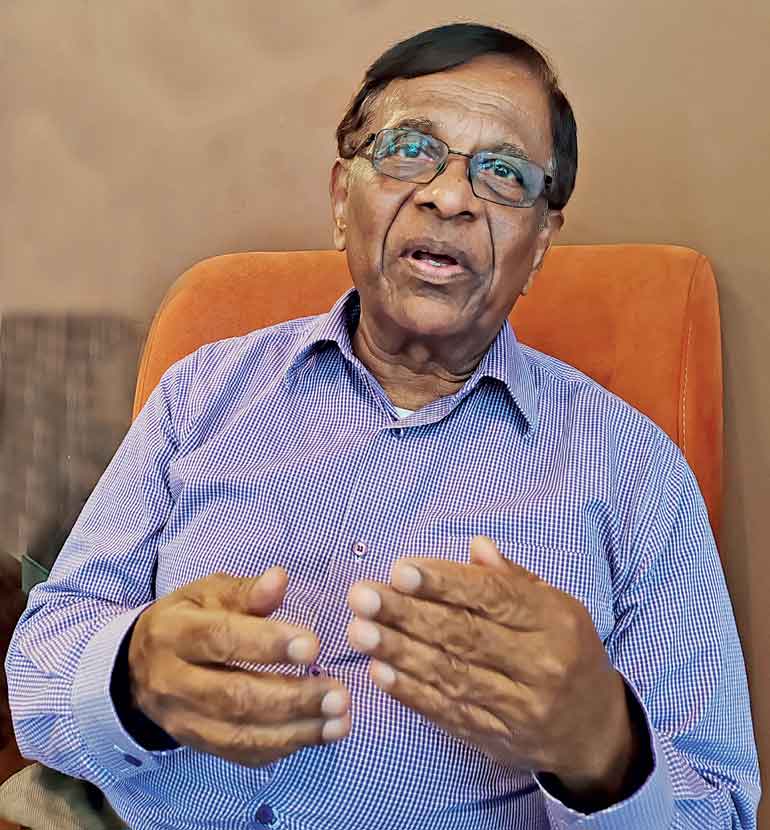
Former JVP General Secretary Dr. Lionel Bopage
By Shanika Sriyananda
Former JVP General Secretary Dr. Lionel Bopage has backed the Government’s anti-corruption drive but cautioned against turning arrests and investigations into political spectacles, while calling for stronger institutions, administrative reform, and better coordination within the Government.
“I don’t agree that the Government is taking political revenge by arresting people,” Bopage said, stressing that those responsible for corruption should be brought to justice through proper legal procedures.
However, he warned that public ridicule of suspects and premature announcements about cases could undermine confidence in the process.
In an interview with the Daily FT, Dr. Bopage recalled the JVP’s past with its founder Rohana Wijeweera, mistakes made by Wijeweera that contributed to the then President J.R. Jayewardene’s decision to proscribe the party, the motives and limitations of the 2022 Aragalaya, the National People’s Power (NPP) Government’s shortcomings in bringing about change, and the importance of maintaining a balanced approach in relations with global powers.
He said the Government’s anti-corruption drive would have limited impact without reforming a bureaucracy that, under successive administrations, had discouraged initiative and independent decision-making.
Following are excerpts of the interview:
Q: Have you received any invitations from the present Government to contribute your expertise, perhaps through an advisory board or discussions with the Government?
A: No. There are former senior JVP members, such as Prof. Jayadeva Uyangoda and Prof. Athula Sumathipala, as well as many professional experts, particularly in the expatriate community, who are willing to contribute to building a better and more prosperous Sri Lanka.
I met President Anura Kumara Dissanayake twice before the 2024 Presidential Election. We discussed general policy issues, but there was no invitation to contribute to the party or Government.
I first met him in 2019, when I was invited to join the JVP’s final Galle Face rally, but I declined because there was no agreement on principles. I later met him when he visited me in Melbourne while I was ill. We discussed policies, but again there was no request for me to contribute.
Q: If the Government invited you to join in an advisory capacity, would you accept?
A: Yes, depending on the conditions. I am willing to help if I believe I can make a useful and positive contribution. I campaigned for him during the 2024 Presidential Election, travelling to the North, East and other districts to address NPP meetings.
There are shortcomings in the NPP Government, partly because many of those elected are academics without sufficient ground-level political and administrative experience
Q: Do you think the JVP deviated from its original policies, especially on the national issue, in the 1980s?
A: Yes. The JVP changed significantly after 1983, particularly during 1988-89, from the original policies we developed in the 1970s.
I believe the JVP was responsible for greatly aggravating chauvinism during that period through the Deshapremi Janatha Vyaparaya (DJV). It brought together chauvinist and extremely nationalist organisations, and the effects are still felt in Sri Lankan society. This remains a negative factor in Sri Lankan politics, and the JVP has a responsibility to address it.
Q: Some people also hold the JVP responsible for destroying infrastructure, including power projects, and for killing people during that period. Do you agree?
A: I left the country in September 1989, so I cannot comment on every incident. It was a complex conflict in which different groups committed acts of violence.
The JVP was certainly responsible for killing political opponents, particularly those who supported the 13th Amendment, and that was wrong. But the Government also carried out actions and blamed the JVP.
The fundamental mistake, in my view, was the proscription of the JVP in 1983. If the UNP Government had not banned the party, the JVP might not have taken the path it subsequently followed. But that does not absolve the JVP of responsibility for its actions.
I believe the JVP should have returned to open politics when opportunities arose.
Q: But the party was banned. How could it have come into the open?
A: Even under proscription, it could have used whatever opportunities were available. For example, while I was detained with 17 others, I proposed holding a press conference to explain the JVP’s position. President J.R. Jayewardene had called an all-party conference on the national question, and I suggested that a JVP delegation hold a press conference explaining its position.
Q: You said the JVP was falsely accused of being behind the 1983 riots. Why did the party not openly state its position?
A: We were not involved in the riots, and later we found out which politicians and groups were behind them. Before the riots, I had intended to resign over the JVP’s position on the Tamil issue. We then held the Central Committee meeting on the issue in Tangalle, and the riots broke out soon afterwards.
The Government banned the JVP, accusing it of being behind the riots, which was not true. I refused Wijeweera’s decision to go underground because we were not involved in the riots. I argued that if we went underground, people would believe the Government’s claim that we were responsible.
I strongly believed that we should have publicly stated that we had not been involved in the riots and that the Government was responsible. But Wijeweera and other leaders, including Upatissa Gamanayake, did not agree. The JVP was proscribed on 30 July 1983.
I regard that decision as one of the major mistakes. The leadership could have come into the open, even if it meant being arrested, so that people would understand what had happened.
Q: But later, the then Government wanted to meet the JVP over this issue.
A: Yes. After my release, the JVP Politburo wanted me to meet President Jayewardene because there were no charges against us and requested him to lift the proscription.
I met President Jayewardene at his residence. He said Wijeweera should come and make a statement, after which he would consider lifting the JVP’s proscription.
Q: Why do you think Wijeweera did not take that opportunity?
A: Wijeweera did not want to come out of hiding. I think he feared that he would be harassed or killed.
He had experienced this fear from childhood. His father had been assaulted by UNP thugs during an election and remained bedridden until his death. I think that may have had a psychological impact on him.
When I was with the JVP, whenever there was a problem with the police, they sent me to the police station. Wijeweera would even avoid going near a police station. I think that phobia may have stemmed from the same experience.
Q: There is talk in political circles about friction between the NPP and the JVP. Is it true?
A: I am not aware of the internal politics of the NPP-JVP coalition, so I cannot comment. But I recall the negative experience of internal disputes within the JVP in 1971, which affected the insurrection. By 1983, factions within the JVP had again weakened the party and affected its activities.
If there is a dispute within the NPP or JVP, it could be disastrous for the future. They should resolve their differences through dialogue and consultation. If they cannot, they may have to go their own way, but that would not be good for the country.
Q: Did you support Aragalaya from Australia in 2022?
A: Yes. I supported it from Australia because Sri Lanka was in a disastrous crisis. The system was deeply corrupt and people wanted change.
However, the Aragalaya was not a unified movement. It included people associated with the UNP, JVP, Frontline Socialist Party and many other groups, without a common agenda.
Nevertheless, it represented an important awakening among young people. We organised public meetings in Australia and supported the movement through advocacy and provided material and financial assistance when requested.
Q: Was its main objective to change the Government or the system? Are you satisfied with the outcome?
A: The objective was to change the system to some extent, but there was no clear common agenda for achieving that objective. Different groups tried to develop one but could not agree.
The movement developed largely through social media rather than through a conventional organisation. It could have gone further if the groups had united, reached compromises and developed a common agenda. The movement was eventually suppressed by President Ranil Wickremesinghe.
Q: Do you mean former President Wickremesinghe was also part of the Aragalaya?
A: One of the groups associated with the movement was the Black Hats. They were linked to a faction associated with President Wickremesinghe and played a prominent role in the Aragalaya.
Q: You described the previous regime as autocratic and welcomed the change. Did you welcome the change that followed the Aragalaya?
A: No. I did not support Wickremesinghe becoming President because it was not a decision made directly by the people who participated in the Aragalaya or by the general population.
It was a parliamentary decision by MPs who were already part of the existing political system, including people associated with the previous Rajapaksa regime. Although it was constitutionally valid, I did not consider it representative of what the people wanted.
Q: But did President Wickremesinghe not help improve the economy and the situation at the time?
A: That is debatable. Both the previous and present Governments adopted the IMF program, but their approaches have differed.
Under Wickremesinghe, the program involved significant restrictions on the public and relatively few concessions. The present Government also has to comply with IMF conditions because of legislation and agreements inherited from the previous Government, but it has provided greater concessions to the people.
Current difficulties are also influenced by international developments, including geopolitical conflicts and tensions involving major powers. As a result, some election promises have become difficult to implement.
At the same time, I am critical of the Government because I do not think it has always got its priorities right.
Q: Aren’t you satisfied with what the NPP Government is doing to tackle corruption and improve the economy?
A: I think it could have done better. Sri Lanka needs to reduce its excessive dependence on exports as the primary source of foreign exchange. Exports and services are necessary, but they should be built on a stronger domestic economic foundation.
We need to address basic requirements such as food, energy, water and telecommunications, and then build a stronger export economy.
Since 1977, we have become heavily dependent on exports, tourism and migrant remittances. Tea, rubber, coconut, apparel and footwear are important, but these sectors are vulnerable when global conditions deteriorate.
The JVP was certainly responsible for killing political opponents, particularly those who supported the 13th Amendment, and that was wrong
We have the potential to develop agriculture and renewable energy. Sri Lanka has solar, water, ocean and wind resources that could be better utilised. We also need to reduce our dependence on imported fossil fuels.
I strongly disagreed with the NPP’s proposal to establish a nuclear power plant and have publicly expressed my opposition.
In terms of priorities, therefore, I do not think the Government has taken all the right initiatives. However, its efforts to tackle corruption and drugs are positive, and I commend them.
Q: Some parties have criticised the Government for inefficiency in handling crucial issues. How do you see this?
A: We have to understand that this is not a socialist Government. It is a social democratic Government operating within a capitalist system, so we cannot expect it to implement socialism.
It has a parliamentary mandate to pursue a social democratic agenda, and that is what it is attempting to do.
There are shortcomings, partly because many of those elected are academics without sufficient ground-level political and administrative experience. They are gradually gaining experience, but perhaps not as quickly as we would like.
Q: What about the bureaucracy?
A: The bureaucracy was developed under previous regimes in a way that discouraged initiative. Officials were generally expected to follow political instructions rather than make independent decisions, and some were also corrupt.
The same weaknesses remain because there have not been major changes to the administrative system. Some officials may still occupy positions where they can obstruct reforms.
Q: Should there have been administrative changes?
A: Yes. If the Government wanted to retain existing officials, it could have established supervisory and advisory mechanisms to monitor performance against key result areas.
Many professionals would be willing to contribute without payment. The Government could establish advisory bodies to provide independent advice to ministers and officials and monitor implementation.
Unfortunately, that has not happened sufficiently, and I am not satisfied with this aspect of the Government’s performance.
Q: Are you satisfied with the way the Government is exposing corruption and arresting people?
A: Yes, but there are better ways of handling these cases without turning them into political spectacles. Legal procedures must be followed while ensuring efficiency.
I am also concerned about delays in the Attorney General’s Department and the judiciary. I am not blaming those institutions, but the system needs more staff and resources, improved procedures and clear timeframes.
I do not agree that every arrest represents political revenge. The previous regime included many corrupt people, although there were also genuine individuals. If people who committed wrongdoing are brought to justice, that is appropriate.
But the process must be conducted properly. Ridiculing people in Parliament or publicly announcing that a case will be taken up within a week does not strengthen the justice system.
Q: How do you assess the present Government’s leadership under Anura Kumara Dissanayake?
A: In general, people are happy with his performance, although I cannot comment fully because I do not know what is happening inside the Government. From the outside, however, I think its communication and coordination could improve.
At times, important leaders make different statements on the same issue. There should be greater consensus before positions are announced publicly.
That was how we operated in the JVP. Important issues and policies were discussed within the Politburo or Central Committee before being presented publicly. I do not know whether similar discussions take place within the present leadership, but I sense a lack of coordination.
Q: How do you assess the Government’s international relations with the United States, China and India?
A: Sri Lanka is in a very sensitive position. A significant amount of foreign exchange comes from the United States and Western markets, while China and India are also strategically and economically important.
The Government therefore has to maintain a delicate balance. We should protect Sri Lanka’s sovereignty and economic interests without putting economic stability at risk.
Maintaining good relations with the US, India and China is essential. If Sri Lanka antagonises any of these major powers, the consequences could be serious.
Q: Do you see any lapses in the Government’s relationship with the United States?
A: No. I think the Government is trying to maintain good relations with the US because it understands the risks of antagonising a major economic power.
The same applies to India and China. Sri Lanka needs all three relationships while it rebuilds the economy.
Q: Do you see a difference between the ideology of the original JVP and the present JVP?
A: Obviously. The original JVP was based on socialism, whereas the present Government is not socialist. It is a coalition pursuing a social democratic agenda.
The Government is trying to recover the economy and improve living conditions within a capitalist framework. That is fundamentally different from running a socialist system.
Q: The JVP originally promoted equality and non-discrimination. Do you think it has taken a different approach now and overlooked communal issues?
A: Its current position is not entirely clear to me. It still rejects the right to self-determination, which remains an important aspect of its earlier position.
But equality means equal rights for all citizens, including equal language rights and protection from discrimination based on religion or other factors.
The Constitution recognises Sinhala and Tamil as official languages, but Government communication is still not consistently available in both languages. I have complained about this for decades under different Governments.
The present Government should address this. Ensuring equal language rights through the administrative system would be far cheaper than allowing grievances to accumulate and eventually contribute to conflict.
I do not think the Government is deliberately refusing to implement the policy. It may simply lack an effective mechanism to do so. There should be strict requirements for all Government departments and agencies to implement the language policy, with consequences for failure.
Sri Lanka cannot build a genuinely equal society without addressing these practical issues.



