Monday Sep 28, 2026
Monday Sep 28, 2026
Monday, 3 August 2026 00:23 - - {{hitsCtrl.values.hits}}
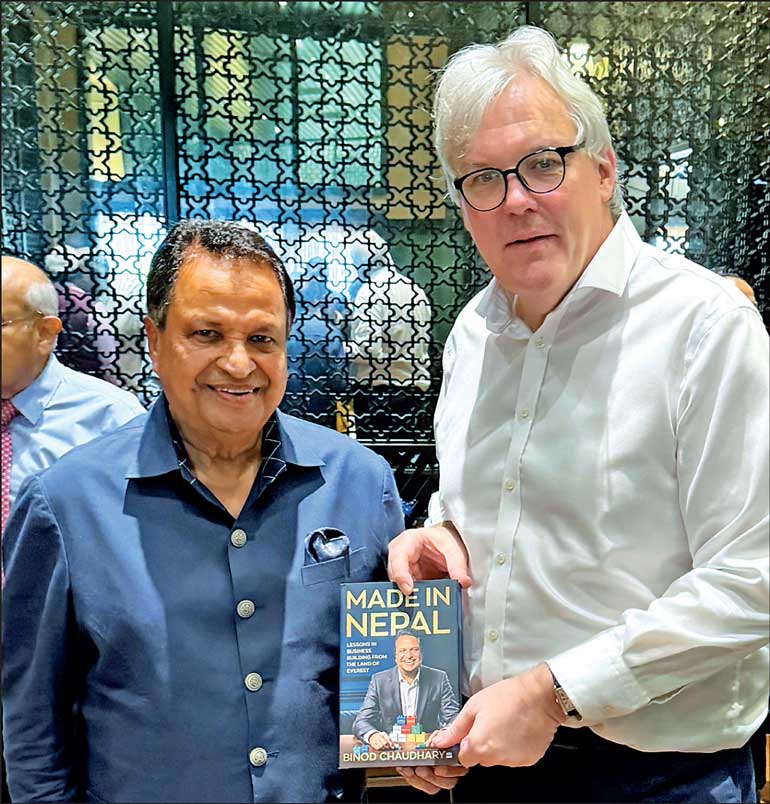
Dr. Binod Chaudhary (left) presenting his book “Made in Nepal” to the British High Commissioner to Sri Lanka Andrew Patrick
 I first heard Dr. Binod Chaudhary speak at the Sri Lanka Corporate Director Summit 2026. His name was familiar, for my father had often spoken of him, but it was only after listening to his address that I fully grasped the magnitude of his journey. Inspired by his story, I immediately picked up his latest book, Made in Nepal. This article reflects on both the man and his manifesto.
There is something compelling about leaders who build enduring institutions from modest beginnings. Dr. Chaudhary’s Chaudhary’s story is not merely about becoming Nepal’s first billionaire. It is proof that geography does not dictate destiny: companies from small economies can become global brands, and courage, discipline, resilience and vision often matter more than abundant resources.
Addressing directors and business leaders in Colombo, Dr. Chaudhary challenged a common weakness in modern boardrooms. Too often, he argued, directors become consumed by compliance, governance and risk management while forgetting that one of their core responsibilities is to enable growth and encourage ambition.
“Entrepreneurs bring ambition. Boards provide discipline. The two should complement each other, not work against each other,” he said.
It was perhaps the defining message of the summit. Governance without ambition breeds stagnation, while ambition without governance invites recklessness. Sustainable success demands both.
His own life demonstrates this balance. In 2000, at the height of Sri Lanka’s civil conflict,
Dr. Chaudhary invested in the former Hotel Samudra. Many questioned his judgement, but he saw opportunity where others saw only danger. The investment evolved into a successful partnership with the Taj Group and reinforced a philosophy that has guided his career: the greatest opportunities often emerge when others are paralysed by fear.
The same thinking fuelled the extraordinary success of Wai Wai noodles. Industry experts insisted Nepal was too small to create a global food brand. Dr. Chaudhary ignored conventional wisdom and built the business with international markets in mind from the outset. Today, Wai Wai is sold in over 100 countries, with annual sales exceeding three billion packets.
His message was simple: if the board thinks small, the company will remain small.
The Chaudhary Group’s partnership with John Keells to distribute BYD electric vehicles in Sri Lanka is another example of calculated ambition. Despite limited experience in the automotive industry beyond introducing Suzuki to Nepal decades earlier, the venture exceeded expectations. Under the leadership of his son, Nirvana Chaudhary, the business expanded into 25 countries within a year.
When asked whether they possessed all the necessary capabilities, Dr. Chaudhary’s answer was refreshingly honest: “Perhaps not. But we had the determination to build those capabilities.”
That determination runs through every page of Made in Nepal. Unlike many business memoirs that celebrate wealth, this one celebrates perseverance. It traces the transformation of a modest family trading business into CG Corp Global, a diversified enterprise of more than 200 companies operating across Asia, Europe and Africa.
At its heart are the values inherited from his father: discipline, prudence, humility and long-term thinking. These principles became the foundation of sustainable growth.
Greatest lesson
The book’s greatest lesson, however, is its rejection of excuses. Nepal has endured political instability, infrastructure constraints and regulatory uncertainty for decades. Yet Dr. Chaudhary never presents these as reasons for failure. Instead, they became the proving ground that strengthened resilience and sharpened leadership.
One memorable episode illustrates the unpredictability of operating in fragile environments. During a period of unrest, armed men approached him and asked, “Are you Binod Chaudhary?” Having previously encountered Maoist insurgents and militant groups, he feared the worst. Moments later, he realised they were members of his own security team. The story captures the psychological demands of leadership and the courage required simply to keep moving forward.
Yet, ‘Made in Nepal’ is about more than entrepreneurial success. It is equally about institution-building. Dr. Chaudhary repeatedly argues that businesses cannot depend forever on charismatic founders. Sustainable organisations require professional management, strong governance, succession planning and systems that outlive individuals. His philosophy closely mirrors Jim Collins’ Built to Last: enduring companies are built on disciplined leadership rather than individual heroics.
For Sri Lankan business leaders, these lessons are particularly relevant. We too operate from a small market and have endured political uncertainty and economic crises. Yet Sri Lanka possesses considerable strengths: its strategic location, educated workforce and entrepreneurial talent.
Dr. Chaudhary himself observed that Sri Lankan businesses enjoy advantages many Nepali companies do not. His continued investments in Sri Lanka, even during difficult times, from Taj Samudra to Union Bank, reflect his confidence in the country’s long-term potential and reinforce an enduring principle: successful investors look beyond temporary crises and focus on lasting fundamentals.
He concluded his keynote by identifying five qualities every future-ready director should possess: think globally, embrace innovation and artificial intelligence, take calculated risks, build trusted brands rather than simply manufacture products, and remain proud of one’s national identity. The strongest global companies, he reminded the audience, never forget where they came from.
That message lies at the heart of Made in Nepal. World-class companies can emerge from Kathmandu, Colombo or any city where people possess vision, discipline and determination. Small countries should never think small.
Ultimately, Dr. Chaudhary’s
story is not wealth. It is about building belief: that adversity can become opportunity, that resilience is a lasting competitive advantage, and that leaders who combine ambition with integrity can build not only successful companies but stronger nations. His journey is a powerful reminder that the size of your country should never define the size of your dreams.
References
“Made in Nepal” by Binod Chaudry
https://www.ft.lk/front-page/Dr-Binod-Chaudhary-urges-Sri-Lankan-boards-to-pair-governance-with-global-ambition/44-795058
(The author teaches Accounting and Finance at the University of Buckingham UK)




