Thursday Oct 15, 2026
Thursday Oct 15, 2026
Tuesday, 4 August 2026 03:05 - - {{hitsCtrl.values.hits}}
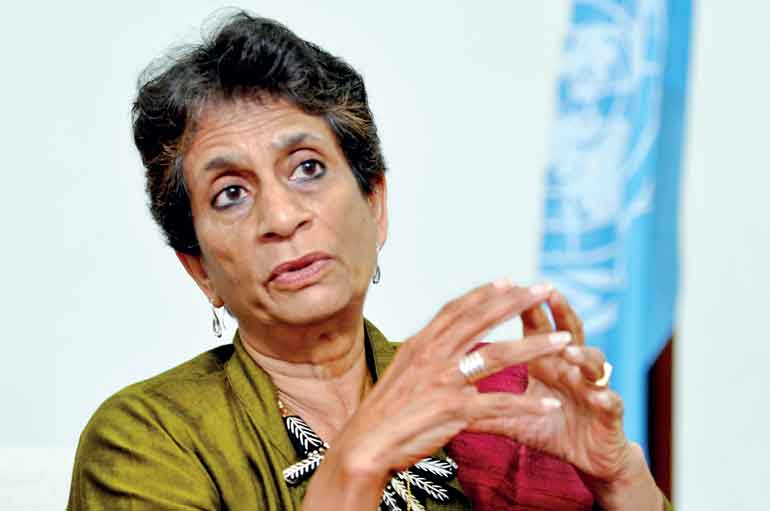
United Nations Assistant Secretary-General and UNDP Regional Bureau for Asia and the Pacific Regional Director Kanni Wignaraja – Pic by Lasantha Kumara
Sri Lankan-born Kanni Wignaraja, United Nations Assistant Secretary-General and Regional Director of the United Nations Development Program (UNDP) Regional Bureau for Asia and the Pacific, was in Sri Lanka on a two-day mission at a pivotal moment in the country’s recovery journey.
Bringing more than three decades of leadership experience across Asia, the Pacific, Africa, Geneva and New York, Wignaraja met with Government leaders, development partners, the private sector and other key stakeholders to discuss Sri Lanka’s next phase of economic transformation and long-term resilience.
During her visit, UNDP also shared its latest policy brief, “Redefining Resilience in an Era of Compound Shocks,” which examines how countries can strengthen resilience amid overlapping economic, climate and geopolitical crises.
In an exclusive interview with the Daily FT, Wignaraja drew on both her global development expertise and her deep personal connection to Sri Lanka, reflecting on the country’s remarkable economic stabilisation, the reforms needed to accelerate inclusive growth, the importance of governance and institutional strengthening, climate resilience, development financing, and the critical role of partnerships in positioning Sri Lanka for sustainable prosperity in an increasingly uncertain world.
Below are excerpts of the interview:
By Charumini de Silva
Q: Sri Lanka restored macroeconomic stability after an unprecedented economic crisis. From UNDP’s perspective, what should be the country’s next priorities to ensure this recovery translates into sustainable, inclusive growth?
A: Stabilisation is never a destination; it is an ongoing process. You can never take your eyes off macroeconomic stability because maintaining it is essential, particularly to continue sending positive signals to international markets and attract healthy financing. The next question is: how do you expand the economic pie? At this stage of development, countries across Asia and the Pacific have shown that sustained growth of around 5-7% is important. But it cannot be just any growth, it has to be inclusive. I like the way you framed the question because it highlights two critical issues. First, growth must carry as many people as possible. In Sri Lanka’s case, nearly half of GDP comes from small and medium-sized enterprises, so ensuring that SMEs remain healthy and continue to grow is fundamental. The second issue is inclusivity. Frankly, I expected that by now Sri Lanka would have achieved higher female labour force participation, stronger labour productivity and a more competitive agricultural sector.
Stabilisation is never a destination; it is an ongoing process. You can never take your eyes off macroeconomic stability because maintaining it is essential, particularly to continue sending positive signals to international markets and attract healthy financing
Agriculture still supports a significant share of the population, yet there is considerable room to modernise the sector and improve productivity. These are areas that require continued and perhaps renewed investment; modernising agriculture, upgrading skills and preparing the workforce for a more competitive future. Another important consideration is scale. We may think of ourselves as a large island of 22 million people, but from a global investor’s perspective, Sri Lanka is a relatively small market. Investors increasingly look at regional opportunities rather than individual countries. That is why Sri Lanka’s location is such a strategic advantage. Positioned in the Indian Ocean, the country can become part of broader regional value chains connecting India and South Asia with Southeast Asia. Whether in services, manufacturing or value-added agriculture, integrating into these regional production networks offers tremendous potential for more sustainable and inclusive growth.
Q: What distinguishes Sri Lanka’s recovery story, and where do you see the country’s greatest untapped potential?
A: Sri Lanka’s recovery has been astounding. When you consider the succession of multiple shocks the country has endured from COVID-19 and the economic crisis to Cyclone Ditwah and the conflict in the Middle East, which affected energy markets, the fact that the country has managed to regain stability and build a positive economic narrative is something that deserves recognition. The challenge now is how to move beyond stabilisation. We cannot remain at this stage indefinitely. Recovery must now accelerate because new external shocks continue to emerge. One message that has consistently come up in my discussions with both national and international partners is, implementation must be faster. We need to reduce bureaucratic layers, simplify procedures and shorten the time it takes to deliver results, particularly in priority sectors. The second priority is reducing the cost of living. Regardless of broader economic improvements, households, especially poorer families judge recovery by whether everyday expenses become more affordable. UNDP’s analysis shows three major expenditure items. The first is the cost of electricity. Sri Lanka has significant hydropower and solar potential. Expanding renewable energy would strengthen energy security, reduce dependence on imported fuel and lower electricity costs. The second is the cost of food. Sri Lanka remains heavily dependent on imported chemical fertiliser, a vulnerability exposed by global disruptions. Transitioning towards a balanced mix of locally produced chemical fertiliser and organic alternatives will take time, perhaps two to three years. However, it is an important long-term investment because it can improve agricultural resilience and help reduce food costs. The third is the cost of transport. Beyond fuel prices, Sri Lanka should accelerate the transition towards electric mobility. Across China, Southeast Asia and India electric vehicles, including public transport are becoming increasingly common. If managed properly with prudent regulations, this transition can reduce transport costs, lower air pollution and improve public health. Together, these measures can make a meaningful difference to household living costs, whilst strengthening long-term economic resilience.
Q: How is UNDP reshaping its support to Sri Lanka, and what will be the key priority sectors?
A: UNDP is now beginning the design of its next five-year Country Program, which will be presented to our Executive Board for approval next August. The priorities we are discussing with the Government include energy security, water security, employment and financing. Jobs will be a particularly important focus. Sri Lanka faces a difficult challenge as many young people are leaving to work overseas. While migration brings income, skills and international exposure, it also creates a void within the domestic labour market, particularly among skilled young workers in the middle management level. The challenge is twofold. First, how do you encourage people to return and contribute to a country that invested in their free education? Second, while they are abroad, how do you fill the resulting skills gap? That requires continuous reskilling, retraining and in some cases, attracting talent from elsewhere. Sri Lanka is not alone in facing this challenge. Many countries are experimenting with different approaches to managing migration. Personally, I believe a circular model works best where people leave, gain skills and experience, then return to invest, innovate and contribute before perhaps going abroad again. This becomes even more important because Sri Lanka has an ageing population. Although the country is classified as an upper-middle-income economy, many people do not yet experience that level of prosperity in their daily lives. The objective must therefore be to become more prosperous before the demographic burden grows significantly older. Otherwise, pressures on pensions, healthcare and social protection will continue to increase. Climate action will remain another major pillar of UNDP’s work, alongside governance reforms and broader economic reforms that underpin all these priorities. The program will be developed through an extensive nationwide consultation process. UNDP has been in Sri Lanka since the 1960s, so this is not a new conversation. But we constantly ask ourselves whether our support remains relevant to the country’s future needs.
Although the country is classified as an upper-middle-income economy, many people do not yet experience that level of prosperity in their daily lives. The objective must therefore be to become more prosperous before the demographic burden grows significantly older. Otherwise, pressures on pensions, healthcare and social protection will continue to increase
Q: How can stronger partnerships between Government, businesses and development agencies boost investment, innovation, job creation and better align with the SDGs while remaining competitive?
A: The old argument that countries must choose between sustainability and economic growth or between pursuing the SDGs and making profits, has largely been disproven. Technology has advanced. Science has advanced. The evidence is now very clear. So, the countries performing best in our region are successfully doing both. A strong private sector is indispensable. No country can achieve broad-based prosperity without the contribution of a very robust and positive private sector. But the private sector must also operate responsibly and in the public interest. I have never seen those two objectives as contradictory. Responsible businesses are essential for achieving 6-7% economic growth, creating quality jobs, driving innovation, strengthening competitiveness and attracting FDIs. The Government’s role is equally important. It must provide the right regulatory framework, uphold quality standards, minimise corruption and reduce the cost of doing business. If Sri Lanka succeeds in doing that, it will become increasingly attractive not only to domestic investors, but also to international businesses seeking long-term investment opportunities.
Q: Development financing is becoming increasingly constrained globally. How should countries like Sri Lanka diversify financing beyond traditional development assistance?
A: Once countries reach upper-middle-income status, access to traditional Official Development Assistance (ODA) naturally declines. ODA fell by like 24% in 2025 and that’s going to only drop even a third more going into 2026 and next year. As a result, traditional aid will increasingly serve as catalytic financing leveraging much larger sources of investment rather than acting as the primary source of funding. Some of the ways in which Sri Lanka can benefit is by still having very good negotiated deals with the multilateral banks. Sri Lanka is well positioned to attract financing because it has maintained a strong IMF-supported reform program. Continued implementation of those reforms sends a positive signal to international financial institutions such as the World Bank, Asian Development Bank (ADB) and the Asian Infrastructure Investment Bank (AIIB). Climate finance presents another major opportunity. Sri Lanka is highly vulnerable to climate shocks, and climate vulnerability, not just GDP should increasingly determine access to financing. I think we need a bigger voice on the climate stage to say this is something, whether it’s the biodiversity funds, the loss and damage fund, etc. The country also possesses extraordinary natural assets, both on land and at sea. We often talk about “putting nature on the balance sheet.” If these ecosystems are properly valued and protected, they can unlock innovative financing instruments, including nature-based bonds, debt-for-nature swaps and biodiversity financing. Insurance is another area with considerable potential from crop insurance to health insurance and parametric insurance, which remains underdeveloped. South-South financing is also becoming increasingly important. Ultimately, the issue is not whether financing exists. The issue is ensuring that financing is purpose-driven. Countries should not borrow simply because funding is available. They should first identify the desired outcomes and then determine the most appropriate mix of financing to achieve them.
Q: What should be Sri Lanka’s priorities for climate resilience, and how can climate financing be mobilised more effectively?
A: Climate finance is highly competitive. Sri Lanka therefore needs to understand which climate financing mechanisms best align with its own priorities and strengths. For example, biodiversity conservation offers major opportunities. Sri Lanka has exceptional biodiversity, including coral reefs, mangrove ecosystems and coastal habitats. There is substantial international financing available for restoring and protecting these ecosystems. The key is understanding what financing instruments exist, identifying where Sri Lanka has comparative advantages and then packaging strong, evidence-based proposals that align national priorities with available climate funds.
Ultimately, the issue is not whether financing exists. The issue is ensuring that financing is purpose-driven. Countries should not borrow simply because funding is available. They should first identify the desired outcomes and then determine the most appropriate mix of financing to achieve them
Q: Governance has become a key pillar of Sri Lanka’s reform program. How critical are institutional reforms, transparency and public sector reforms?
A: They are fundamental because they build trust. Trust matters not only for investors, but also for citizens. Reforms of this scale take time, and people are generally willing to give Governments that time, provided institutions remain transparent and accountable. Citizens need to understand what is being delivered, what cannot yet be delivered and why. Communication is therefore extremely important. Many political leaders communicate actively during election campaigns, but become much less visible once they enter Government because governing itself is so demanding. However, communication cannot stop. Leaders need to continue engaging with people, listening to concerns and explaining decisions. That communication can happen through television, radio, community meetings, digital platforms or social media. Different audiences require different approaches. It is critical that the Government carve out some time to still feel the pulse of people, engage and communicate at very local levels. Younger generations can get impatient and expect rapid access to information. Thus, the Governments should never assume that people will simply wait patiently without regular communication.
Building lasting prosperity requires recognising the past, supporting reconciliation and ensuring that every community feels included in the country’s future. If Sri Lanka can combine sound economic management with genuine social healing, then its prospects extend well beyond the next five years. The country’s potential over the next decade and indeed the next half-century, is truly remarkable
Q: How do you assess Sri Lanka’s economic outlook over the next three to five years? What are the biggest risks, and if you had to recommend three priorities, what would they be?
A: The overall trajectory is encouraging. Internationally, Sri Lanka now has a much more positive narrative. The challenge is ensuring that this positive narrative translates into tangible improvements in people’s daily lives by lower living costs, better healthcare, improved nutrition and education that leads to quality employment. Three priorities stand out. First, continue strengthening governance by rooting out corruption and tackling both domestic and transnational crime. These undermine confidence, institutions and ultimately national sovereignty. Second, achieve energy and water security. If, five years from now, Sri Lanka can confidently say it has secured both, that will represent a major milestone for long-term resilience. Third, continue the country’s healing process. Sri Lanka experienced decades of civil conflict and societies do not heal overnight. Different communities carry different traumas, and many members of the diaspora left under painful circumstances. Yet the diaspora also represents an enormous asset, bringing skills, investment, technology and international networks. Building lasting prosperity requires recognising the past, supporting reconciliation and ensuring that every community feels included in the country’s future. If Sri Lanka can combine sound economic management with genuine social healing, then its prospects extend well beyond the next five years. The country’s potential over the next decade and indeed the next half-century, is truly remarkable.




