Saturday Jul 04, 2026
Saturday Jul 04, 2026
Thursday, 9 April 2026 00:24 - - {{hitsCtrl.values.hits}}
2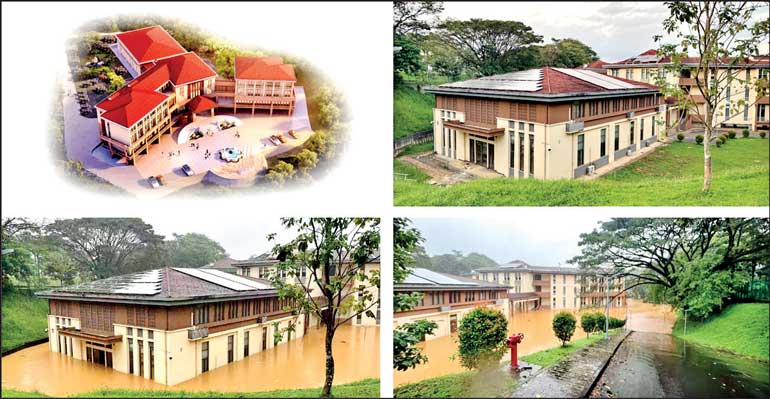
 In recent years, extreme rainfall and flooding have become increasingly frequent in Sri Lanka. Flood risk is not confined to a single structure or agency. Reservoir operation, river conveyance capacity, urban drainage systems, land-use decisions, housing location, and social vulnerability together form an interconnected system. When any element fails under extreme conditions, risk is amplified and transferred across regions and social groups, with the costs ultimately borne by society as a whole. Recent flood events highlight a practical challenge: under tight fiscal conditions, current response approaches have not been effective in reducing future flood risk.
Sri Lanka is not lacking in technical foundations. Government agencies have long recorded historical peak water levels, developed flood and landslide hazard maps, and established river reservations or “blueline” regulations. The issue is not whether these tools exist, but the extent to which they meaningfully influence infrastructure planning, urban expansion, and development approvals.
In practice, hazard maps and historical water-level records are not always used as binding inputs to decision-making. Enforcement of river reservation lines is often constrained by land pressure, informal development, and fragmented institutional responsibilities. As climate extremes intensify, standards and boundaries based on past conditions are becoming increasingly misaligned with present and future risk realities.
Post-disaster responses typically focus on repairing roads, restoring the water supply, and rebuilding damaged facilities. These actions are necessary. However, when post-disaster recovery becomes the dominant long-term strategy, the outcome is often the same: damage followed by reconstruction, with little substantive reduction in overall risk.
The most recent floods caused severe loss of life and damage to infrastructure and also disrupted research and cooperation platforms. The China–Sri Lanka Joint Research and Demonstration Centre for Water Technology (JRDC) at Peradeniya was among the affected facilities, with operations temporarily interrupted. JRDC is connected to both the University of Peradeniya and the Ministry of Urban Development and Housing. We are aware of the severe damage inflicted on the University of Peradeniya by Cyclone Ditwah. Post-disaster recovery of JRDC is today supported by China; however, long-term risk reduction can only be done through the internal mechanisms as discussed.
In contrast, some countries, including China, have adopted different approaches to long-term flood management. Rather than attempting to eliminate floods, they integrate climate risk into decision-making at an early stage. A key element of this approach is the use of legally mandated master plans, with a strong emphasis on implementation, cross-sector coordination, and performance assessment. Practical measures include risk zoning to guide land use, clear design standards and safety margins in reservoirs and urban drainage systems to reduce flood peaks, and cross-sector coordination to prevent risk from being transferred downstream or into other systems. The core objective is to minimise total social cost, rather than the cost borne by individual projects or agencies.
For Sri Lanka, the key priority is not to replicate another country’s governance model, but to strengthen linkages among existing tools and institutions. Developing a unified, regularly updated national reference framework for flood and landslide risk, based on existing data, and embedding it in planning and approval processes would help improve consistency and transparency across sectors.
Even under fiscal constraints, shifting a portion of resources toward threshold-based early warning systems, pre-arranged emergency response measures, and protection of critical public services is often more cost-effective than relying primarily on post-disaster repair.
As climate uncertainty continues to rise, Sri Lanka’s central challenge is no longer only how to recover from the next flood, but how to reduce the social cost of the one that follows. This requires more consistent, earlier-stage risk governance rather than relying solely on post-disaster recovery.
(The author is attached to the CAS Research Center for Eco-Environmental Sciences, Beijing, China)