Thursday Oct 22, 2026
Thursday Oct 22, 2026
Wednesday, 13 May 2026 04:37 - - {{hitsCtrl.values.hits}}
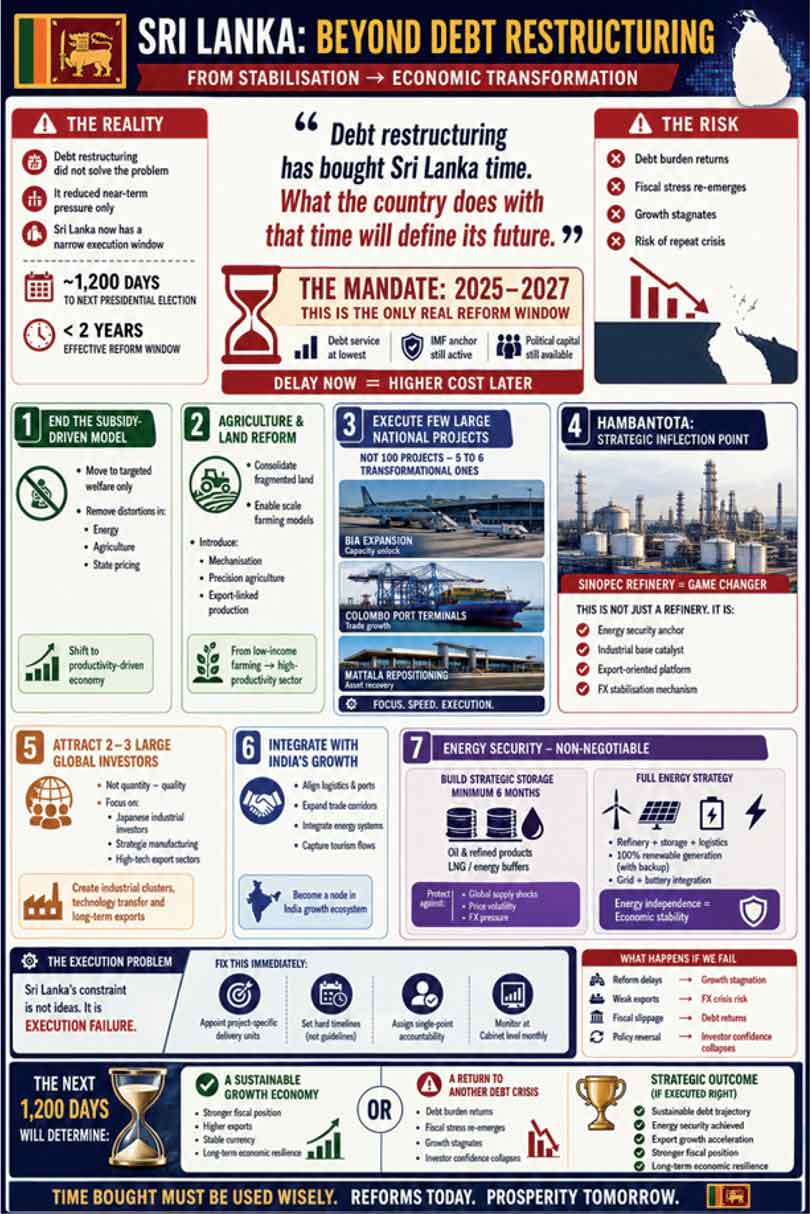
The Government now has approximately 1,200 days to the next Presidential election. Within that window, there is a much narrower effective reform period of less than two years—before political cycles, electoral considerations, and policy hesitation begin to dominate. If critical , decisive reforms and strategic investments are not initiated now and meaningfully progressed—within that timeframe, the responsibility will inevitably fall to the next administration. And history suggests that transitions rarely accelerate unfinished reforms or let them naturally die. Do we have that luxury anymore?
 Sri Lanka has reached a critical milestone by moving out of bankruptcy, but it would be misleading to call it a success.
Debt restructuring is almost completed. Most agreements have been secured, a pathway to debt sustainability has been mapped, and institutional frameworks such as the Medium-Term Debt Management Strategy (MTDS) and institutionalising the centralised debt management function are being put in place. Please refer my 2017 article on MTDS (Reforming public debt management: Need for a Medium-Term Debt Management Strategy | Daily FT) and Reforms in Public debt (Reforming public debt management: Lesson from the Colombian experience | Daily FT). These are long delayed, necessary steps to restore credibility, stabilise expectations and signal discipline. However, none of these actions could create a sustainable path to restore the growth.
They do not generate employments and expand exports. They do not transform the structure of the economy and certainly do not guarantee that Sri Lanka will not find itself in a similar position again in the future. Debt restructuring has given us a necessary breathing space. The real question is whether we will use that time effectively.
The Government now has approximately 1,200 days to the next Presidential election. Within that window, there is a much narrower effective reform period of less than two years—before political cycles, electoral considerations, and policy hesitation begin to dominate.
If critical , decisive reforms and strategic investments are not initiated now and meaningfully progressed—within that timeframe, the responsibility will inevitably fall to the next administration. And history suggests that transitions rarely accelerate unfinished reforms or let them naturally die. Do we have that luxury anymore?
Stability is not a strategy
Macroeconomic stabilisation was unavoidable, it is also insufficient. Fiscal consolidation, exchange rate correction, and monetary tightening have prevented further deterioration of the economy. They have created a platform for lunching strategic blueprint for future growth but this platform itself is not considered a strategy.
Sri Lanka’s core problem is structural. The economy is characterised by low productivity, limited industrial depth, a narrow export base, and a persistent reliance on imports. Growth has historically been consumption-driven rather than investment-led. Growth was primarily derived from Non-Tradable Goods. Unless this structure changes permanently, stabilisation will simply lead to stagnation. The next phase must therefore be about productive transformation and structural shift.
Breaking the subsidy cycle
At the heart of Sri Lanka’s economic challenge lies a deeply embedded policy mindset—the belief that growth can be sustained through pro-poor policies largely based on subsidies, protection, and state intervention. The debate on policies of pro-poor vs pro-growth has always resulted in pro-poor wining and ending up with a disasters outcome subsequently.
Subsidies distort incentives and reward inefficiency, create fiscal imbalance, and over time, they entrench dependency rather than resilience. Sri Lanka can no longer afford to subsidise inefficiency at this scale.
The transition must be deliberate but decisive. Support must be targeted, time-bound, and focused on the vulnerable, not used as a blanket mechanism to nurture unproductive structures. This is not about removing support for needy and poor. It is about redirecting it toward productivity by lifting them out of poverty and connecting with broader economy within targeted period of time.
Agriculture: The case for scale and productivity
Nowhere is reform more urgent than in agriculture. Sri Lanka’s land ownership is fragmented and act as major deterrent for urbanisation and improving productivity. Cost of provision of basic utilities such as connectivity, roads, power and water is significantly higher while scaling up agriculture is nearly impossible.
The agriculture sector continues to employ a large share of the workforce while contributing disproportionately less share of GDP. Land ownership is fragmented and resulting low productivity. Income levels remain suppressed. And the system as a whole is highly vulnerable to weather, price volatility, and policy shocks. The current model—smallholder-based, subsidy-supported, and largely disconnected from global value chains—is no longer viable.
Sri Lanka must move toward a fundamentally different model with consolidated land use, mechanised operations, technology-driven farming, integrated supply chains and market-oriented production. This transition will not be easy. It will require policy clarity, institutional coordination, and political will. But without it, agriculture will continue to constrain growth rather than contribute to it.
The need for catalytic projects
Structural reform must be complemented by visible, high-impact investments. Sri Lanka does not need a long list of small, incremental projects. It needs a focstrongused set of large, catalytic initiatives that can reshape sectors, attract capital, and signal intent. Several such projects are already on the table. What is missing is urgency and execution.
BIA expansion: A test
of credibility
The expansion of Bandaranaike International Airport (BIA) should have been a straightforward capacity enhancement project. Instead, it has become a case study in delay. In a region where aviation infrastructure is expanding rapidly—from Bangalore to Navi Mumbai to the Middle East—Sri Lanka cannot afford to fall behind. Every year of delay is loss of competitiveness.
Colombo Port: Defending strategic relevance
Colombo remains one of the most strategically located ports in the Indian Ocean. But geography alone does not guarantee relevance. History suggest that the shipping chases cargo, it’s a matter of time that India build maritime capacity since the cargo volumes exponentially grow along with the growth of economy.
Capacity expansion, efficiency improvements, and integration with regional trade flows are essential. With India’s trade volumes set to grow significantly, Port of Colombo (PoC) must stay relevant and maintain its position as the most preferred and complementary transshipment hub.
Mattala: From liability to opportunity
Mattala International Airport with a gigantic capital investment cannot continue as an underutilised asset. It must either be repurposed, repositioned, or integrated into a broader logistics and aviation strategy. The objective should not be to justify past investment, but to extract future value.
Hambantota: The defining
opportunity
If there is one project that can fundamentally alter Sri Lanka’s economic trajectory, it is Hambantota. The proposed refinery investment by Sinopec is not just another infrastructure project. It is a strategic inflection point. For decades, Sri Lanka has operated without meaningful downstream petroleum capacity. This has left the country exposed—to global price volatility, supply disruptions, and foreign exchange pressures. A large-scale refinery changes that equation. It creates the foundation for energy security, export-oriented refining, industrial clustering and logistics integration
Energy security: A non-negotiable priority
Sri Lanka’s energy vulnerability is structural. The country relies heavily on imported fuel, with limited storage capacity and exposure to global supply disruptions.
This must change. A serious energy strategy must include adding significant refining capacity (Hambantota), strategic storage equivalent to at least six months of national requirement, integrated logistics and distribution infrastructure and diversification into renewables at scale. Given the scenarios the world experience today, the concept of six-month storage is not excessive, rather it is prudent. It provides buffer against global shocks, price stabilisation capability and strategic autonomy in an increasingly volatile global energy environment.
From project to ecosystem
Hambantota should not be viewed in isolation. The refinery must be part of a broader industrial and energy ecosystem, including petrochemical industries, logistics and storage hubs, export-oriented manufacturing and renewable energy integration. This is how value is created—not through standalone projects, but through clustered development.
Strategic investors: Quality over quantity
Sri Lanka does not need more investors. It needs the right investors. There many recent case studies how large scale strategic investors can transform an economy through integration to global supply chain. Large, credible, long-term partners—particularly from countries such as Japan—can play a critical role in industrial development. Their approach to investment is fundamentally different, longer time horizons, higher technological content and stronger governance standards. Targeting a few large anchor investments—rather than many small ones—can create momentum and signal seriousness.
Renewable energy: From ambition to execution
Sri Lanka has repeatedly articulated its ambition to transition toward renewable energy. The opportunity is real. Wind and solar resources are abundant. Technology costs are declining rapidly. Global capital is increasingly aligned with green investments.
But ambition must translate into execution. A credible pathway toward 100% renewable energy generation—while retaining thermal capacity as backup only requires grid modernisation, significant energy storage capacity (BESS and Pump Hydro) and regulatory clarity.
India: The growth opportunity next door
India’s growth over the next two decades is not speculative, it is structural. Sri Lanka’s proximity to India is an advantage that remains highly unexploited and underutilised. Greater integration—across trade, logistics, energy, and services—can unlock significant value. The objective should be to position Sri Lanka as a supporting node within India’s growth ecosystem, rather than competing in isolation. Please read (Economic integration and cooperation with India is vital for economic resurgence of Sri Lanka | Daily FT)
Execution: Sri Lanka’s challenge is not a lack of ideas. It is a lack of significant desire for decisive execution. Projects stall. Reforms are diluted. Decisions are deferred. This must change.
The two-year imperative
Time is the most critical variable. The first two years of a political cycle represent the only realistic window for meaningful reform. Beyond that, the ability to implement difficult decisions diminishes rapidly. Sri Lanka is already within that window. Delays now are not neutral. They are costly.
Conclusion: The window is closing
Sri Lanka has endured a crisis and achieved macroeconomic stabilisation. That alone is not adequate. The country now faces a choice. It can continue on a path of incremental improvement—slow, cautious, and ultimately insufficient or it can use this moment to execute a decisive economic reset which could fundamentally shift Sri Lanka to economically aspirant.
This requires:
1. Moving beyond subsidies
2. Decisive reforms in agriculture
3. Accelerating key infrastructure Development projects such as BIA Expansion and Hambantota Refinery
4. Building energy security
5. Attracting strategic investment
6. Integrating with regional growth
Above all, it requires urgency because the window is closing. And what is not done within the next two years will define the limits of what can be achieved over the next decade. Sri Lanka has been given time. The Government has been given a time. The President has been given a time. It is the decision of the Government to use it effectively and cement future for Sri Lanka.
(The writer is a CFA charterholder; capital market specialist and Certified FRM. The views and opinions expressed in this article are those of the writer and do not necessarily reflect the official policy or position of any institution)




