Monday Nov 16, 2026
Monday Nov 16, 2026
Friday, 13 November 2026 04:56 - - {{hitsCtrl.values.hits}}
By Shanika Sriyananda
 Sri Lanka could gain significant opportunities to expand regional trade, attract investment and strengthen economic and strategic cooperation through the Bay of Bengal Initiative for Multi-Sectoral Technical and Economic Cooperation (BIMSTEC), as the regional organisation seeks to strengthen collaboration among its member States.
This was highlighted by BIMSTEC Secretary-General Ambassador Indra Mani Pandey, who said that maritime security, energy cooperation, business connectivity and technology transfer were emerging as important areas of regional engagement.
The seven-member organisation is seeking to strengthen collaboration among its member States while addressing common economic and security challenges.
Addressing the 7th RCSS Strategic Dialogue on ‘BIMSTEC and the Evolving Regional Order’, organised by the Regional Centre for Strategic Studies (RCSS), Ambassador Pandey highlighted the opportunities available to Sri Lanka through regional cooperation, emphasising that the country could benefit from greater trade, investment, tourism, technology access and people-to-people exchanges.
“Through regional cooperation under BIMSTEC, Sri Lanka can make substantive gains, whether through more trade, more investment, more travel, more tourism and more cultural exchanges,” he said.
The seven-member organisation, comprising Bangladesh, Bhutan, India, Myanmar, Nepal, Sri Lanka and Thailand, provides a regional platform connecting South and Southeast Asia through cooperation in several areas of mutual interest.
For Sri Lanka, participation is particularly relevant as the country seeks to strengthen its economic relationships, expand investment opportunities and benefit from regional cooperation in maritime affairs, energy, science and technology.
Moderated by RCSS Executive Director Ravinatha Aryasinha, a former Foreign Ministry Secretary and Ambassador, the dialogue focused on the relevance and future direction of regional cooperation in the Bay of Bengal region, as BIMSTEC prepares to mark its 30th anniversary next year.
Aryasinha outlined the progress achieved by the RCSS, with the support of The Asia Foundation, on non-traditional security in the Bay of Bengal, the deployment of emerging technologies to address maritime security challenges, and an impending study on building a resilient and inclusive blue economy and critical infrastructure.
Strengthening business-to-business cooperation
Highlighting the importance of stronger business-to-business relationships, Pandey said BIMSTEC was considering several initiatives to improve commercial connections among member States.
A proposal to establish a BIMSTEC Chamber of Commerce and Industry had reached an advanced stage, although he acknowledged that institutional initiatives within the organisation often required considerable time to move from proposals to implementation.
He said BIMSTEC was also looking at establishing a platform connecting the investment promotion authorities of member countries, including Sri Lanka, Bangladesh and India.
According to Pandey, such a platform would enable countries to collectively promote the BIMSTEC region as a global investment destination, creating opportunities to attract investors and strengthen business relationships.
“We want to create a platform for investment promotion authorities,” Pandey said, explaining that stronger links among these institutions could help promote investment opportunities across the region.
He identified this initiative, together with the proposed BIMSTEC Chamber of Commerce and Industry, as important steps towards strengthening regional business cooperation.
Another area under consideration is mutual recognition agreements, which could help businesses overcome difficulties arising from differences in standards, quality requirements and product specifications across member countries.
Pandey noted that the recognition of certificates was particularly important when businesses attempted to operate across national markets.
Bangladesh, which leads the relevant area, had supported a concept aimed at addressing these issues. Pandey expressed hope that member States would respond promptly to enable further progress.
He also highlighted the importance of the BIMSTEC Business Summit in bringing business communities together and strengthening links among chambers of commerce and other private-sector organisations.
For Sri Lanka, stronger engagement with regional business networks could provide opportunities to expand trade, attract investment and develop partnerships with companies across member countries.
Free trade agreement negotiations
Addressing the progress of the proposed BIMSTEC Free Trade Agreement, Pandey said the framework agreement had already been concluded, but negotiations on its six constituent agreements were continuing.
These negotiations cover different aspects of the proposed free trade arrangements, including rules of origin, customs cooperation, trade facilitation, trade in services and dispute settlement, including arbitration.
He said some negotiating groups had made sufficient progress and could move towards concluding their respective agreements with further engagement.
However, other groups had made limited progress because meetings had been held infrequently.
“In some subgroups, we have made sufficient progress. With a few more pushes, we might reach the stage where we can conclude those agreements,” he said.
He stressed that member States needed to demonstrate greater commitment to the organisation if its initiatives were to deliver tangible economic benefits.
“Our member states need to invest more in BIMSTEC, because that is when the organisation will start delivering the benefits of BIMSTEC,” Pandey said.
The progress of these negotiations is important for the future of regional trade cooperation, as the proposed arrangements are intended to facilitate commercial exchanges and improve the business environment among member countries.
Maritime security
Maritime security was another major area highlighted by Pandey, given the shared challenges faced by countries in the Bay of Bengal region.
He said BIMSTEC member States had identified maritime security as an important area of cooperation, with an expert group functioning under the Joint Working Group on Security.
The expert group had finalised several guidelines covering maritime cooperation, including maritime law enforcement, the maritime component of Humanitarian Assistance and Disaster Relief (HADR) operations, and cooperation among relevant maritime security agencies.
He said the organisation was now concentrating on moving beyond the preparation of guidelines towards their practical implementation.
A significant development was the first BIMSTEC maritime security exercise, held from 30 October to 3 November 2026, with Sri Lanka, Myanmar, India and Bangladesh participating.
Thailand participated officially, while Nepal and Bhutan were expected to participate in subsequent exercises.
Pandey described the exercise as an important beginning in addressing common maritime security challenges through practical cooperation.
The exercise was intended to translate the guidelines and mechanisms developed by member States, including information-sharing and consultation, into concrete action.
“Our member states have been dealing with challenges like human trafficking, drug trafficking, counter-terrorism, legalisation and its link to counter-terrorism, money laundering, terrorist financing,” he said, adding that maritime security cooperation was an important area in which member countries could work together to address common threats.
According to Pandey, BIMSTEC had also established mechanisms involving national security advisers, who had met five times during the previous nine years.
In addition, BIMSTEC had recently initiated two mechanisms to address transnational organised crime affecting member States.
Pandey emphasised that economic cooperation and security cooperation were not separate priorities.
“Both go together. But it’s up to our member states to determine the future cooperation through a collective consensus-building,” he said.
Energy cooperation and renewable energy
Energy cooperation is another important component of BIMSTEC’s regional agenda, with particular attention being given to the interconnection of electricity grids among member States.
Pandey said the BIMSTEC Energy Centre (BEC) in Bengaluru, India, would play an important role in supporting regional cooperation in the energy sector and would function as the secretariat for initiatives relating to interconnected power grids.
However, he pointed out that connecting electricity grids required considerable technical preparation and capacity-building.
“The primary area of work has been interconnecting the power grids of our member states. Therefore, one of our roles in the energy sector will be to act as the secretariat for the interconnected power grids, but it needs a lot of capacity building,” he said.
With countries increasingly using diverse sources of electricity, managing interconnected power systems had become a major technical challenge.
Pandey said the BEC had been conducting capacity-building workshops for member States, with hundreds of participants nominated for some programmes. He described these workshops as practical examples of how regional cooperation could benefit member countries through technical training and knowledge-sharing.
“This is a good example of how cooperation on the ground can benefit the people,” he said, adding that renewable energy was also included in the organisation’s energy cooperation agenda, with capacity-building and knowledge-sharing identified as important areas of work.
Sri Lanka to host BIMSTEC Technology Transfer Facility
The BIMSTEC Secretary-General also explained Sri Lanka’s role in strengthening cooperation in science, technology and innovation, health, and human resource development among member States.
This sector is expected to create further opportunities through the establishment of the BIMSTEC Technology Transfer Facility (BTTF) in Colombo.
The facility is intended to promote technology transfer among member States by enabling countries to share technologies developed according to their respective needs and capabilities.
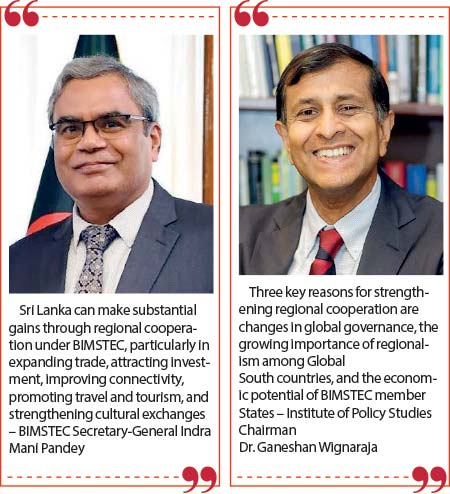
“Sri Lanka can make substantial gains through regional cooperation under BIMSTEC, particularly in expanding trade, attracting investment, improving connectivity, promoting travel and tourism, and strengthening cultural exchanges,” he said.
According to the Secretary-General, the BTTF being established in Sri Lanka will provide the country with access to technologies shared by other member States. Once fully functional, Sri Lanka will benefit from technology transfers on an equal footing with other members.
He said Sri Lanka was also playing a proactive role in BIMSTEC.
Pandey emphasised that BIMSTEC’s cooperation framework was based on the collective priorities of its seven member States, with each country having an equal role in determining the organisation’s direction.
“We all gain. All seven member states have an equal role in the organisation’s consensus-based decision-making process and can benefit from progress across all areas of regional cooperation,” he said.
Green economy and climate cooperation
Pandey also highlighted the progress made in developing cooperation on the green economy and climate-related issues.
Climate change-related cooperation, particularly disaster management and the maritime component of humanitarian assistance and disaster relief, was another important area.
He said the guidelines developed for maritime HADR cooperation would help relevant agencies work together when disasters occurred in maritime areas of the Bay of Bengal.
Such cooperation would enable member States to improve coordination and respond collectively to emergencies affecting the region.
He added that member countries believed they could benefit from progress made under BIMSTEC, irrespective of which country led a particular sector.
Proposed Convention to tackle human trafficking
Explaining BIMSTEC’s collaboration with the United Nations Office on Drugs and Crime (UNODC) on the proposed BIMSTEC Convention on Human Trafficking, Pandey said it would provide a legal framework for member States to work together more effectively.
“Human trafficking and other transnational crimes are important concerns for member states. These issues, including scam centres operating around the Myanmar–Thailand border, have also been discussed at meetings of National Security Advisers and Home Ministers,” he said.
The seven member States have opportunities to discuss common challenges, share their experiences and identify areas for joint action.
“Through these discussions, practical areas of cooperation can be incorporated into regional action plans and implemented collectively,” he pointed out.
Pandey highlighted both the opportunities available through BIMSTEC and the need for stronger commitment from member States to translate regional initiatives into practical results.
As he emphasised, the success of BIMSTEC ultimately depends on the willingness of its member States to invest in the organisation and actively implement the initiatives they have collectively agreed to pursue.
Meanwhile, he commended Sri Lanka’s chairmanship of BIMSTEC. During the period when former Ambassador Aryasinha served as Sri Lanka’s Foreign Secretary, the BIMSTEC Charter and rationalised areas of cooperation were negotiated and finalised in 2019–2020, and later adopted at the summit.
He noted that Sri Lanka had convened key sectoral meetings not only in the areas it leads but also in other sectors, and appreciated the country’s willingness to go beyond its own sectoral responsibilities.
He also commended the recently concluded 8th Meeting of the BIMSTEC Network of Policy Think Tanks, held in Colombo and coordinated by the Lakshman Kadirgamar Institute, in which the RCSS and several other Sri Lankan think tanks played an active role. He said wider consultation with think tanks would allow BIMSTEC to benefit from diverse insights.
Deeper regional integration
Offering a Sri Lankan economic perspective on regional cooperation, Institute of Policy Studies of Sri Lanka Chairman Dr. Ganeshan Wignaraja said the economic rationale for BIMSTEC remained compelling, particularly at a time of global economic uncertainty and the weakening of multilateral institutions.
He pointed to the challenges facing major multilateral institutions, including the World Trade Organisation (WTO), the World Bank and the International Monetary Fund (IMF), noting that the world was witnessing a structural shift in global governance.
“The second is the Global South, which includes all the BIMSTEC countries, are really looking to regionalism to foster cooperation, trade and also public goods,” he said, identifying regional cooperation as another important reason for strengthening BIMSTEC.
According to Dr. Wignaraja, three key reasons for strengthening regional cooperation are changes in global governance, the growing importance of regionalism among Global South countries, and the economic potential of BIMSTEC member States.
He noted that regional cooperation could help member States expand trade, strengthen economic partnerships and provide public goods.
He also identified several areas that could help advance this agenda, including developing regional supply chains, modernising the BIMSTEC Free Trade Area framework to address emerging areas such as e-commerce, intellectual property and artificial intelligence, and improving regional connectivity.
Dr. Wignaraja pointed out that intra-regional trade among BIMSTEC members remained at around 5–6% of their total trade, highlighting the scope for stronger economic links. He also stressed the need to identify and finance genuinely regional infrastructure projects, including roads and railways, rather than focusing solely on projects benefiting individual countries.




