Tuesday Sep 15, 2026
Tuesday Sep 15, 2026
Wednesday, 4 March 2026 00:40 - - {{hitsCtrl.values.hits}}
 By Tisaranee Gunasekara
Little girls died first. Over a hundred of them. Felled by a missile on a warm sunny morning. On the first day of Israel-America’s illegal war against Iran.
The Shajareh Tayyebeh elementary school in Minab was hit by an Israeli/American missile on 28 February. There were 170 students in the school that morning. 108 of them were killed, girls aged between seven and twelve. UNESCO condemned the massacre as ‘a grave violation of international humanitarian law’.
Perhaps the invasion of Venezuela and the capture of President Maduro constituted a dry run. Perhaps the Trump administration thought that decapitation would make the Iranian regime collapse or buckle down. The Iranian regime is tyrannical and murderous, but the Iranian state is neither weak nor brittle. As analysts have pointed out, the Islamic Revolution of 1978 did not upend the Iranian state. It captured the state and built on it. Over the last decade or so, the balance of power within has shifted from clerics to the Revolutionary Guard which reportedly owns about one third of the Iranian economy including such vital sectors as oil, gas, and construction. They are said to care more about strengthening Iranian nationalism than enforcing hijab rules.
Modern Iran is the successor to arguably the most successful empire in history, the Persian Empire, a pioneer state-builder, the first creator of a postal system and Royal Roads, among others. Iran is the 17th largest country in the world at 1,648,195 square kilometres with a population of 93 million. By contrast, Iraq is only 434,134 square kilometres with between 24 to 26 million in 2002. Most pertinently, for Netanyahu-Trump delusions about a speedy and relatively painless war, Saddam Hussain was a Sunni ruler in a predominantly Shia country while the Iranian regime governs in the name of the religion of over 90% of Iranians, Shia Islam. President Trump is talking about the possibility of boots on the ground. How many troops would be needed to pacify a country as massive, populous, and variegated like Iran? At what cost, to American troops and to Iranian civilians Netanyahu-Trump claims to want to liberate?
 The war is just 4 days old and global energy supply lines are already breaking down. Oil prices can go up as much as $200 a barrel, experts warn. What will the global economy and ordinary lives everywhere look like a month from now? Already, close to 60% of Americans oppose the war. What will happen when the war drags on, casualties mount, and less and less money is available for butter (social programmes) because defence spending has turned into a bottomless pit? What will Donald Trump do when his Imperial Alexandrian dreams of conquering Iran morph into a nightmare of unending conflict with an enemy he is not programmed to understand?
The real casus belli
Analysts have called the Israel-US war against Iran ‘senseless’ and ‘reckless’. The US-Iran nuclear talks were going well. On 27 February, Omani foreign minister, a key mediator, told the CBS that a peace deal was ‘within reach’ since Iran had agreed to ‘zero stockpiling, zero accumulation’ of nuclear fuel and to ‘full verification’ (https://www.cbsnews.com/news/full-transcript-omani-foreign-minister-badr-albusaidi/). Within hours of that announcement, Israel-US launched their murderous assault on Iran.
President Trump has no proper war plan or even a half-way credible justification for his illegal and unprovoked invasion of a sovereign country. The excuse offered, that Iran was about to rain missiles on US cities, is manifestly, laughably untrue. It is also a rehashing of a claim made by American broadcaster and key proponent of a war against Iran Mark Levin on Fox News - that Iran has nuclear tipped ICBMs aimed at Tel Aviv, Jerusalem, New York, Los Angelis, and Chicago!
The war makes no sense from a global, American or even Israeli point of view, but it does from the point of view of Binyamin Netanyahu and Donald Trump. On 2 March, Israeli paper Haaretz quoted a ‘minister close to Netanyahu’ saying, “As far as Netanyahu is concerned, the road to the polling stations runs through Washington and Tehran.” Mr Netanyahu also is facing three separate corruption cases. Last November, he made an official request for a presidential pardon. The president is yet to respond to it. Staying on as prime minister might be the only way he can evade a long jail sentence up to 10 years.
 Donald Trump has his own bag of woes. On 24 February, NPR reported that the US Justice Department has, in violation of a judicial order, withheld several Epstein files “related to allegations that President Trump sexually abused a minor.” The top Democrat on the congressional committee investigating the Epstein files as well as the Republican chairman of the House Oversight Committee have pledged to get to the bottom of the matter. That would be bad news for a president whose approval ratings are at a record-setting low. On 1 March, he reached -13.4 (-18.6 on the economy, -32.3 on inflation, -22.4 on trade, and -13.7 on his signature issue, immigration).
In January, in the reliably Republican/MAGA Texas, the Trump-supported Republican candidate lost a state election by a wide margin to a progressive Democrat. The incredible outcome indicates a 31point swing towards the Democrats compared to the 2024 presidential poll in this supposedly Forever-Trump state. If, as most analysts predict, the Democratic Party regains the Congress at the November mid-term polls, it will stymie President Trump’s agenda and make him vulnerable to new investigations, including his activities on Jeffery Epstein’s notorious plane and on his even more notorious island.
So a sharp, fast, victorious foreign war might have seemed like a lifesaver to the two beleaguered leaders. After all, George W Bush did win his second term on a wave of patriotic hysteria following the US invasion of Iraq. Binyamin Netanyahu would know all about it, because he was a key promoter of that disastrous war. “A war on Iraq is a good choice, the right choice…” he emphasised in his testimony before the US Congress on 12 September 2002. “A nuclear-armed Saddam would place the security of our entire world at risk… If you take out Saddam, Saddam’s regime, I guarantee you that it will have positive reverberations in the region” (https://www.vox.com/2015/2/26/8114221/netanyahu-iraq-2002). Reverberations indeed, from regional destabilisation and a refugee crisis to the birth of the murderous and antediluvian Islamic State IS), which beheaded Christian captives and roasted alive Islamic ones. Incidentally, the IS seems to be rising from its grave. After a hiatus of two years, its spokesman released a speech attacking Syria’s al-Ansari Government and calling the faithful to action. This was followed almost immediately by nine attacks on Syrian Government checkpoints including a gunfight in Raqqa which killed 4 Syrian soldiers. The Netanyahu-Trump war on Shia Iran might turn into a lifesaver for the Sunni-extremist IS.
In a recent interview with MS Now, former CIA director John Brennan said, “This is the second time in a century that the US made a drastically bad mistake in terms of engaging in a conflict in the Middle East. The first one was in 2003 when we invaded Iraq. That ushered in years and years of chaos and violence and terror… It is clear to me that Binyamin Netanyahu had long wanted this type of operation against Iran. He was able to bring Trump along… We could have said to the Israelis, You do not go forward because we are not going to help you… What is happening now is going to be with us for many, many years to come.”
Don’t do stupid stuff, was a constant refrain of the president who appointed Mr Brennan as director, CIA, Barack Obama. Stuff cannot get stupider than the Israeli-American invasion of Iran. The world has been plunged into an unending nightmare because two men wanted to cling to power and evade justice for their alleged wrongdoing.
Did the Rajapaksas, in their determination to regain power, do something equally criminal albeit not so stupid?
 Mastermind or enabler?
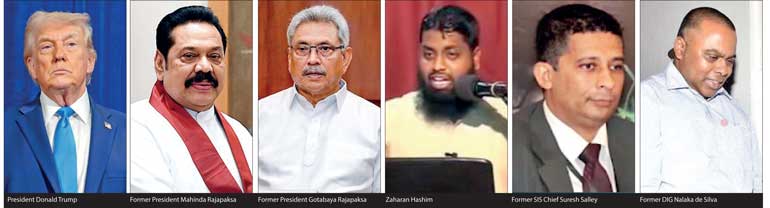
In September 2018, DIG Nalaka de Silva was arrested under the PTA. He was accused of planning to assassinate President Maithripala Sirisena and presidential-hopeful Gotabaya Rajapaksa.
DIG de Silva’s accuser was an unknown man, Namal Kumara, heading an equally unknown outfit, Dushana Virodi Balakaya (Anti-Corruption Brigade). Addressing the media, Namal Kumara claimed that the mastermind of the assassination plot was Prime Minister Ranil Wickremesinghe. He had no evidence, he admitted, he just knew.
The Rajapaksa-led Joint Opposition (JO) embraced the tale. Addressing a September 19th press conference, organised by Namal Kumara’s outfit, parliamentarian Mahindananda Aluthgamage accused DIG de Silva of planning the conspiracy with the IGP’s connivance. “These conspirators are in an attempt to favour Prime Minister Ranil Wickremesinghe. We thought that only the Rajapaksas have become victims, but at present President Sirisena’s life is also at stake,” (http://www.dailymirror.lk/print/breaking_news/We-lost-faith-in-Police-IGP-JO/108-155479). In 2023, the courts released Nalaka de Silva after the AG admitted a lack of sufficient evidence. The assassination-plot drama had two momentous consequences. One was the anti-constitutional coup of 26 October 2018. The assassination-plot tale addled Maithripala Sirisena’s mind and made his shift to the Rajapaksa camp final. It also helped the future Easter bomber Zaharan Hashim escape arrest. Nalaka de Silva had been overseeing the TID investigation into Zaharan Hashim. His arrest pushed the investigation onto a backburner, giving Zaharan Hashim some much-needed breathing space.
These TID investigations had revealed how the anti-Muslim hysteria unleashed by the BBS in 2012 created pockets of radicalisation within the Muslim community. “After the Digana incident they published a lot of posts against Sinhala-Buddhist extremism. And from our Research and Analysis units we could see that they got many comments and likes,” the then acting head of the TID Jagath Vishantha informed the parliamentary select committee on the Easter Attack. “Zaharan started a campaign to radicalise Muslim youth and motivate them to use violence to achieve their ends post March 2018 attacks on Muslims in Digana...” the select committee concluded. “He was able to recruit many by using that incident and the Aluthgama incidents of 2014 to embrace the Islamic State of Syria and Iraq ideology.”
After the total extermination of the LTTE, the Rajapaksas needed an enemy potent enough to justify their project of familial rule and dynastic succession. Neither the Undead Tiger nor Christian Conversion Threat worked. So the BBS unleashed a wave of anti-Muslim hysteria with their Halal campaign. That hysteria would lead to the Aluthgama riots of 2014.
Afterwards, political pressure was exerted to release 13 of the men who were arrested even as the police were about to take their statements. Kalutara DIG V Indran was told by “an advisor of the Defence Ministry and a high placed official of the state intelligence service” to release the suspects immediately. When the DIG refused, his superior DIG Gamini Navaratne (who had received a call from ‘a powerful minister’) did so (Sri Lanka Guardian – 22.6.2014).
In late 2015/early 2016, the Sinha Le Movement (Blood of the Lion) erupted onto the political scene. As lead-organiser Madille Pannaloka thero revealed during a 2020 interview with A5 News in 2020, when the movement was in the making, Gotabaya Rajapaksa took part in ‘lengthy discussions’ and provided them with ‘certain guidelines’. “For one and a half hours he taught us tricks,” the monk said.
 The Easter Sunday massacre was not inevitable. Had the Rajapaksas not unleashed the Muslim bogey in 2012 to stay in power and bolstered it in 2015-19 to regain power, that horror might not have happened. Even after the radicalisation was complete and the project was set in motion, it was preventable. Sri Lankan defence and intelligence authorities were provided detailed information about the coming disaster by foreign counterparts starting from 4 April 2019. In its report, the Parliamentary Select Committee pointed out that the SIS chief, MOD secretary, IGP, CNI, DMI “failed in their responsibilities. All were informed of the intelligence information prior to the Easter Sunday attacks but failed to take the necessary steps to mitigate or prevent it.” For example, head of the SIS Nilantha Jayawardane knew the names of several potential attackers: Mohamed Zaharan, Mohamed Milhan, and Mohamedu Rilwan by 21 April. Two days after the Massacre, Mahinda Rajapaksa told the parliament that his security officers had received the warning about the attack, but did not keep him in the loop. In its final report, the Parliamentary Select Committee wondered, “Whether those with vested interests did not act on intelligence so as to create chaos and instil fear and uncertainty in the country in the lead up to the presidential election.”
When the police came to the Dematagoda house of Ilham Ibrahim, the Shangri La bomber, his pregnant wife detonated a bomb, killing herself, her three children, and unborn baby. That horrendous deed is a testimony to the religious passion which motivated the bombers and some of their helpers. It also debunks the idea of a hidden Mastermind, a notion first made public by the Rajapaksa camp. But the possibility of a conspiracy of silence, even trusted enablers nudging true-believers away from certain targets towards others (such as from temples to churches) cannot be ruled out.
Did Suresh Salley play such a role? Was he the only one? On whose behalf did he act? Hopefully, the ongoing CID investigation will answer these and other related questions. If not, the Easter tragedy can be repeated, with different targets and different actors, but, ultimately, in the service of some fervid power dream. There’s nothing some leaders wouldn’t do for power, from butchering their own people to starting disastrous wars.




