Friday Mar 13, 2026
Friday Mar 13, 2026
Monday, 5 January 2026 02:43 - - {{hitsCtrl.values.hits}}
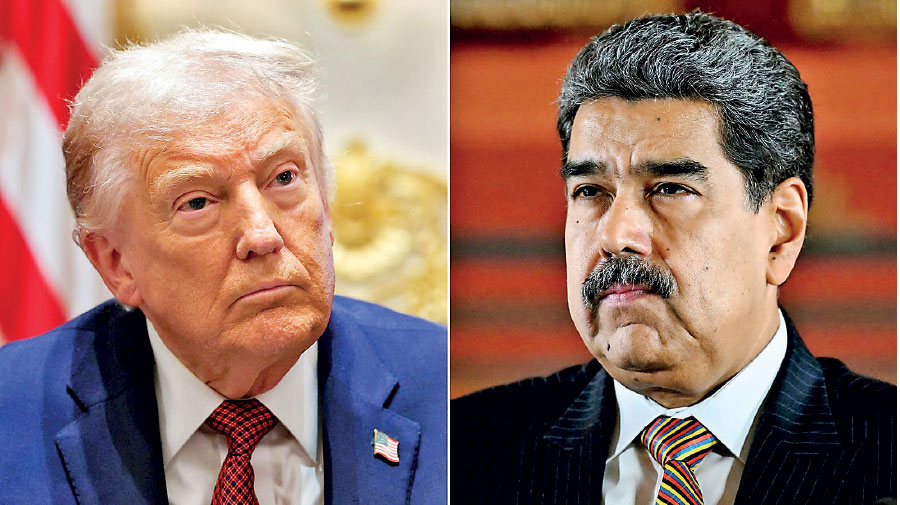
US President Donald Trump (left) and Venezuelan President Nicolás Maduro
 President Donald Trump’s address on 3 January announcing the “arrest” of Venezuelan President Nicolás Maduro marks one of the most consequential and controversial assertions of power in contemporary international relations. Whether framed as law enforcement, counter-narcotics action, or geopolitical signalling, the declaration has sent shockwaves through diplomatic and legal circles worldwide. Beyond Venezuela, the episode raises fundamental questions about head-of-state immunity, unilateral use of force, selective accountability, and the increasingly fragile foundations of the rules-based international order.
This is not merely a dispute between Washington and Caracas. It is a test case for how international law functions—or fails—when confronted by overwhelming power.
Trump’s address: Law, force, and political messaging
In his address, President Trump claimed that U.S. forces had captured President Nicolás Maduro and transported him to the United States to face charges relating to narcotics trafficking and terrorism. He justified the operation as a necessary act to protect American security, dismantle what he described as a “narco-state,” and deliver justice where international mechanisms had allegedly failed.
Trump went further, signalling that the United States would assume a temporary supervisory role in Venezuela during a political transition and indicated that American companies would play a role in rehabilitating Venezuela’s oil sector. The speech blended legal rhetoric with strategic messaging, presenting military action as both lawful and morally justified, while offering few references to multilateral authorisation or international legal processes.
The address was also unmistakably political. The language of arrest, justice, and strength echoed domestic campaign themes, reinforcing a long-standing narrative of decisive action against perceived adversaries. In doing so, it blurred the line between international law enforcement and unilateral coercion.
International law and the arrest of a sitting Head of State
At the core of the controversy lies a well-established principle of international law: immunity ratione personae (personal immunity while in office). Sitting heads of state enjoy absolute immunity from arrest and prosecution by foreign national courts while in office. This immunity is functional rather than personal, designed to uphold sovereign equality and ensure the orderly conduct of international relations.
The International Court of Justice, in its 2002 Arrest Warrant judgment, affirmed that even allegations of serious international crimes do not nullify such immunity before domestic courts of another state. The only recognised exception arises in proceedings before competent international tribunals.
The International Criminal Court may issue arrest warrants against sitting leaders for genocide, crimes against humanity, or war crimes, but only within the strict confines of its jurisdiction and subject to state cooperation. Venezuela is not a party to the Rome Statute, and no ICC warrant existed against Maduro at the time of Trump’s announcement.
In this context, a unilateral declaration of arrest by a foreign leader lacks standing under international law. Without Security Council authorisation or an international judicial mandate, such action sits uneasily with the UN Charter’s prohibition on the use of force.
Why Maduro? Selective accountability and strategic interests
The allegations against Maduro—ranging from narcotics trafficking to human rights abuses—are not new. The United States has pursued domestic indictments and imposed extensive sanctions on Venezuela’s leadership for years. However, domestic legal processes do not confer international enforcement authority.
The decision to act against Maduro must therefore be understood not only through a legal lens but also a geopolitical one. Venezuela’s strategic location, vast oil reserves, and long-standing defiance of U.S. influence have made it a persistent target of pressure. The framing of military action as law enforcement reflects a broader trend in which legal language is used to legitimise strategic objectives.
This selectivity has consequences. When accountability appears to be pursued primarily against adversaries, rather than through consistent multilateral processes, it undermines confidence in international justice.
Global reactions: A fractured international response
The international response to Trump’s announcement has been sharply divided, exposing deep fissures in global attitudes toward sovereignty and intervention.
China condemned the action as a violation of Venezuela’s sovereignty and international law, warning that unilateral military interventions threaten global stability. Russia described the move as armed aggression and called for urgent deliberation at the UN Security Council.
The European Union expressed deep concern, urging restraint and emphasising that any resolution of Venezuela’s crisis must be grounded in diplomacy and respect for the UN Charter. The United Kingdom distanced itself from the operation, stressing that it was not involved and reaffirming the primacy of international legal norms.
India, reflecting its long-standing emphasis on sovereignty and non-intervention, called for de-escalation, protection of civilians, and resolution through dialogue. Across Latin America, reactions ranged from outright condemnation to cautious endorsement, underscoring regional divisions.
The United Nations and the question of precedent
The United Nations Secretary-General António Guterres warned that the action set a “dangerous precedent,” reiterating that the use of force is permissible only in self-defence or with Security Council authorisation. Calls for an emergency Security Council meeting reflected widespread unease that unilateral enforcement actions risk eroding the foundations of international order.
The UN’s response highlighted a central dilemma: accountability is essential, but it must be pursued through institutions that command legitimacy across regions and power blocs. When states bypass those institutions, the authority of international law itself is weakened.
Comparative cases: Putin and Netanyahu
The Maduro episode gains sharper clarity when viewed alongside other contemporary cases.
In 2023, the ICC issued an arrest warrant for Russian President Vladimir Putin over alleged war crimes in Ukraine. While legally significant, the warrant has had limited practical effect due to Russia’s geopolitical weight and non-membership in the ICC. Law exists, but enforcement remains constrained by power.
Similarly, debates surrounding potential ICC scrutiny of Israeli leaders, including Prime Minister Benjamin Netanyahu, have exposed discomfort among Western states when legal accountability approaches their allies. These contrasting reactions reinforce perceptions of selective justice, particularly in the Global South.
Universal jurisdiction and the Sri Lankan experience
Sri Lanka has, at various times, seen individual former officials become the subject of attempted legal actions or civil complaints in foreign jurisdictions invoking universal jurisdiction, particularly in parts of Europe and the United States—though none have resulted in criminal convictions. These episodes, which included preliminary inquiries, arrest applications, and civil liability suits, were ultimately constrained by diplomatic immunity, prosecutorial discretion, or jurisdictional limits.
Nevertheless, they triggered intense domestic debate over sovereignty, legal asymmetry, and the perceived selectivity with which international justice mechanisms are applied to states outside major power blocs. If powerful countries can wield their military might while simultaneously claiming legal mandates, the spectre of legal overreach looms larger for all—making the protection of multilateral legal norms all the more urgent for countries like Sri Lanka, which depend on predictable rules rather than discretionary power for their security and international standing.
From rules to power: Implications for the global order
The Trump–Maduro episode illustrates a broader drift from rules-based multilateralism toward power-centred unilateralism. When arrest rhetoric replaces judicial process and forces substitutes for consensus, international law risks becoming a language of convenience rather than a binding framework.
For small and middle powers, this shift is particularly unsettling. International law, however imperfect, provides predictability and restraint. Its erosion leaves weaker states more vulnerable to coercion and
instability.
Conclusion: Accountability without anarchy
The issue at stake is not whether leaders accused of grave crimes should be held accountable—they should. The real question is how that accountability is pursued. Justice that bypasses multilateral processes may deliver short-term political satisfaction, but it weakens the very legal order needed to sustain long-term global stability.
If arrest warrants become political instruments rather than legal outcomes, the world risks sliding from an imperfect rules-based system into one governed by raw power. For the Global South, and for countries like Sri Lanka, that is a future worth resisting.
(The author is a Retired Ambassador)
References
International Court of Justice, Arrest Warrant of 11 April 2000 (Democratic Republic of the Congo v. Belgium), Judgment, 14 February 2002.
United Nations Charter, Article 2(4); Statement by UN Secretary-General António Guterres on Venezuela, January 2026.
Rome Statute of the International Criminal Court, 1998.
International Criminal Court, Situation in Ukraine, Arrest Warrant against Vladimir Putin, 2023.
Amnesty International, Universal Jurisdiction: The Duty of States to Enact and Implement Legislation (London: Amnesty International, 2001).
International Commission of Jurists, Universal Jurisdiction in Europe: The State of the Art (Geneva: ICJ, 2015).




