Monday Oct 12, 2026
Monday Oct 12, 2026
Thursday, 14 May 2026 00:00 - - {{hitsCtrl.values.hits}}
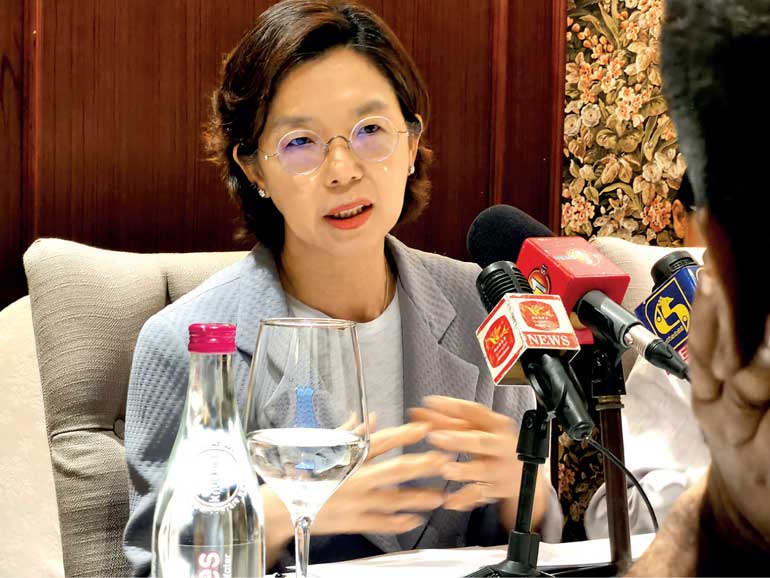
Republic of Korea Ambassador Miyon Lee
Pathfinder Foundation hosted the Ambassador of the Republic of Korea, Miyon Lee, who highlighted Korea’s remarkable transformation from a war-devastated nation into one of the world’s leading economies and a global cultural powerhouse.
Titled “Pop goes Korea: Public diplomacy and the making of the K-initiative”, the discussion focused on the roles of public diplomacy, democratic development, economic transformation, and global integration in shaping modern Korea and the global success of the “K-Wave”.
Opening the session, Pathfinder Foundation Chairman Bernard Goonetilleke, noted that public diplomacy became the third pillar of Korea’s diplomatic strategy in 2013, alongside political and economic diplomacy. He reflected on Korea’s extraordinary economic journey—from a per capita income of less than $100 in the 1950s to approximately $36,000 today, making it the world’s 13th-largest economy. Drawing comparisons with Sri Lanka’s development path, he emphasised the importance of learning from Korea’s development trajectory.
Ambassador Lee, who has served in Sri Lanka since June 2023, explained that the roundtable theme was chosen in response to growing interest in Korean culture and the global rise of Korean entertainment. She described how the Korean Wave, originally identified by Chinese media, spread from Asia to the rest of the world through cultural exports such as K-dramas, K-pop hits like “Gangnam Style,” and BTS.
 The Ambassador outlined three key pillars behind Korea’s success: Democratisation, Economic Transformation and Global Integration. She explained that the 1997 Asian Financial Crisis became a turning point that accelerated industrial restructuring and encouraged investment in the cultural industry as the new engine of economic growth with legislative reforms and strategic support helping to build globally competitive entertainment companies and creative industries. She also emphasised the importance of digitalisation, national branding, and institutional support for public diplomacy, highlighting the 2016 Public Diplomacy Act, which formalised Korea’s efforts to strengthen international engagement through cultural, intellectual, and policy exchanges. Korean cultural programs in Sri Lanka—including K-pop contests, Taekwondo championships, cultural festivals, and educational exchanges—were highlighted as examples of these initiatives in action.
The Ambassador further noted that Korea’s current “K-Initiative” public diplomacy strategy aims to position Korea as a responsible global “smart power” by combining democratic values, technological innovation, and cultural influence. Concluding the session, the Ambassador reaffirmed Korea’s commitment to strengthening cooperation with Sri Lanka through partnerships among government institutions, businesses, and people-to-people exchanges. She expressed appreciation for Sri Lanka’s friendship and emphasised the importance of continued collaboration for shared prosperity and regional peace.
During the interactive Q&A session, participants engaged the Ambassador on a wide range of topics, including Korea’s development trajectory, globalisation, governance, trade policy, investment, security, reconciliation, and digital transformation.
Responding to a question on Korea’s decisive development path in the 1960s, the Ambassador explained that the Korean War and the continued security threat from North Korea created a strong national sense of urgency. Since Korea lacked natural resources and foreign currency, making export-led industrialisation was essential for survival. She noted that strong state-led economic planning, close coordination with the private sector, and a national determination to overcome poverty shaped Korea’s long-term development strategy.
On globalisation and trade liberalisation, participants observed that Korea’s rise coincided with an era of expanding global trade, while today’s international environment is increasingly fragmented. The Ambassador acknowledged the challenges posed by geopolitical tensions, supply chain disruptions, and changing trade dynamics, but stressed that open economic policies, trade agreements, and investment facilitation remain essential. She highlighted Korea’s continued commitment to free trade agreements (FTAs), regional cooperation, and supply chain resilience, while emphasising the importance of upgrading domestic trade and investment regimes.
Questions on governance and political stability focused on how Korea maintained policy continuity across changing administrations. The Ambassador explained that while successive governments introduce new priorities, long-term policy direction is maintained through strong institutions, political party think tanks, detailed election manifestos, structured five-year national plans, and public accountability whilst annual implementation reviews and legislative reforms ensure continuity and adaptability. Participants also discussed the role of democracy and civic engagement in Korea’s development. The Ambassador emphasised the importance of an active opposition, free media, public participation, and independent institutions in strengthening accountability and democratic resilience.
Several questions focused on Sri Lanka–Korea economic cooperation and foreign direct investment (FDI). The Ambassador recalled that Korean companies had invested significantly in Sri Lanka during the 1980s but later shifted to markets offering larger export opportunities and stronger incentives. She encouraged Sri Lanka to improve trade facilitation, streamline bureaucratic processes, modernise customs and investment regulations, and clearly identify priority sectors such as tourism, digital infrastructure, logistics, and technology. She stressed the importance of building a strong national brand and creating investor confidence through policy consistency and transparency. The Ambassador noted that while direct trade between Korea and Sri Lanka remains limited, both countries already cooperate under the Asia-Pacific Trade Agreement (APTA). She encouraged Sri Lanka to pursue broader regional integration initiatives, including participation in regional trade frameworks, while strengthening domestic trade governance and investment standards. Participants also raised concerns regarding Sri Lankan workers in Korea and allegations of irregularities in recruitment processes. The Ambassador reaffirmed Korea’s strong commitment to protecting migrant workers’ rights and ensuring equal treatment under Korean labour laws.
Security issues relating to the Korean Peninsula and changing global security dynamics were also discussed. Questions on reconciliation and transitional justice prompted the Ambassador to reflect on Korea’s own experience addressing historical grievances stemming from colonial rule, the Korean War, authoritarianism, and political repression. She encouraged Sri Lanka to pursue reconciliation through both political commitment and balanced regional economic development. The discussion also explored innovation, intellectual property rights (IPR), and support for youth entrepreneurship. The Ambassador stressed that strong IPR protections are critical for fostering creativity and protecting cultural and technological innovation. She noted that Korea’s government actively supports startups, digital platforms, and young entrepreneurs through funding programs and innovation ecosystems designed to encourage experimentation and long-term growth.
Concluding the session, participants expressed appreciation for the Ambassador’s candid insights into Korea’s development experience and its relevance for Sri Lanka’s future economic and institutional transformation. The Pathfinder Foundation hosts regular roundtable discussions with Heads of Mission based in Colombo.




