Friday Mar 13, 2026
Friday Mar 13, 2026
Tuesday, 24 February 2026 01:04 - - {{hitsCtrl.values.hits}}
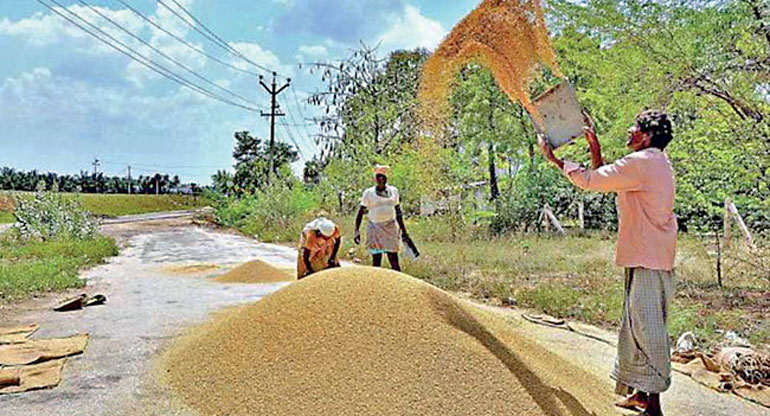
A civilisation built on agricultural mastery
 Sri Lanka is not a nation that lacks agricultural pedigree. We are a civilisation shaped by irrigation engineering, water management systems, and disciplined cultivation practices that predate modern economic theory.
From the reservoirs of Anuradhapura to the fertile plains across the island, agriculture was once not merely an industry — it was statecraft.
Yet in contemporary economic planning, agriculture has too often been treated as peripheral rather than strategic. Policy inconsistency, regulatory volatility, and short-term fiscal thinking weakened what should have remained a national competitive advantage.
The issue was never land.
The issue was never farmer capability.
The issue has been execution and policy continuity.
The policy gap and import dependence
For decades, successive administrations approached agriculture through fragmented initiatives rather than structured long-term strategy. Import-heavy economic models frequently appeared easier than building resilient domestic production ecosystems.
Such an approach may provide temporary fiscal breathing space, but it weakens self-sufficiency and rural confidence. Agriculture cannot be managed politically in five-year cycles. It requires industrial planning measured in decades.
Sri Lanka’s fertile soil and diverse agro-climatic zones remain under-leveraged assets. The private sector has demonstrated what is possible when agriculture is treated as serious enterprise rather than subsistence activity.
Proof that scale and discipline deliver results
Entrepreneurs such as Dudley Sirisena, Chairman of Araliya Rice, and the leadership behind Ratna Group have shown that agriculture can be structured as scalable industry.
Through vertical integration, industrial-scale processing, logistics infrastructure, farmer network development, brand positioning, and disciplined execution, they built enterprises with national impact.
Their visible success — including ownership of Rolls-Royce vehicles, helicopters, and private jets — should not be viewed cynically.
Sri Lankans should take pride when local entrepreneurs achieve global standards of wealth creation.
This is not power projection.
It is proof of possibility.
When wealth is generated transparently through enterprise and reinvested into families, employment creation, and broader economic ecosystems, it signals economic maturity.
From Individual Success to National Transformation
However, isolated entrepreneurial excellence cannot substitute for national policy alignment.
If Sri Lanka is serious about long-term economic transformation, agriculture must move from rhetorical support to structured industrial prioritisation.
This requires:
 Ten-year policy stability with bipartisan commitment
Predictable regulatory frameworks
Structured agricultural financing models through state and private banks
Mechanisation and agri-technology integration
Export-oriented value addition strategies
Incentives for youth agribusiness entrepreneurship
Agriculture must transition from survival politics to industrial strategy.
Governance, global funding, and sustainability
International development funding — including grants and facilities from the World Bank and the Asian Development Bank (ADB) — must be deployed with disciplined governance.
External financing should not merely enable isolated wealth accumulation.
It must build:
Sustainable production ecosystems
Strategic national food security buffers
A resilient future food reserve framework for Sri Lanka
Competitive export platforms in regional and global markets
Good governance, transparency, and measurable impact must underpin every agricultural reform initiative supported by multilateral funding.
Development capital is most effective when it builds systems — not personalities.
A direct call to the sitting Government
The responsibility now rests squarely with the present administration.
Sri Lanka does not need another short-term agricultural programme designed to satisfy immediate political cycles. It requires disciplined, bipartisan, long-horizon reform anchored in measurable outcomes.
The sitting Government must recognise that agriculture is not a welfare sector — it is a strategic economic engine.
Policy must move beyond slogans and temporary subsidy adjustments. It must deliver:
Guaranteed policy stability for a minimum of 10 years
Clear national production targets
Structured agri-financing with accountability
Technology-driven productivity benchmarks
Transparent and performance-based deployment of World Bank and ADB funding
Export-oriented value chain development
Multilateral grants and facilities must not become passive fiscal support mechanisms. They must be governed with transparency and institutional accountability to ensure they build sustainable production systems — not short-lived headlines.
Sri Lanka must aim not only to create successful entrepreneurs, but to build a resilient national food bank, ensure long-term food security, and position itself as a competitive agricultural exporter.
The private sector has demonstrated what disciplined execution can achieve.
The land is ready.
The capability exists.
The policy moment is now.
Agriculture cannot wait for another cycle.
It requires decisive reform — now.




