Tuesday Aug 25, 2026
Tuesday Aug 25, 2026
Tuesday, 25 August 2026 05:59 - - {{hitsCtrl.values.hits}}

 A half-century of recurring current-account weakness suggests that Sri Lanka's external constraint is not merely a crisis-management problem. The country must protect and grow its traditional foreign-exchange earners while systematically opening new pathways that make a measurable net contribution to the national FX position.
Sri Lanka's current account is back in the news. After recording surpluses in 2023, 2024 and 2025, the balance moved into a cumulative deficit of about $ 245 million in the first half of 2026. That does not undo the progress made since the 2022 crisis. But it revives a question that is much older than the latest monthly numbers.
Why does Sri Lanka's external position so easily return to stress?
I ask this as a manufacturer who has spent four decades earning foreign exchange and paying for imported inputs, not as an economist. From that seat, the pattern is hard to miss.
For decades we have discussed debt, reserves, exchange rates, import controls, export promotion, tourism, foreign investment and IMF programs as separate subjects. Yet beneath many of them sits a recurring national constraint: the economy has repeatedly needed more foreign currency than its productive and service-earning base could comfortably generate.
That does not make the current account the sole root cause of Sri Lanka's economic difficulties. A current-account balance is an accounting outcome, not a moral score. Deficits can be entirely sensible when they finance productive investment that builds future earning capacity. Nor should fiscal, monetary, governance and debt-management failures be reduced to one external-sector indicator.
But a pattern that persists for half a century deserves more than routine management.
Pattern too persistent to ignore
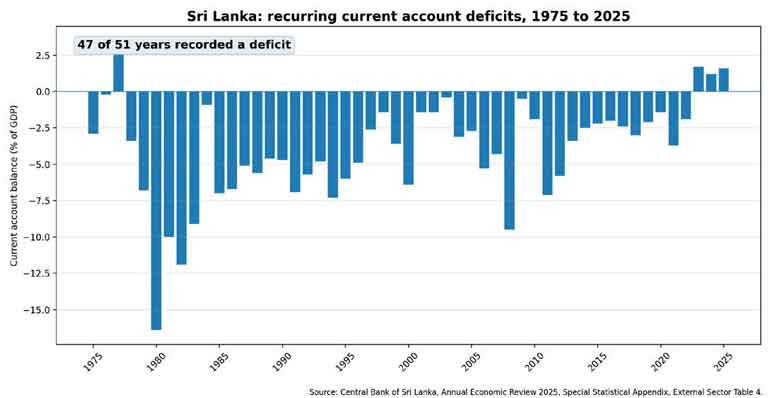
The Central Bank of Sri Lanka's own historical series shows that Sri Lanka recorded a current-account deficit in 47 of the 51 years from 1975 to 2025. The only surplus years were 1977, 2023, 2024 and 2025.
The exceptional deficits of the early 1980s should not be read as evidence of one simple policy failure. The post-1977 liberalisation released pent-up import demand, a major public-investment program sharply raised imports, and the second global oil shock worsened Sri Lanka's terms of trade. The current-account deficit reached 16.4% of GDP in 1980 and remained exceptionally high in 1981 and 1982.
That is precisely why no single year should carry the argument. The more important evidence is that, after those extraordinary circumstances passed, the economy kept returning to external deficits under different governments, exchange-rate regimes, development strategies and global conditions.
Instead of asking only, 'How do we finance the external gap this year?', we should also ask, 'Why has the economy not generated a sufficiently broad and resilient portfolio of net foreign-currency earning pathways over several generations?'
Figure 1. Sri Lanka: current-account balance as a share of GDP, 1975 to 2025. Source: CBSL Annual Economic Review 2025, Special Statistical Appendix, External Sector Table 4.
Financing gap is not the same as fixing it
Sri Lanka was able to live with recurring external deficits because financing was available in different forms at different times. Concessional borrowing, bilateral and multilateral finance, foreign investment, other capital inflows, reserve drawdowns and, later, international sovereign bonds all helped bridge external financing needs.
These inflows were not inherently undesirable. Many financed valuable infrastructure, development and private investment. Trouble begins when it becomes easier to borrow foreign currency than to plan and earn it, and the country stops building its own earning power.
A country can finance an external imbalance for years without transforming the structure that produces it. As long as lenders are willing, reserves are adequate and external liquidity is available, the underlying constraint can remain manageable. When financing conditions tighten, confidence falls or reserves are depleted, the same weakness can become a crisis.
What 2022 exposed
Sri Lanka's 2022 crisis had many causes. Major fiscal and monetary policy errors, tax reductions, the loss of tourism during the pandemic, global commodity shocks, exchange-rate policy, weak reserves and an unsustainable debt structure all played roles.
It would therefore be simplistic to describe 2022 merely as a current-account crisis. But the exhaustion of usable foreign exchange and the loss of access to external financing converted accumulated weaknesses into an immediate national emergency. Sri Lanka could no longer obtain enough foreign currency to meet essential imports and debt obligations through the mechanisms on which it had previously relied. Ordinary families felt it in the fuel queues, the gas shortages and the pharmacy shelves, long before they read it in a balance-of-payments table.
The lesson should not only be that Sri Lanka must never again lose control of reserves or debt. The deeper lesson is that the country must build a much larger, more diversified and more resilient capacity to generate foreign currency.
Recent surpluses are progress, not proof of transformation
The return to current-account surpluses after the crisis is a significant achievement. The CBSL estimates the 2025 surplus at about $ 1.7 billion, equivalent to 1.6% of GDP. Strong remittances and services inflows were important supports, even as the merchandise trade deficit widened.
The first half of 2026 nevertheless produced a cumulative current-account deficit of about $ 245 million. Remittances remained strong. But higher fuel import costs linked to the conflict in the Middle East, a full year of normal vehicle imports after restrictions were lifted, and weaker tourism and services earnings were together enough to turn the balance. It is worth pausing on that. One regional conflict and one year of ordinary vehicle imports were sufficient to reverse three years of surplus. That says less about 2026 than it does about how thin the earning base beneath those surpluses still is.
The point is not that Sri Lanka has returned to crisis. It is that the external account can still change direction quickly. A few surplus years are welcome evidence of improvement, but not sufficient evidence that the underlying FX-earning structure has been transformed.
Liabilities still have to be serviced
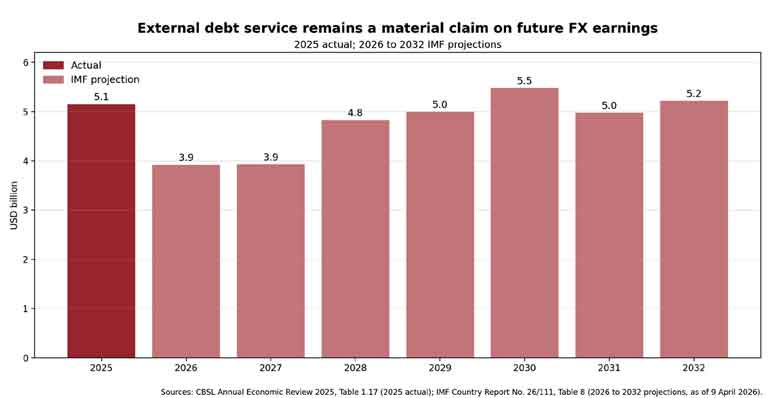
The claims on future foreign-currency earnings also remain substantial. CBSL data show total external debt-service payments of about $ 5.1 billion in 2025. IMF projections, on the assumptions embedded in the current program and debt restructuring, keep annual external debt service in the broad range of roughly $ 3.9 billion to $ 5.5 billion through 2032.
Debt restructuring has made the burden more manageable. It has not removed the need to earn the foreign currency with which those obligations must ultimately be serviced.
This is where the old method breaks down. For decades, when a repayment fell due, the answer was to borrow again. That is what the restructuring was needed to undo, and lenders will not allow it to be repeated on the same terms. The four to five billion dollars a year shown in the chart cannot be rolled over the way they once were. They have to be earned, year after year, on top of what the country needs for fuel, medicine, food and the imports its industries run on. Borrowing to repay borrowing is not a plan. It is the road that led to 2022.
That gives Sri Lanka a practical reason to think beyond recovery. The country needs not only enough FX to avoid another shortage, but an expanding margin of external earning capacity that can support growth, investment, imports and debt service at the same time.
Figure 2. External debt service remains a material claim on future foreign-currency earnings. 2025 actual; 2026 to 2032 IMF projections.
Are the traditional pathways enough?
Sri Lanka should continue to push its established FX pathways aggressively: merchandise exports, tourism, logistics, IT and business-process services, professional services, higher-value agriculture, maritime activity, foreign investment and remittances. These are national strengths, and there is considerable scope to improve their productivity and value addition.
The question is not whether these pathways matter. They unquestionably do. The question is whether relying predominantly on the same portfolio will be enough to create the scale, diversity and resilience of net FX earnings required for Sri Lanka's next stage of development.
Five decades of recurring external imbalance suggest that this question deserves a serious answer.
Measure what actually stays with the country
We may also need an additional decision lens. Policy discussion often celebrates gross export earnings, gross tourism receipts or the headline dollar value of an investment. Those numbers matter, but they do not always tell us how much foreign currency an activity ultimately adds to Sri Lanka's external position.
Alongside conventional balance-of-payments measures, policymakers could therefore examine Net Foreign Currency Contribution, or NFCC: how much foreign currency an activity actually adds to, or saves for, Sri Lanka after accounting for the foreign currency it consumes or causes to flow out.
A simple example makes the point. A garment export worth one million dollars may carry five hundred thousand dollars of imported fabric, trims and accessories inside it. A software export of the same value may carry almost none. Both appear as one million dollars in the export statistics. Their contribution to the country's foreign-exchange position is very different.
NFCC is not proposed as a replacement for established statistics. It is a practical screening lens. Thinking in these terms would encourage Sri Lanka to prioritise opportunities that genuinely strengthen the national FX position rather than merely produce an impressive gross number.
National FX Pathway Accelerator
If the diagnosis is accepted, a further question follows: who is responsible for continuously discovering and activating new FX pathways?
Sri Lanka already has capable institutions with defined mandates, among them the Treasury, CBSL, EDB, BOI, SLTDA and the line ministries. The missing element may not be another institution with another broad mandate. It may be a mechanism that works across those mandates.
A National FX Pathway Accelerator could be designed for that purpose. It need not be another ministry, large bureaucracy or funding agency. Its role could be narrower and more practical: continuously identify potentially scalable FX-earning or FX-saving opportunities; assess their expected NFCC; identify the regulatory, infrastructure, market-access or coordination barriers holding them back; connect the relevant public and private actors; push viable pathways through defined decision gates; and measure the realised FX contribution after implementation.
The emphasis should be on pathways, not projects alone. Opportunities may come from existing industries changing business models, or from technology, the diaspora, new professional services, logistics, intellectual property, specialised manufacturing, regional value chains and areas nobody has yet counted as FX earners.
Importantly, the mechanism should be open to ideas from outside formal authority. Businesses, professionals, researchers, universities, diaspora networks, public servants and citizens may see opportunities that do not naturally originate within an institutional mandate. Valuable national ideas should be judged by evidence, integrity and potential contribution, not by the title of the person who first identifies them.
A country with decades of recurring external deficits needs a deliberate national capability for FX creation: protecting what already works, improving the net contribution of established sectors, and relentlessly searching for additional pathways. The historical record is not an argument for pessimism. It is an argument for changing the question. Instead of asking only how Sri Lanka can finance its next foreign-exchange requirement, we should increasingly ask how many new, sustainable and measurable sources of net foreign currency we can create
Properly designed, such an accelerator would not weaken existing institutions. It would help them work together on opportunities that otherwise fall between institutional boundaries.
From FX management to FX creation
Sri Lanka has become considerably better at discussing how foreign exchange should be managed. Reserve adequacy, debt sustainability, exchange-rate flexibility and fiscal discipline are now central to national economic debate, and rightly so. Even the compulsory conversion of export proceeds, still a live grievance among exporters, is at heart a rule about managing the dollars that already come in, not about bringing in more.
But management alone cannot be the destination.
A country with decades of recurring external deficits needs a deliberate national capability for FX creation: protecting what already works, improving the net contribution of established sectors, and relentlessly searching for additional pathways.
The historical record is not an argument for pessimism. It is an argument for changing the question. Instead of asking only how Sri Lanka can finance its next foreign-exchange requirement, we should increasingly ask how many new, sustainable and measurable sources of net foreign currency we can create.
For forty seven of the last 51 years, Sri Lanka managed its way through a shortage it never set out to cure. The next generation will judge us by one thing: whether we kept managing, or finally learned to earn.
(The author is Founder and Chairman of the KIK Group of Companies, an export-oriented engineering and switchgear manufacturer and a Presidential Export Award winner, and serves on the Executive Committee of the Free Trade Zone Manufacturers' Association of Sri Lanka. The views expressed are his own)



