Thursday Mar 26, 2026
Thursday Mar 26, 2026
Wednesday, 10 December 2025 01:55 - - {{hitsCtrl.values.hits}}
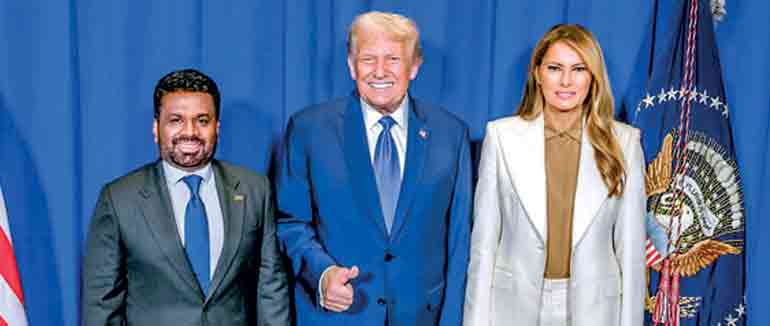
President Anura Kumara Dissanayake poses for the traditional photograph with US President Donald Trump and First Lady Melania Trump upon arriving for the dinner reception hosted by the US President for world leaders at the Lotte New York Palace Hotel in September - File photo
 Sri Lanka is currently navigating a complex international trade environment shaped by the imposition of new US tariffs on a range of imported goods. These developments have intensified domestic discussions about the potential “softening” of trade terms as the country must simultaneously prepare for possible secondary tariffs on raw materials critical to key export sectors. The challenge for Sri Lanka lies not only in mitigating the immediate economic disruptions caused by these measures but also in leveraging the situation strategically to enhance long-term trade resilience and competitiveness.
Multifaceted strategic leveraging
Strategic leverage in this context requires a multifaceted approach. Strengthening domestic preparedness is essential, including robust institutional frameworks, effective regulatory systems, and enhanced fiscal governance. Clear articulation of trade objectives allows policymakers to prioritise sectors where Sri Lanka can maximise gains while minimising exposure to risks. Adaptive policy measures, guided by a realistic understanding of US policy behavior, judicious use of predictability, and robust domestic readiness, form the essential pillars for navigating future trade negotiations and international economic pressures effectively. By aligning domestic capabilities with global opportunities, Sri Lanka can position itself to respond proactively rather than reactively to shifts in the global trade landscape.
The Organisation for Economic Co-operation and Development’s (OECD) Economic Outlook, Interim Report of September 2025, underscores the duality of the global economy, describing it as navigating a “two-way track” between expansionary impulses and structural constraints. In the United States, targeted investment in artificial intelligence, including the development of data centers and advanced technological infrastructure, has catalysed domestic economic dynamism. In other regions, expansive fiscal policies have mitigated the negative impacts of trade barriers and housing market vulnerabilities. Against this backdrop, the US has imposed tariffs on imports from multiple countries to protect domestic industries and reshape global supply chains, influencing trade flows and introducing uncertainty into international markets. For smaller economies such as Sri Lanka, understanding these developments is crucial to accurately assessing both the risks and opportunities arising from evolving trade dynamics.
In the United States, targeted investment in artificial intelligence has catalysed domestic economic dynamism
While OECD conclusions are primarily informed by the experiences of high-income countries and therefore may not seamlessly translate to the Sri Lankan context, the Organisation remains an invaluable platform for dialogue, analytical insights, and policy benchmarking. Engagement with OECD studies can support strategic modernisation of domestic policies, strengthen fiscal governance, and enhance international credibility. Thoughtful adjustments to tariffs or securing preferential access could facilitate entry into high-growth sectors; however, policymakers must carefully evaluate potential risks, including retaliatory tariffs on essential raw materials. Consequently, trade diversification, adaptive supply chains, and robust macroeconomic planning should serve as the foundation of Sri Lanka’s trade strategy, ensuring it is both opportunistic and resilient, attuned to the bifurcated contours of the contemporary global economy.
Effects of US tariffs
Despite the short-term disruptions and higher costs faced by US consumers, the American economy has remained resilient, supported by robust growth, rising consumer spending, and stable employment trends. Nevertheless, the ripple effects of US tariffs have been significant globally, prompting realignment in import flows, supply chain adjustments, and heightened market uncertainty. While investor sentiment remains generally positive, emerging markets continue to face pressures from changing demand patterns, commodity price fluctuations, and evolving trade policies. For Sri Lanka, these developments present a dual challenge: navigating the risks posed by tariff-induced disruptions while simultaneously seizing new opportunities created by shifts in global trade flows.
Government policies should aim to enable informed decision-making by private sector actors, fostering resilient choices that collectively strengthen national economic stability
One such opportunity arises from the potential redirection of trade away from major exporters such as China and India toward smaller economies. US tariffs may create openings for Sri Lanka to expand its exports in sectors such as apparel, tea, and rubber. At the same time, higher costs for imported raw materials could increase domestic production expenses, emphasising the importance of strategic planning and fiscal preparedness. In this context, trade diversification emerges as a critical tool, allowing Sri Lanka to reduce dependency on a limited number of trading partners and enhance resilience against global shocks.
Economic diversification, both in terms of products and markets, is widely recognised as a mechanism for building resilience. Empirical studies indicate that economies with a broader and more varied economic base demonstrate greater flexibility during crises and are better able to absorb sector-specific or nationwide shocks. While specialisation offers efficiency advantages, a balanced approach that promotes both diversification and strategic specialisation enhances long-term resilience without undermining comparative advantages. For Sri Lanka, this translates into the need to emphasise economic diversification at a regional and national level while leveraging smart specialisation in key sectors.
US trade measures present both risks and opportunities for Sri Lanka. By combining strategic trade planning, diversification, strong domestic frameworks, and adherence to international standards, the country can navigate global shocks, seize emerging opportunities, and enhance long-term economic resilience in an increasingly complex and interconnected world
Human capital development, industrialisation, and urbanisation are key factors that influence resilience, with more developed regions often showing higher vulnerability to shocks, while investment in skills and knowledge consistently enhances economic performance. Government policies should therefore aim to enable informed decision-making by private sector actors, fostering resilient choices that collectively strengthen national economic stability.
The need for domestic preparedness for service sector liberalisation
Service sector liberalisation under the General Agreement on Trade in Services (GATS) presents additional considerations. While GATS offers a structured framework for expanding service exports such as IT, tourism, and professional services, unilateral US tariffs introduce uncertainty that may limit market access and diminish the benefits of liberalisation. In this context, strong domestic preparedness, including effective regulatory frameworks and institutional capacity, is essential to ensure that Sri Lanka can respond strategically, protect market opportunities, and maintain credibility with trading partners. By adhering to rules-based frameworks, Sri Lanka can enhance market access, reduce the risk of trade disputes, attract investment, and promote fair competition, all while safeguarding against arbitrary or
discriminatory measures.
Strong domestic preparedness is essential to ensure Sri Lanka can respond strategically, protect market opportunities, and maintain credibility with trading partners
US tariffs also have destabilising effects on both domestic and international markets, reducing cross-country diversification and limiting the ability of firms and consumers to buffer against economic shocks. While these measures increase income volatility and reduce overall economic resilience, they can simultaneously create opportunities for countries like Sri Lanka by redirecting trade flows and incentivising improvements in competitiveness. By strategically adapting to these changes, Sri Lanka can strengthen supply chain quality, improve production processes, comply with international standards, and enhance operational efficiency, supporting both short-term adaptation and long-term economic resilience.
Finally, reports such as the “Global Economic Diversification Index 2025” emphasise the critical importance of diversification, particularly for commodity-dependent economies, to mitigate exposure to price shocks, climate change, pandemics, and geopolitical disruptions. Sri Lanka can leverage digitalisation, value-added manufacturing, services-based economies, and investment in human capital and infrastructure to strengthen resilience, enhance competitiveness, and access new markets. Tariff-induced pressures, while disruptive, can be used strategically to promote long-term sustainable development, alignment with international standards, and achievement of the Sustainable Development Goals, including industrial competitiveness (SDG 8), innovation and resilient infrastructure (SDG 9), responsible production (SDG 12), and economic stability (SDGs 1 and 10).
US tariffs may create openings for Sri Lanka to expand its exports in sectors such as apparel, tea, and rubber
In conclusion, US trade measures present both risks and opportunities for Sri Lanka. By combining strategic trade planning, diversification, strong domestic frameworks, and adherence to international standards, the country can navigate global shocks, seize emerging opportunities, and enhance long-term economic resilience in an increasingly complex and interconnected world.
(The author is a researcher and policy practitioner. She has a MPhil from the Australian National University.)



