Monday Sep 28, 2026
Monday Sep 28, 2026
Friday, 7 August 2026 00:26 - - {{hitsCtrl.values.hits}}
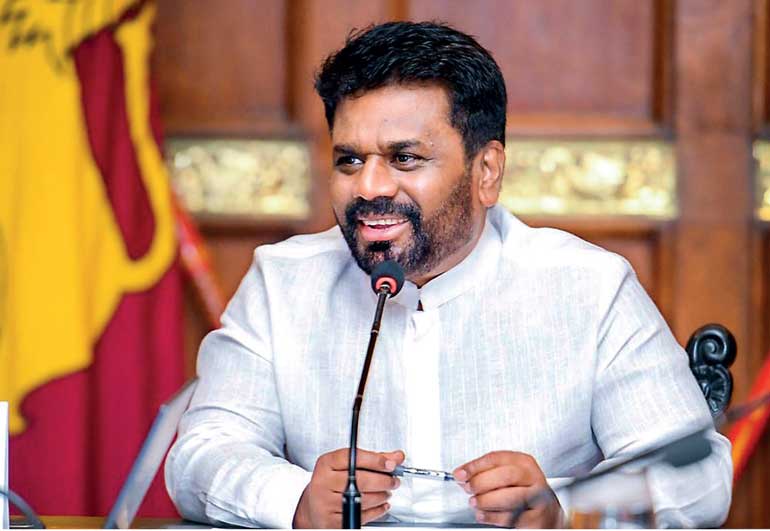
President and Finance Minister Anura Kumara Dissanayake
 Given the volatility of the prevailing global economic environment, caused primarily by a collapsing post-World War II economic order, but worsened by the two wars in Europe and the Middle East, developing countries like Sri Lanka are left with no other option but to be extremely pragmatic rather than sticking to dictates of economic theories and political doctrines so that at least a respectable level of growth and development could be achieved. This basic fact should be kept in mind by those who jump to criticise the economic performance of Sri Lanka’s current presidency and government.
Tenets of pragmatism
Tenets of pragmatism rather than radical ideologies seem to be the guiding principle driving the AKD-NPP leadership since they came to power in 2024. Yes, system change is their goal, but should that pass through a chaotic and violent phase to reach? That sadly seems to be the expectation of some of the local pessimists.
The current leadership inherited an economy, which had been the victim of a political culture that not only converted the nation’s parliamentary democracy into a vehicle to produce a form of dynastic rule headed by a few prominent families of pre-independence era, but also transformed the art of national governance and its legislative, executive and judicial branches into a network to accumulate private fortunes with impunity.
Only now under the new leadership the actual magnitude of this misgovernance and the extent of damage it had caused to the nation is beginning to come to light because of AKD’s “cleanup campaign” and restoration of judicial independence.
There is now a new cry that judicial independence is under threat because of the extension of judges’ retirement age. Captains of the ancient regime are trying hard to bring down this presidency and government at any cost which itself is an index of proof that AKD is translating his promise into action that he would end the previous “rotten political culture through a social revolution”.
More to be done to realise “system change”
However, there is more to be done to realise “system change”. For instance, no constructive step has yet been to materialise ethnic reconciliation. It has been 43 years since JR unleashed his July pogrom against the Tamils, and before him and from the time of SWRD the national cancer of a politically motivated ethnic hatred fertilised by political Buddhism had remained a bulwark against national unity. It is time President AKD, and the NPP Government take at least the preliminary step of appointing an expert committee to work on a new constitution without which ethnic reconciliation cannot receive statutory strength. That constitution should above all abolish the executive presidency as promised before the election. Is the President waiting till the tail end of his five-year term to do these? It is better to start the spade work now Mr. President.
With all these minuses there is one plus sign regarding the economy’s health. When the new leadership took over the country’s presidency and Government, IMF - the watchdog of a rotten global economic order, was already here for the seventeenth time thanks to the desperate move by the stop-gap president Ranil Wickremasinghe. Despite their schooling in radicalism AKD and his JVP entourage sacrificed their revolutionary ethos and adopted the path of pragmatism to achieve their radical objectives of clean governance, economic development with equity and improved public welfare. Hence, their acceptance of IMF’s financial and economic engineering. As a result, the country has recaptured its upper-middle income status and according to the latest S&P global rating Sri Lanka’s Long and Short-term crediting ratings stand at CCC+/C while maintaining a stable outlook, continued economic recovery with 5% growth in 2025 and improvement in fiscal management. President AKD’s 2027 Budget optimism expressed recently, where he expects a record Budget surplus of Rs. 197 billion against the Rs. 236 billion deficit a year earlier; revenue and grants increasing by 23.9% to Rs. 2.32 trillion; primary surplus expanding by 52.3% year to year to Rs. 1.13 trillion and export growth of a modest 7.3% are evidence that substantiates IMF’s and international agencies positive assessment of the economy. Yet, the critics ignore these facts and go on expressing persistent pessimism about the achievements of the new leadership. AKD’s record of clean governance and pragmatic approach to the country’s economic issues deserve appreciation.
Challenges
Yet, there are challenges even in the economic arena. For instance, the burden of economic restoration so far had been shared unequally, and the low-income earners had carried a heavy burden. The IMF’s fiscal philosophy of broadening the tax base goes against the principle of equity through economic growth. Even now before releasing the next tranche of the $3 billion grant, the IMF is insisting on reforming the method of tax collection and not changing the tax structure. Meanwhile the poverty rate of 24.5% in 2024 which was expected to decline to 22.7% in 2025 is still too high and shows that the benefits of IMF steered economic growth is not trickling down fast enough to uplift the downtrodden. The biggest problem facing the Government is to find enough resources to rejuvenate the rural sector to become more productive. All this requires a comprehensive economic plan which is anathema to the IMF’s open economy and market-led approach.
But US that championed this approach since the end of WWII is currently headed by a president who, in the words of Robert Reich an eminent American political economist, “is willing to violate, all norms, rules and laws about how US presidents are supposed to act” and doing “anything that helps him accumulate more wealth, power and glory and wreak vengeance on anyone who has tried to get in the way”, has become the chief enemy of IMF’s economic philosophy. Can the IMF stop him? If not why resist economic planning in smaller economies? All these inconsistencies and systemic breakdown had prompted a new generation of youth from the US to India to rise up against the ruling economic order with their demand for system change. To Sri Lanka’s credit it was the 2022 Aragalaya that lit this fire of protest. There will be setbacks no doubt, but the future belongs to this new generation. Once the economy is set on strong footing other items on the agenda should take precedence. There is room for optimism. Let the pessimists have their say but the caravan must move.




