Tuesday Sep 22, 2026
Tuesday Sep 22, 2026
Friday, 7 August 2026 00:00 - - {{hitsCtrl.values.hits}}
By Devan Daniel
For much of the past decade, geopolitical crises were treated by corporate boards as intermittent shocks to supply chains, commodity prices or financial markets. That assumption no longer holds.
Business leaders increasingly see volatility itself as a permanent feature of the operating environment, forcing companies to rethink capital allocation, supply chains, energy security and technology investment.
That shift in thinking dominated a panel discussion at the CMA National Management Accounting Conference 2026 last week, where executives representing telecommunications, manufacturing, energy, exports and economics argued that resilience is no longer a contingency plan but a strategic capability that directly influences competitiveness and shareholder value.
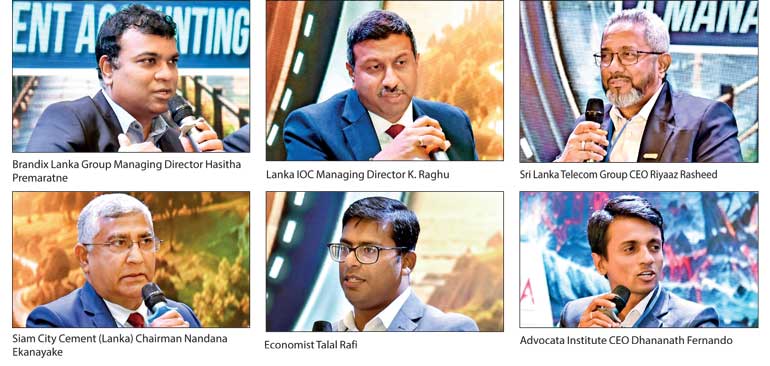
Moderated by Advocata Institute CEO Dhananath Fernando, the discussion moved beyond the immediate effects of conflict in the Middle East to examine how businesses can position themselves in an international economy increasingly defined by geopolitical rivalry, fragmented supply chains and accelerating technological change.
Economic landscape
 Economist Talal Rafi argued that while attention remains focused on conflicts in the Middle East, the more profound structural change confronting Sri Lanka is the long-term realignment of the global economy around strategic competition between the United States and China.
He said the consequences were already becoming evident in Sri Lanka’s macroeconomic outlook.
The latest IMF projections indicate official reserves are expected to reach only $ 11.8 billion by end-2027, below earlier expectations. Reaching even that level would require Sri Lanka to accumulate an additional $ 3 billion in reserves, including a planned $ 1.5 billion international sovereign Bond issuance, placing renewed emphasis on restoring international credit ratings.
Rafi argued that trade disputes introduced during the first Trump administration had evolved into a bipartisan shift in US economic policy rather than a temporary political phenomenon.
“What people don’t notice is that some of the things he put in, when Biden became president, he continued,” he said.
“I don’t think that’s the case that everything goes back to normal.”
He said Europe was now adopting a similarly defensive industrial stance towards China, increasing the likelihood that Chinese manufacturers would redirect excess production towards developing markets.
China’s export-led economic model, combined with substantial manufacturing overcapacity and state support, would place increasing pressure on industrialising economies unable to compete on scale or financing, he said.
“The actual hurting for developing countries not to develop was coming from China,” he said, referring to international research examining the effects of Chinese industrial capacity on emerging economies.
Yet Rafi maintained that disruption also creates opportunity.
He identified ports, tourism and renewable energy as sectors positioned to benefit from changing trade flows, particularly as instability around Middle Eastern logistics networks encourages businesses to diversify supply chains.
His strongest argument, however, centred on India.
By 2050, India’s economy is expected to reach approximately $ 30 trillion, roughly equivalent to the size of today’s United States economy, while neighbouring Tamil Nadu alone could become a $ 4 trillion economy.
“We are going to have a United States-size economy just 50 kilometres north of us,” he said.
Rather than viewing India primarily through a diplomatic lens, Sri Lanka should treat it as the country’s most significant long-term commercial opportunity, he argued, pointing to countries such as Canada and New Zealand that naturally orient much of their economic strategy towards neighbouring markets.
The economist also highlighted a second structural challenge confronting emerging economies — the changing direction of global investment.
He cited United Nations data showing around 20% of global foreign direct investment is now flowing into artificial intelligence and digital infrastructure, while more than half of international investment is concentrated in developed economies.
Combined with record levels of sovereign debt across advanced economies following the pandemic, developing countries face increasing competition for international capital.
That means attracting investment will require stronger domestic institutions and greater policy credibility rather than relying solely on traditional competitive advantages, he suggested.
Volatility as permanent operating expense
Brandix Lanka Group Managing Director Hasitha Premaratne approached the discussion from the perspective of an export manufacturer operating at the centre of global supply chains.
For apparel manufacturers, he said, geopolitical disruption is no longer measured simply by shipping delays or higher freight costs.
Instead, volatility itself has become another permanent operating expense.
“There is a cost embedded in managing this volatility and risk. That we have to factor into the P&L,” Premaratne said.
Brandix experienced perhaps its greatest commercial pressure not from the latest Middle East crisis but from tariff changes introduced since April 2025.
Customers approached suppliers seeking to share the burden of additional tariffs, forcing difficult negotiations that significantly reduced margins across multiple product categories.
Rather than attempting to predict geopolitical developments beyond management’s control, Premaratne said the company deliberately redirected attention towards variables it could influence.
That meant rethinking procurement strategies, redesigning manufacturing processes, reassessing legacy operating models and challenging long-held assumptions across the business.
“What we looked at was that everything out there is not in our control,” he said.
“We should focus on what is in our control.”
Although Brandix began its transformation programme in 2023, the past 12 months had produced deeper operational change than previous years because management no longer had the luxury of postponing difficult decisions.
Many of those decisions had been debated internally for years but only became possible under sustained external pressure.
The objective was not simply to reduce costs temporarily but to permanently lower the company’s cost per unit while preserving competitiveness against global manufacturers despite higher tariffs, utility costs and logistics expenses.
Premaratne argued that productivity rather than expansion had become the principal driver of resilience.
Artificial intelligence, in his view, represents an important contributor to that productivity shift.
While acknowledging that enthusiasm surrounding AI currently exceeds its commercial application, he dismissed suggestions that it represents merely another technology trend.
“AI is happening,” he said.
“The buzz is much bigger than the reality. That’s always the case. But if you play the game properly, there is plenty of opportunity in that space for you to drive productivity.”
His broader conclusion reflected a recurring theme emerging throughout the discussion: businesses can no longer rely on external stability to preserve profitability.
Instead, sustained competitiveness increasingly depends on organisations becoming structurally more efficient before the next geopolitical shock arrives.
Whether the disruption originates from tariffs, armed conflict, commodity markets or technological change is becoming less important than a company’s ability to adapt before competitors do.
Sustained investment
Siam City Cement (Lanka) Chairman Nandana Ekanayake said resilience in manufacturing cannot be achieved simply by holding larger inventories. Instead, it requires sustained investment to reduce structural dependence on imported energy and raw materials, even when those investments weigh on short-term returns.
The company’s experience illustrates the dilemma facing long-term foreign investors operating in volatile markets.
Siam City Cement’s parent company invested $ 100 million in Sri Lanka based on forecasts of a construction boom and an expected 10-year payback period. More than a decade later, that investment has yet to achieve the anticipated returns, reflecting the prolonged weakness in construction activity and successive economic shocks.
“Only thing is that they can delay the return,” Ekanayake said, noting that the original assumptions underpinning the investment had fundamentally changed.
Despite those setbacks, he said the company’s priority remained protecting customers rather than maximising margins during periods of disruption.
Like many manufacturers, Siam City Cement carries additional inventories despite the associated financing costs because interruptions to supply have wider commercial consequences than higher working capital.
“As long as possible, we sacrifice some of our net margin,” he said, explaining that maintaining supply was essential to protecting distributor networks and construction projects.
That strategy was severely tested when geopolitical tensions disrupted the supply of imported coal, one of the industry’s most important raw materials.
Coal accounts for around 70% of cement manufacturing inputs in Sri Lanka, compared with around 50% in some other markets such as Nigeria, making producers particularly vulnerable to international shipping disruptions and commodity price volatility.
Rather than relying on a single sourcing strategy, the company activated alternative procurement arrangements across its regional network, drawing supplies from other operations while also working with affiliated companies to secure emergency shipments.
The crisis reinforced management’s view that resilience requires investment long before disruption occurs.
One area receiving increasing attention is the replacement of imported fossil fuels with locally available alternative fuels derived from industrial waste.
Ekanayake said the company is investing around Rs.1.5 billion this year to modify its production systems to increase the use of waste-derived fuels, reducing dependence on imported coal over time.
The strategy extends beyond energy.
Siam City Cement is also increasing the use of locally available materials, including fly ash and other industrial by-products, to reduce reliance on imported clinker, one of cement manufacturing’s largest cost components.
The transition is technically complex because alternative materials require extensive testing before they can be incorporated into production at scale.
“You cannot change it very quickly,” he said. “We have to test the process, test the design and see how it performs.”
The company is also strengthening regional supply resilience by coordinating inventories across operations in Thailand and Vietnam and exploring greater control over regional shipping capacity to improve supply flexibility during future disruptions.
For Ekanayake, resilience ultimately depends less on carrying larger inventories than on systematically reducing structural import dependence.
Energy security
Lanka IOC Managing Director K. Raghu argued that energy security presents a different challenge because fuel importers have limited influence over the upstream segments of the value chain.
Unlike integrated international oil companies involved in exploration, production and refining, Lanka IOC enters the value chain only after products have already been refined, leaving it exposed to international market volatility with relatively few opportunities to influence costs.
“Our game starts from where we source,” he said.
That reality, he argued, means Sri Lanka should focus less on crude oil prices and more on the economics of refined petroleum products.
Using prevailing international market prices, Raghu noted that crude was trading at around $ 88 per barrel while gasoil was closer to $ 138, illustrating that countries importing refined products pay substantial premiums beyond the cost of crude itself.
This, he said, strengthens the case for refinery modernisation.
Domestic refining capacity would not only improve energy security but also enable Sri Lanka to produce cleaner fuels that meet evolving international environmental standards.
While many countries have already adopted Euro 6 fuel standards containing 10 ppm sulphur, Sri Lanka continues to permit fuels containing 500 ppm sulphur, highlighting the need for technological investment.
Raghu identified three additional priorities for strengthening long-term energy resilience: expanding storage infrastructure, introducing greater pricing certainty and maintaining stable Government policy.
Storage capacity remains limited, restricting the country’s ability to accumulate strategic inventories even when international prices are favourable.
Pricing uncertainty also discourages investment because companies cannot accurately forecast future returns.
“Today in the market, nobody knows at what price the product is going to be sold. If I don’t know what price I am going to realise, why will an investor invest?” he said.
Rather than broad-based price subsidies, Raghu suggested digital mechanisms linked to national identity numbers could enable more targeted assistance for vulnerable consumers while allowing market pricing to remain transparent.
Operationally, Lanka IOC has responded by diversifying suppliers, expanding higher-value products beyond transport fuels and maintaining a lean cost structure.
Over two decades, the company’s business mix has shifted from around 90% transport fuels to approximately 75%, reducing concentration risk while preserving profitability. Strong stakeholder relationships, disciplined balance-sheet management and prudent procurement have also strengthened the company’s ability to absorb market shocks, he said.
AI is here to stay
Sri Lanka Telecom PLC Group CEO Riyaaz Rasheed said digital infrastructure has become one of the most strategically exposed sectors in an increasingly fragmented global economy, requiring companies to manage geopolitical risk, cyber threats, supply chain disruptions and talent shortages simultaneously.
Unlike traditional infrastructure businesses, telecommunications operators cannot simply suspend operations during crises. National connectivity, enterprise networks, cloud infrastructure and data centres must continue functioning regardless of disruptions to global supply chains or regional conflicts.
SLT’s enterprise business now extends far beyond consumer connectivity, encompassing cybersecurity services, Government networks, cloud infrastructure and data centres that host critical customer information.
“The biggest challenge is the enterprise business,” Rasheed said. “We have cloud, we have data centres where we host information about customers. This is where the biggest challenge is.”
Maintaining those services increasingly depends on infrastructure that itself has become vulnerable to geopolitical tensions.
Sri Lanka currently relies on five international submarine cables for global connectivity, with another expected to become operational next year. While redundancy has improved network resilience, Rasheed said any disruption to those international links would have consequences extending well beyond the telecommunications sector.
“Imagine one of these cables gets cut. It’s going to be very challenging for the country, for the economy,” he said.
Power security presents another operational challenge.
Telecommunications infrastructure cannot tolerate prolonged electricity interruptions, forcing operators to maintain generators, batteries and backup systems across thousands of network sites. That makes energy costs a structural component of operating expenditure rather than simply another utility expense.
The industry’s capital requirements have also increased sharply because of disruptions in global semiconductor supply chains.
Rasheed said chip prices have risen by between 10 and 20 times in some cases, but the greater challenge is availability rather than price.
Major global technology companies have secured semiconductor production capacity years in advance, leaving smaller buyers struggling to source equipment even when prepared to pay substantially higher prices.
“The bigger price is not the price. Even if you pay a higher price, you can’t source them,” he said, noting that some buyers have already reserved production capacity for the next three years.
That has forced telecommunications companies to strengthen relationships with long-standing suppliers while carrying additional inventories to ensure equipment remains available for network expansion and hardware replacement.
Demand for computing capacity continues to grow alongside cloud services and artificial intelligence, meaning operators must simultaneously expand infrastructure while replacing ageing hardware, typically every five to six years.
The industry also faces increasing competition for skilled technology professionals.
Rasheed said engineers, cybersecurity specialists and digital infrastructure experts remain in high demand globally, while Sri Lanka continues to experience outward migration of experienced professionals.
Companies therefore have little choice but to invest continuously in developing new talent while retaining critical technical expertise.
Yet he argued the most significant strategic challenge facing corporate Sri Lanka is cybersecurity.
As artificial intelligence evolves from predictive models to increasingly autonomous systems capable of interacting with other AI agents, boards can no longer treat cybersecurity as an operational technology issue delegated to information technology departments.
“We started AI probably 10 to 15 years ago. Then suddenly it broke out. Then from AI we have gone into Gen AI. Now we are talking about agentic AI,” Rasheed said.
“What happens when an AI agent deals with another agent without a human in between? We don’t know what will happen. It is so very complex.”
He said many organisations remain reluctant to commit significant resources to cybersecurity because the financial consequences of cyberattacks are difficult to quantify before an incident occurs.
The investment required is substantial, while the benefits are often invisible until systems are compromised.
Nevertheless, Rasheed said delaying those investments represents a far greater risk as digitalisation accelerates across both Government and private sector organisations.
“We always tell them, please invest, please make sure you cover yourself with cybersecurity,” he said.
“This is a risk that we as a country cannot take.”
The discussion suggested that resilience is no longer defined simply by maintaining larger inventories or preserving financial buffers. Instead, it increasingly depends on making long-term investments before crises emerge, whether through stronger balance sheets, diversified supply chains, productivity-enhancing technologies, domestic industrial capability, energy infrastructure or digital security.
While each sector faces different operational risks, the executives agreed on one principle: companies that continue to treat geopolitical disruption as an exceptional event, risk falling behind those redesigning their businesses around a world where uncertainty has become permanent.




