Tuesday Mar 03, 2026
Tuesday Mar 03, 2026
Tuesday, 3 March 2026 05:05 - - {{hitsCtrl.values.hits}}
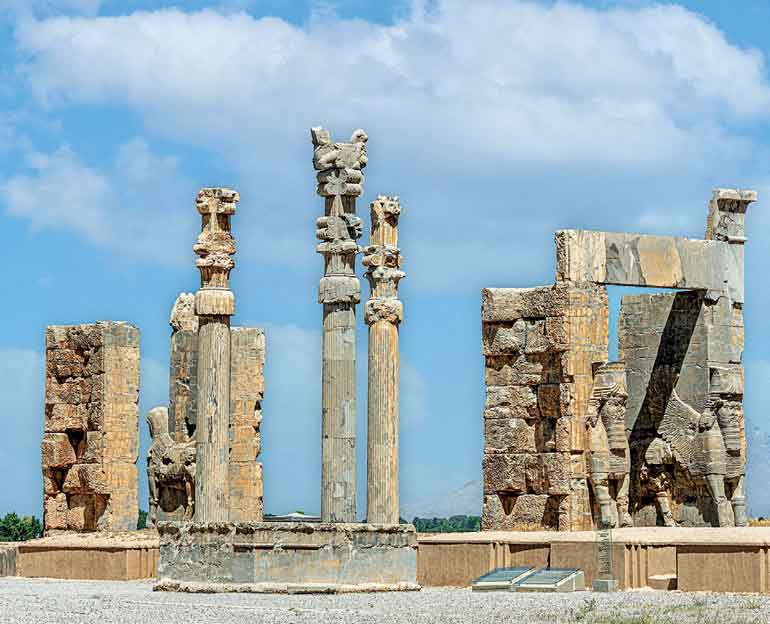
Ruins of the Gate of All Nations in the ancient city of Persepolis (5th century BCE) in Iran
 Doomscrolling through the scenes of doom emerging from the lands of ancient great civilisations they now call the Middle East, I try to wrap my head around the latest act of savage aggression by the current empire, and in doing so, try to follow the advice of Arundhati Roy, ‘to never simplify what is complicated or complicate what is simple.’
I teach business, among other things, to people living on the periphery of the imperial core, and in this line of work one cannot escape the simple fact that war is great business. And since war is business, as with everything else to do with business, one must try to time it well. For instance, we now know weekends are great for illegal strikes against other sovereign nations because the financial markets are closed. There is enough time for the initial panic to settle down, and perhaps even for some quick victories, so that the minor matter of human suffering can be largely ignored in the calculation of what stocks to hold and what to sell. The financial gods must be appeased before anyone else.
War has always been great business for its funders, but now that we are fighting corporatist wars (not even badly disguised as ideological wars anymore), the truism has become truer. The imperial military suppliers such as Lockheed Martin, Boeing, Raytheon, General Dynamics and Northrop Grumman receive the significant part of the one and a half trillion dollars the empire allocates for its Department of War, and as Iran was getting bombed, the shareholders had reason to dance in the (Wall)streets. For decades now the Middle East has been a fertile testing ground for their death-bringers, and this was a moment to celebrate the expansion of arable land for bombs.
Managing collateral damage
The problem with Iran, as with Palestine, Syria, Libya, Iraq etc. before it, is that it is populated. When bombs fall, they take out places like the Shajareh Tayyebeh girls’ elementary school in Minab where hundreds of children were studying at the time. Not even a genocide livestreamed for two and a half years can prepare one for the images of body parts of children strewn about as if in some grotesque art installation, of parents frantically searching for their children amidst the burnt rubble, images of sheer, utter, inconsolable grief.
This kind of collateral damage, as they call it, requires some public relations management, of course, as otherwise it would be bad for business. This is where long-term strategy is of great value, and thankfully much of the groundwork has already been laid by the previous empire. There is a general consensus that melanin has an inversely proportional relationship to one’s human worth, and Iranians fail to pass this colour test. This already makes their suffering not entirely human, which is a good place to start when demonising their religious beliefs and cultural traits, until it seems that to die horrific deaths is almost part of their way of life. There is great value in numbers too: as one dictator famously said, one death is a tragedy but a million is a statistic — a number that was, in fact, reached in Iraq not too long ago in a similar imperial conquest.
Bringing democracy to the Middle East
Before one brings democracy to the Middle East, one must take it away, because the people there know of the great civilisations they built millennia ago, and are completely capable of continuing in that tradition. Iran, for instance, had to be put in its place when her people elected a democratic government in the 1950s, lest they succumb to the notion that the oil underneath their feet belong to them and not to British Petroleum. Once you install a puppet dictator in place and milk the oil for all its worth, and the public resistance gradually takes a religious form under brutal repression for decades and manages to recapture political power, only then is the time to worry about the women and the children and human rights and free speech.
One should not, however, attack a large, highly populated, industrialised, and dare one say, proud nation like Iran immediately. It makes better business sense to cripple the country by siege tactics. The unilateral sanctions imposed by the empire have affected all aspects of social life in Iran, including healthcare and education. Thousands of preventable deaths have occurred due to lack of medication. There are observable intergenerational effects of the impact on the education system. As usual, the most affected are the poorest of the country, who wield little political power.
Once its economy has been sufficiently handicapped, the empire has moved into causing what it calls a regime change in Iran, and have in fact killed the Ayatollah in a rather swift attack (notwithstanding the aforementioned collateral damage). The deceased, however, just happens to be a man who never shied away from martyrdom. It remains to be seen whether his murder brings democracy to Iran (perhaps the Instant-Mix Imperial variety, as coined by Roy), but what is not in doubt is that Ali Khamenei’s sainthood among his believers is now canonised forever. Who is to say that a thousand more Khameneis will not blossom on his grave?
Sri Lankan cognitive dissonance
The Sri Lankan reaction, in the midst of all this savagery, has been most fascinating to observe. There seems to be significant support for imperial aggression, and even though I am not one for complicated analysis, I still see this stemming from three sources.
In the post-Gotabaya era defined by a slow recovery from an economic crisis, Sri Lankans (and their governments) have been thoroughly domesticated by para-imperial institutions such as the IMF. The Overton window has already been set for expressing dissent, and there are clear incentives for towing the imperial line. We simply cannot afford to empathise with, let alone support Iran, it seems.
We are also dependent on the hundreds of thousands of migrant workers in the Middle East, almost none of whom are in Iran, and almost all in countries that are at the receiving end of the Iranian counterattack. Most notably the Sri Lankan population in Israel has ballooned to 30,000, and they (and their kin) seem to have fully embraced the Zionist outlook on politics. Embracing Zionist apartheid requires dehumanising entire swaths of humanity, and Iranians happen to fall on the wrong side of that line.
Thirdly, and most detestably, there is blatant Islamophobia. One can only wonder if the reaction would have been the same if the majority of Iranians followed some other religion. All things being equal, if it were a Pope that was in Iran instead of an Ayatollah (history attests to the fact that Popes are not above brutality), would the bombs have been cheered with the same gusto?
(The author is a social anthropologist based in Amsterdam, The Netherlands)



