Friday Sep 25, 2026
Friday Sep 25, 2026
Friday, 12 December 2025 00:20 - - {{hitsCtrl.values.hits}}

 Sri Lanka’s microfinance and money lending sector is poised for a major transformation with the introduction of the Microfinance and Credit Regulatory Authority Act 2025. This landmark legislation replaces the Microfinance Act No. 6 of 2016, introducing a far more comprehensive and structured regulatory framework aimed at protecting borrowers, strengthening institutions, and enhancing transparency across the financial ecosystem.
Microfinance has long played a vital role in supporting low-income households, micro-entrepreneurs, and rural borrowers. Yet persistent regulatory gaps, concerns about unethical lending, and the limited effectiveness of the 2016 Act underscored the need for a stronger, more coherent framework.
Introduction
Efforts to introduce dedicated microfinance regulation in Sri Lanka date back nearly two decades, beginning with discussions between the Central Bank and the Ministry of Finance in 2006. Despite multiple drafts and consultations, these early attempts did not materialise into law, depriving the sector, and millions dependent on it, of a robust regulatory foundation.
Although the Microfinance Act No. 6 of 2016 represented an important milestone, it proved inadequate in addressing the sector’s realities. The shortfall became evident when only four institutions were ever registered under the Act, revealing its limited practicality and inability to attract or regulate the broader microfinance industry. Against this backdrop, the proposed Microfinance and Credit Regulatory Authority Act represents long-awaited and much-needed reform. The new Act is comprehensive, sector-aligned, and responsive to issues that have long challenged both MFIs and borrowers. This article reviews the provisions of the Act and highlights key insights relevant to policymakers, lenders, and the public who seek to understand the benefits and broader implications of this reform.
Establishing a central regulatory authority
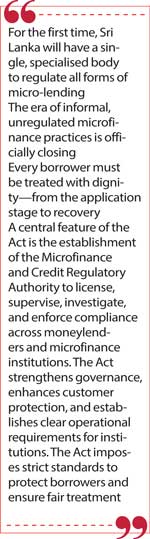
A central feature of the Act is the establishment of the Microfinance and Credit Regulatory Authority (MCRA), an independent body mandated to license, supervise, investigate, and enforce compliance across moneylenders and microfinance institutions. Its core functions include regulating licensed entities, coordinating with the Central Bank and other agencies, promoting responsible lending, and safeguarding customer rights. The Authority is also responsible for maintaining sector databases, conducting financial literacy programs and administering a formal complaints mechanism.
 Mandatory licencing for moneylenders
The Act introduces a decisive change. All moneylenders must obtain a licence from the Authority to operate legally. Eligible applicants include companies, partnerships, trusts, societies, and certain NGOs registered as companies limited by guarantee. Licences are valid for one year and must be prominently displayed at each business location.
A structured pathway to become a microfinance institution
A key reform is the new two-step licencing process for microfinance institutions (MFIs). Organisations may apply for a microfinance licence only after securing a money lending licence. Eligible applicants include:
Microfinance licences are granted for three years, after which the money lending licence held by the institution is automatically cancelled. This layered structure ensures that MFIs operate under higher scrutiny and governance standards.
Expanded permitted activities for MFIs
 The Act significantly broadens the scope of services available to licensed MFIs. These include offering microloans, micro-leasing, microcredit insurance, hire purchase, advisory services, training, and even pawn brokering (subject to approval). This positions MFIs as comprehensive financial service providers serving low-income and underserved segments.
Enhanced oversight and regulatory controls
The Act requires institutions to obtain prior approval for key operational changes, including opening new branches, outsourcing debt collection, altering governance structures, modifying Articles of Association, or reducing capital. Failure to do so may result in penalties of up to Rs. 2 million.
Stronger customer protection mechanisms
Among its most progressive features, the Act imposes strict standards to protect borrowers and ensure fair treatment.
Clear and transparent loan agreements
Loan agreements must be simple, accurate, provided in the borrower’s preferred language, and free from misleading terms. They must clearly disclose interest rates, fees, and conditions.
Prohibited practices
Institutions are explicitly barred from:
Complaints and counselling mechanisms
The Authority must establish formal procedures for complaints and may set up counselling centres for borrowers experiencing difficulties.
Regulation of interest rates and collections
The Authority is empowered to set maximum interest rates, fees, and penalties, define acceptable collateral, standardise fair recovery methods, and regulate digital lending. This flexibility allows the regulator to respond to changing market conditions and protect consumers from harmful practices.
Fit and proper requirements for leadership
The Act sets high standards for individuals holding leadership positions, disqualifying those with criminal records, histories of fraud or bankruptcy, unpaid debts, or prior regulatory sanctions. This safeguard prevents unethical individuals from influencing the sector.
Robust investigation and enforcement powers
The Authority is granted broad powers to inspect records, visit premises, question staff, and conduct investigations. It may suspend directors or employees, revise unfair loan agreements, impose penalties up to Rs. 2 million or publish the names of non-compliant institutions.
Transitional arrangements for existing institutions.
To ensure continuity, the Act grants a transition period:
This phased approach helps institutions adjust gradually to the new regulatory expectations.
A major step forward for the sector
The Microfinance and Credit Regulatory Authority Act 2025 represents one of the most meaningful reforms in Sri Lanka’s microfinance history. It strengthens governance, enhances customer protection, and establishes clear operational requirements for institutions.
(The author is a microfinance professional with over 15 years of experience working with MFIs, development agencies, investors, and Government bodies. He has served as President (2017–2018) and Honorary Secretary of the Microfinance Practitioners Association during multiple terms. The writer has contributed to national committees on microfinance regulation and played a key role in shaping Sri Lanka’s microinsurance framework. He can be contacted at [email protected])




