Friday Mar 13, 2026
Friday Mar 13, 2026
Wednesday, 31 December 2025 00:22 - - {{hitsCtrl.values.hits}}
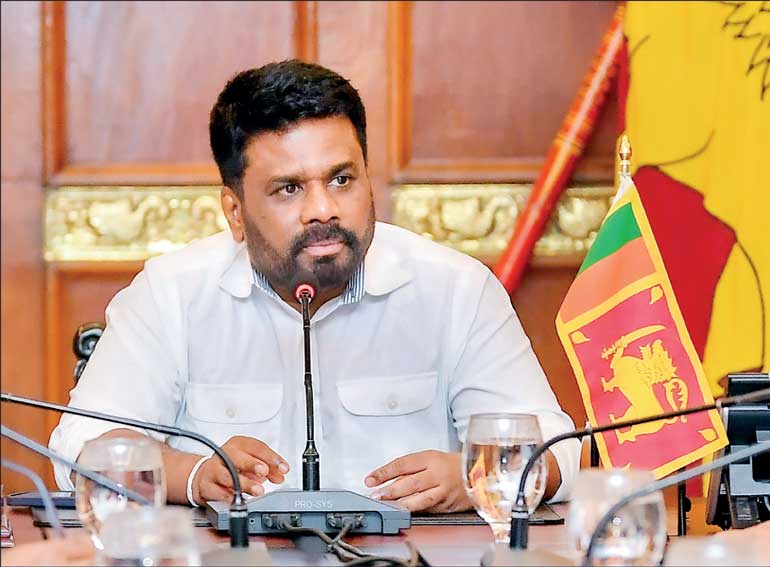
President Anura Kumara Dissanayake now faces a familiar test - not of intent, but of tolerance. Whether this vacancy becomes another episode of managed paralysis, or a moment where independence is preserved despite inconvenience, will shape the credibility of reform far beyond this appointment. Reform that survives only when convenient is not reform at all
 Introduction
For nearly nine months, Sri Lanka has functioned without a properly appointed Auditor General, immobilised by an unresolved deadlock within the Constitutional Council. What should have been a routine act of constitutional governance has hardened into a prolonged vacancy at the apex of public financial oversight.
The delay has provoked growing public unease. A widely circulated comment by a social activist accused the Government of administrative incompetence, questioned the calibre of recent senior appointments, and drew unflattering comparisons with states that elevate seasoned professionals to critical offices. The language was harsh, at times mocking. Yet the frustration it expressed was neither manufactured nor trivial. It reflected a deeper anxiety about standards, seriousness, and institutional credibility.
Then, unexpectedly, the issue resurfaced in a more ordinary setting.
At a Christmas dinner table, a pulled cracker produced a familiar riddle: What lies at the bottom of the sea and shivers? The answer - a nervous wreck - was meant as a joke. Yet the table fell briefly silent, not because the riddle was obscure, but because it felt uncomfortably familiar.
A wreck is not a ship battling rough waters; it is a structure already damaged, submerged, and unable to perform its intended function. To be nervous is not to advance, but to tremble under pressure. Together, the image captures something more troubling than administrative delay. It evokes a state that remains intact in form, yet brittle in function, hesitant precisely when steadiness is required.
This is not merely an administrative failure. It is an accountability problem with constitutional depth.
Constitutional restraint and its fragility
The Constitutional Council was introduced by the Seventeenth Amendment in 2001 as a corrective to the concentration of Executive power that had accumulated since 1978. Its purpose was restraint - to ensure that appointments to institutions overseeing elections, public finance, law enforcement and justice were insulated from unilateral political control.
 Yet from its inception, the framework carried a vulnerability. While the Council was vested with authority, the Constitution imposed no enforceable obligation to ensure its continuous operation. The system presumed good faith. Sri Lanka’s political experience would repeatedly expose how fragile that assumption was.
This weakness became visible during the Rajapaksa presidency, when the Council was allowed to lapse through deliberate inaction. Oversight institutions were paralysed without being formally dismantled. Judicial challenges failed to compel compliance, establishing a troubling precedent: constitutional restraint without enforcement is optional.
The 18th Amendment merely formalised what omission had already achieved. Executive convenience replaced constitutional balance.
Restoration without immunity
The 19th
Amendment restored the Constitutional Council amid public demand for democratic repair. The Twenty-Second Amendment later preserved it after the collapse of the Twentieth. Yet restoration did not confer immunity.
In the post-2015 period, the Council functioned under persistent political pressure. Its formal authority remained intact, but its independence increasingly depended on political goodwill rather than constitutional obligation. Appointments were often justified by urgency or continuity rather than institutional principle.
This marked a shift from overt capture to procedural accommodation. The architecture of accountability remained, but its restraining force weakened.
The clearest example was the appointment of an Inspector General of Police through a divided Council resolved by the Speaker’s casting vote. Defenders cited stability; critics warned of erosion. What mattered was not legality alone, but precedent. A body designed to restrain Executive power had been repurposed to resolve Executive inconvenience.
The Council was neither abolished nor defied. It was used.
Accountability without consequence
 What defines the present crisis is not delay alone, but the absence of consequence attached to it.
Sri Lanka has functioned for months without either a substantive or Acting Auditor General. The result is not mere administrative inconvenience, but institutional paralysis. Without an Auditor General, the Audit Service Commission cannot function. Without audit reports, parliamentary oversight through COPA and COPE is weakened. Article 148 entrusts Parliament with control of public finance; Article 154 mandates the auditing of all public institutions; the National Audit Act reinforces these duties. Yet none of these provisions compels action when the Executive fails to act.
Accountability, in other words, depends not on enforcement but on restraint.
This is the system’s blind spot. When restraint weakens, institutions do not collapse dramatically-they fall silent. The absence of an Auditor General does not trigger alarm; it produces procedural stillness. But silence is not neutrality. It redistributes power.
Without audit scrutiny, oversight becomes ceremonial. Without scrutiny, discretion expands. And when discretion expands without consequence, accountability becomes performative.
The Auditor General deadlock
Against this backdrop, the nine-month vacancy assumes deeper significance.
President Anura Kumara Dissanayake has proposed four nominees, all rejected by the Constitutional Council. The fourth, a former military officer, intensified public unease, given the technical independence required of the office.
Repetition has replaced resolution.
The question is no longer why nominees were rejected, but why the Executive has been unable or unwilling to identify a candidate capable of commanding institutional confidence. This invites political inference, not proof, that delay may be preferable to compromise, or that the appointment is being deferred until conditions become more favourable.
Such strategies are not unprecedented. But they are never cost-free.
Why timing matters
 Sri Lanka is entering a phase of intensified public expenditure: post-disaster reconstruction, infrastructure development, emergency procurement, and externally financed programmes operating under compressed scrutiny. These conditions are structurally vulnerable - not necessarily to corruption, but to weakened safeguards.
With Provincial Council elections approaching, public spending inevitably acquires electoral meaning. History shows that during such periods, governance often slides from stewardship into performance.
This is precisely when the independence of the Auditor General becomes indispensable.
An effective audit authority does more than detect wrongdoing after the fact. It disciplines decision making in advance. A prolonged vacancy therefore creates not merely an administrative gap but a credibility deficit. Even without misconduct, the absence of oversight invites doubt. Trust depends not only on clean conduct, but on visible restraint.
Reform must survive inconvenience
Sri Lanka’s constitutional history offers a clear lesson: accountability rarely collapses through dramatic dismantling. It erodes when power grows impatient with restraint.
The Constitutional Council was designed to slow Executive momentum - to introduce friction where haste tempts excess. Every major institutional failure since has followed attempts to bypass, suspend, or instrumentalise that restraint.
President Anura Kumara Dissanayake now faces a familiar test - not of intent, but of tolerance. Whether this vacancy becomes another episode of managed paralysis, or a moment where independence is preserved despite inconvenience, will shape the credibility of reform far beyond this appointment.
Reform that survives only when convenient is not reform at all.
A quiet warning
 At the Christmas table, the riddle ended in laughter. But in public life, a nervous wreck is no joke. It is a structure still standing, still recognisable, yet no longer capable of steady movement.
That is the danger confronting Sri Lanka today. It is not collapse, but drift; not chaos, but quiet erosion. When accountability trembles, governance does not fall loudly. It sinks slowly. And by the time the wreck is fully visible, the damage is already done.
Footnotes
[1] 17th Amendment to the Constitution of Sri Lanka (2001).
[2] Supreme Court jurisprudence on the non-justiciability of Constitutional Council composition.
[3] Constitutional Council proceedings relating to the IGP appointment under President Ranil Wickremesinghe.
[4] Auditor General’s Department mandate; COPE and COPA oversight frameworks.
(The author is a Sri Lankan academic and independent political analyst whose work focuses on constitutional governance, institutional accountability, and the political economy of reform. He can be contacted at [email protected])




