Monday Sep 28, 2026
Monday Sep 28, 2026
Friday, 3 April 2026 00:25 - - {{hitsCtrl.values.hits}}
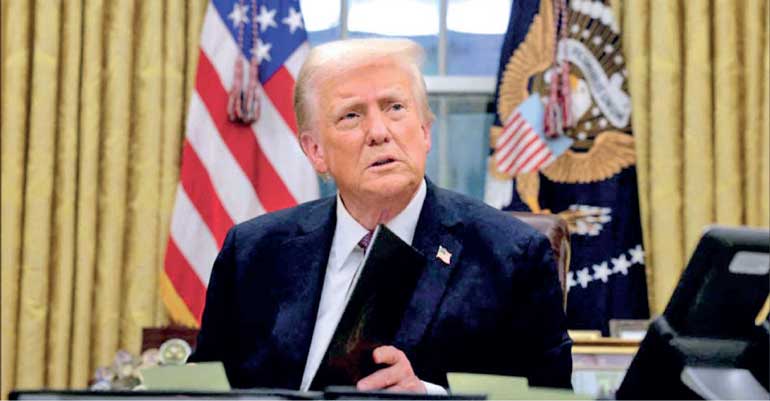
US President Donald Trump
 In 1648, the Thirty Years’ War came to an end. Beginning as a religious and political conflict between Catholics and Protestants regarding freedom of worship and the power of secular authorities to impose their beliefs on their subjects, the war fed upon itself, drawing in more combatants and intertwining with other rivalries and struggles. The devastation it wrought upon central Europe, in particular the regions that now constitute Germany, cannot be overstated.
Marauding soldiers and mercenaries plundered and committed atrocities as they roamed, leaving those who survived dispossessed and destitute. Cities, towns and villages were destroyed; but it was famine and disease that followed in the wake of armies that took the greatest toll. By some estimates, 20% of the population of Europe perished, a greater proportion than in the wars of the 20th Century [1] – meaning that a German, for example, had more of a chance of surviving the Second World War than the Thirty Years’ War.
The Peace of Westphalia, which finally ended the conflict, is marked as the beginning of modern diplomacy, where international relations were defined to be between States, not rulers and dynasties, and where States were sovereign, meaning that they claimed ultimate and exclusive authority within their own territories, and were formally equal to each other.
270 years later, in 1918, the First World War came to an end. It was triggered by an assassination of an Austro-Hungarian Archduke by Bosnian Serb nationalists, and, due to interlocking alliance systems, imperial ambitions and military plans, spread from the Balkans to the rest of Europe, and through their colonial possessions, the world. The war killed millions, wiping out a generation of youth, and unleashed horrors such as chemical warfare onto the world. It also reshaped the world order; of the six powers that began the war in 1914, two were dismembered and ceased to exist, two experienced revolution, and the remaining two were displaced from their premier economic and political positions in the world by upcoming powers.
The Paris Peace Conference and the resulting treaties that ended the conflict, at the instigation of then US President Woodrow Wilson, produced a new form of multilateral diplomacy and a new organisation, the League of Nations, to establish and maintain a permanent peace. In spite of this spirit of Wilsonian liberalism, the League of Nations, partly because the US refused to become a member and pursued isolationism, ultimately proved a failure: it could not thwart the catastrophe that was the Second World War, the most lethal and destructive conflict in human history. Millions more were killed, terrors such as mass aerial bombing of cities and the atom bomb were unveiled, and the world map altered again.
At that war’s end, and in the following decades States have, through treaties and organisations such as the League’s successor, the United Nations, formulated a new international architecture, often referred to as the rules-based world order, to help regulate relations between States and prevent the worst excesses of humanity.
The purpose of the above vignettes is to illustrate two points: firstly, that the raison d’être of the rules-based international order is to avoid the cataclysms of the past and preserve the stability and prosperity of the present, and, secondly, that conflicts tend to spiral out of control and have far-reaching, unintended and often devastating consequences unforeseen by the original combatants.
It is said that safety regulations are written in blood, meaning that they are set down in response to and in order to prevent from reoccurring events that have caused grievous harm, if not death. So too it is with the rules-based international order.
Powers great and small did not agree to constrain themselves because they had become more enlightened and humane – or, as perhaps members of the Trump administration would believe, because they had grown soft and weak-willed. Rather, they had experienced a world of little constraint, and found it to be immiserating for both victor and vanquished alike. They had discovered that, in the end, it was not only the weak that must suffer when the strong did what they could. Additionally, they had found the alternative, where States willingly subject themselves to a system in which they adhere to collectively agreed-upon rules, was not only more stable but mutually beneficial. Indeed, it was and is far more effective in achieving the fundamental goals of every country: protecting sovereignty, ensuring national security, and creating national prosperity. In short, the rules-based order was built out of self-interest, not out of altruism.
This system was and is not perfect. As Prime Minister Carney of Canada stated in his much-lauded speech at Davos: “the strongest would exempt themselves when convenient, [...] trade rules were enforced asymmetrically [and] international law applied with varying rigour depending on the identity of the accused or the victim.” [2] To borrow from Wilhoit’s Law [3], a pithy comment from a classical musical composer critiquing the politics of US conservatism, for some countries international law bound but did not protect, and for others – typically the wealthy and more powerful – it protected but did not bind. However, to quote another Prime Minister, Churchill, who stated of democracy that it “is the worst form of Government except for all those other forms,” [4] – the same can perhaps be said of the sometimes failing, sometimes honoured more in the breach than the observance rules-based world order.
The international order is anarchic; there is no world Government, no Hobbesian Leviathan that imposes and enforces laws between States that adjudicates their disputes and punishes wrongdoing. It is left to the States themselves to ensure their own sovereignty – or indeed, survival – and before the rules-based order, the surest way was actual or potential use of force. Power calculations especially that of balance of power, thus become essential. If force is the only way to guarantee existence, then the military becomes the utmost priority; and it becomes rational to allocate more and more national resources to the armed forces at the expense of anything else that may benefit the populace – guns, over butter. Furthermore, it is not enough to maintain the military, but to pursue the latest and often more lethal and destructive military technologies, in order to keep up with States, as caution and the risk of obsolescence carries with it the risk of extinction.
All of this results in a fundamental sense of insecurity among States, paired often with paranoia that, paradoxically, fosters greater fear and insecurity. States may take pre-emptive violent actions to shore up their position among others; they devour in order to avoid being devoured, and so alarm those remaining. An insecure world, especially in the modern era where warfare is far more destructive and devastating, leaves little room for progress and culture, let alone prosperity. Indeed, it can be likened to the state of nature described by Hobbes, where “every man is enemy to every man,” and as a result life is “solitary, poor, nasty, brutish, and short.” [5]
The rules-based international order was developed to create an alternative to such circumstances. To be clear, it has not established a utopia where consideration of force or indeed its use no longer occurs, but it does a great deal in reducing the fear and insecurity that causes it to occur. It encourages collaboration and peaceful resolution to international disputes, and attempts to limit suffering when force is used. This order was founded in the interest of its founders, in order to avoid the misery of an insecure world, and capture the gains from a more secure one.
There exists a principle called Chesterton’s fence, named after the writer G.K. Chesterton from whose parable it originates: one should not remove a fence until one learns why it was erected [6]. It is quite evident that the Trump administration does not adhere to this principle, in neither domestic nor foreign policy. Had it done so, it would not have turned the US from a guarantor to an opponent of the rules-based world order. Instead, the administration has taken a wrecking ball to the international order, in pursuit of so-called America First policies, not recognising that the US was one of its authors and that the US, like most other countries, greatly benefited from said rules. It has done so with trade wars, and now, an actual war.
As of writing, the war may end, continue as is, or escalate – the sad truth is that nobody knows, least of all US officials, who clearly had not thought much ahead beyond the initial strikes. Whatever happens, there will still be much turmoil and suffering to come. Potentially more lasting and damaging still, will be the harm the US has done to the international order. Should the world devolve into one where might is right and the law of the jungle prevails, it will be much more hostile and poorer for it. Such a situation benefits no one, not even the US, which makes their actions ever more foolish and contemptible.
Indeed, the sheer carelessness of US decision-making, and the pain and chaos that has thus repeatedly been inflicted upon the world brings to mind another quote, from a letter by Swedish Chancellor Count Axel Oxenstierna to his son, one of the negotiators at Westphalia: “Dost thou not know, my son, with how little wisdom the world is governed?” [7]
(The author has an MSc Economics from KU Leuven, a Master in Conflict and Peace Studies from the University of Colombo, and an MA (Hons) Economics from the University of Edinburgh, and can be reached at [email protected])
Endnotes:
1. https://blogs.icrc.org/law-and-policy/2017/05/23/thirty-years-war-first-modern-war/
2. https://www.weforum.org/stories/2026/01/davos-2026-special-address-by-mark-carney-prime-minister-of-canada/
3. https://slate.com/business/2022/06/wilhoits-law-conservatives-frank-wilhoit.html
4. https://winstonchurchill.org/resources/quotes/the-worst-form-of-government/
5. https://standardebooks.org/ebooks/thomas-hobbes/leviathan/text/chapter-13
6. https://en.wiktionary.org/wiki/Chesterton%27s_fence
7. https://www.oxfordreference.com/display/10.1093/acref/9780191826719.001.0001/q-oro-ed4-00008085




