Friday Mar 13, 2026
Friday Mar 13, 2026
Friday, 6 March 2026 00:22 - - {{hitsCtrl.values.hits}}
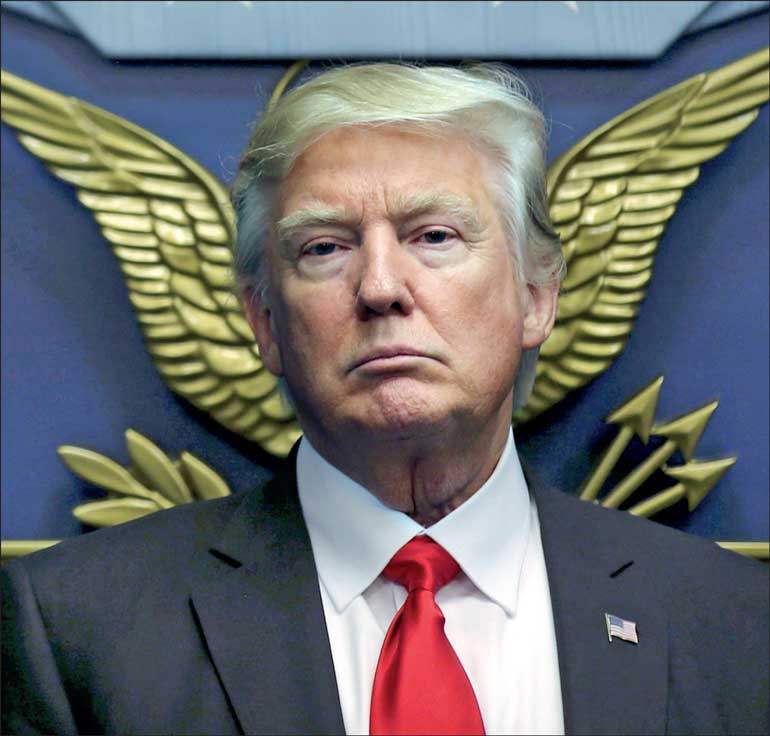
US President Donald Trump
 Despite claims of an imminent threat, the full-blown attack on Iran by the US and Israel represents a decades-long effort to remake the Middle East; an imagined geography of Western fears and desires, as Edward Said famously put it. But it also signifies another major rupture in the global order. By attempting to smash the West’s biggest bogeyman in the region, the US and Israel have managed to take their power to its logical conclusion, but also its most brittle end point. Even if the US and Israel achieve narrow tactical successes in their indiscriminate campaign, the reality is that as a method for governing the world, a system predicated on pure force will always be unsustainable.
It took from the start of the Cold War up until the invasion of Iraq in 2003 for the US to build up its image as a global protector of freedom and democracy, regardless of the bloody coups and rapacious anti-communist regimes it backed. But in the aftermath of the most recent attack, even the international Left’s strongest criticisms during that period pale in comparison to the brutal reality of power when exercised by the US, led by a Far Right administration, and its regional counterparts; in this case, Israel. As some have argued, it is as if Trump read Lenin on imperialism and thought it was a good idea.
The stunning surrender of legitimacy means that the buy-in from other powers, even longstanding allies like the Gulf states, is conditional at best. They are already seething at being turned into the frontline. Framed in this way, US power will depend on ever bigger shows of force until the US suffers inevitable defeat somewhere around the world, whether tactically, strategically, or most likely both. This is, to rephrase the English translation of Frantz Fanon’s book on France in Algeria, a dying imperialism.
Meanwhile, in terms of the sheer revulsion of it all, there are many points that can be made about the latest assault. There is the unbelievable hypocrisy of an apartheid state that has conducted genocide in a constituent part of occupied Palestine framing itself as a regional liberator. Then there is the radical incoherence of Trump’s foreign policy. It is best described as belligerent isolationism or extreme unilateralism. Or as Atlantic staff writer Adam Serwer put it on social media, Trump’s approach is “neoconservatism’s worst impulses shorn of any moral pretence or concern.” Look at the twisted glee with a ‘gloves-off’ approach.
The meaning for Sri Lanka and the South
 What though does all this chaos and destruction mean for Sri Lanka? From the perspective of the country and the survival of its working people, perhaps what matters most is the question of what, if any, order the war in Iran will create. There are tremendous challenges, from vulnerable workers stranded in the Gulf states to further disruption to travel and tourism. This is not to mention the likely dramatic spikes in the price of oil that could put further pressure on the balance of payments. Or even the immediate spillover of war, like the recent US attack on Iranian sailors off the coast. But in a more existential sense, we should not lose sight of an unavoidable fact amid this chaos. Sri Lanka cannot rely on the West to frame its moral and political horizon, or aspirations for the kind of country it can become.
This point may sound redundant. For the Sri Lankan Left founded in principled resistance to Western imperialism as much as the nationalist Right, which refers to Western hypocrisy as a way of deflecting attention from its noxious attitudes towards minorities, such a critique may even appear naïve. The extractive nature of the world system that has been led by the US has long been well known. But the completely unhinged nature of the assault on Iran could help entrench a more critical understanding in the heart of the mainstream point of view. It demands a new organising principle in the same way that the Non Aligned Movement embodied its own moment. Newly independent countries resisted Western neocolonialism after World War II while embracing the tension between democracy and radical social change to carve out paths different from the Soviet Union.
Returning to today’s conjuncture, the assault on Iran reveals in the starkest terms how Western democracy, long under siege, is being unmade from within by a Far Right movement that is now engaging in wanton violence abroad. The only way out is by confronting the long shadow of white supremacy. That includes examining how international law itself originated in distinctions made between ‘civilised’ and ‘barbarian’ peoples, as critical legal scholars have long pointed out. What would it mean to reappropriate it now to condemn the attack on Iran? What, if any, kind of global forum can even function to properly adjudicate the crimes committed in the name of an unravelling hegemony?
These questions do not have an immediate answer, but they must at least be posed. Meanwhile, Trump claims to be a friend of Israel. However, despite the conflation of Zionism with Judaism, it cannot conceal the fact that Netanyahu’s Israel has made life unsafe for Jewish communities around the world. It has exposed them to resurgent Far Right movements that quickly shift between antisemitism and Islamophobia depending on political expediency. In this sense, combating antisemitism cannot also be the basis of the West’s appeal to universal values.
The colour line
What, then, are the principles at stake? The new war and the extremely contradictory response of Western powers to Ukraine versus Iran, along with Gaza, makes clear that the real battle around the world is not simply democracy versus authoritarianism. It also includes what WEB Du Bois, following Frederick Douglass, called the colour line. Iran, unlike Greenland under Denmark’s control, was an easier target because it has been racialised as a non-white country. This distinction, however, does not mean that there is a homogeneous ‘white West’ as some critics like to assert. To accept such a label would imply the same metaphysical consistency white supremacists like to attribute to ‘Western civilisation’. The West as a racialised formation is a constantly evolving relationship of oppressor and oppressed. And it contains plenty of fractures, as we see in the domestic resistance to Trump. Within the West abroad, there is dissent, to the credit of courageous progressive leaders and even countries like Spain and Ireland.
In a broader sense then, the identity of who is filling the positions of power does not necessarily matter. Look at Cuban American Secretary of State Marco Rubio readily making a devil’s bargain with white nationalists like the Defence Secretary Pete Hegseth to enact regime change across Latin America. Rather, it is what the powerful assert is the natural order of things. In a perverse way, the West is an equal opportunity employer when it is conceived as a project of domination. This extractive, violent definition of the West is open to anyone who prefers brutal hierarchy to freedom and democracy though it must necessarily be applied to those places populated by racial others. Eventually, however, it turns inwards, as the legacy of Nazism in Europe showed, to the point no one is safe.
The question remains what can denaturalise and challenge empire, both at home and abroad. In terms of the world outside the West, if anticolonial nationalism was a coordinated yet extremely complex project across multiple continents and multiple time scales, then it is clear there is no comparable ideology today with the same breadth of resistance. But the attack on Iran demonstrates the need to clearly describe what is at stake in the reordering of the world with the growing collapse of US hegemony. The process starts with surrender to the basest tendency towards violence while leading to ultimate defeat.
If the Russian invasion of Ukraine could help clarify the need to defend the principle of self-determination against non-Western imperialisms, then the attack on Iran offers countries like Sri Lanka an opportunity to recentre imperialist assault around the question of a global racial hierarchy as well. Gaza already provided some degree of moral clarity on this matter. But the assault on Iran further sharpens the issue precisely because it is a test case of the lingering moral stance of the West in positioning itself as the opponent of a brutal ‘Third World’ dictatorship. Even the Carney doctrine, representative of a narrow Western anti-Trumpism, has disqualified itself with this test.
To seek answers, it may be helpful to look at history. We can draw a comparison with the dual stakes of the Spanish civil war and the Italian invasion of Abyssinia. The continuation of the European civil war between the two world wars represented the need for anti-fascism and anti-imperialism, respectively. The problem is that in the resolution to World War II, the order that was built around US hegemony managed to deflect the issue of imperialism by reframing the question of freedom as a battle against alleged communist totalitarianism. This rhetoric was further used to suppress dissent at home, including co-opting labour and targeting the Civil Rights Movement.
After the Cold War, neoconservatism tried to use the spectre of Islamism to reinforce US hegemony. But it is a far less convincing argument today especially. Western democracy is itself under siege from the Far Right forces that are using Islam as a scapegoat to shut down pluralism and debate in their own societies. The road to Damascus moment experienced by former neocon ideologues like Bill Kristol, who now articulate democracy as the basis for opposing the Trump regime’s actions at home and abroad, is extremely telling in this regard. But the question remains whether this self-realisation among some in the West can also provoke a coherent and consistent attempt to articulate a revived set of principles for the countries experiencing the immediate threat of imperialist domination.
The coming battle
In the meantime, there is nothing good that can come out of the assault on Iran. Redemption for the brutal crimes against civilian protestors will not occur through the killing of Khamenei when the powers carrying out the assault have themselves committed genocide. There is no universalism of political ideals to be discovered in this craven adventure, which functions more as an attempt to showcase the ability of the US and Israel to dominate at will. But like all direct military interventions, it does at least demonstrate the fundamental weakness of a system that can only rely on force.
The global South—or whichever movements, as much as countries, can organise themselves into a bloc to give this term greater moral consistency—must continue calling out these hypocrisies. At the same time, the South’s critique also reveals the possibility of another order. One that is built on universal principles of democracy, justice, and equality. These ideals did not emerge from Christendom, the West, or any other racialised labels that can be applied to a changing geographic configuration. Instead, they were the product of struggles from below, both in the heart of empire and its colonies. It is the cross-fertilisation of ideas that will define the next wave of freedom struggles, as Greg Grandin has shown in his beautiful history of the Americas.
 For Sri Lanka, the lesson must be clear as night and day: moral-political initiative cannot be found in an exclusive place like the West or even alleged counter-formations that are framed in equally circumscribed ways like Eurasia. It can only be discovered in the principled stance of those who come together across the planet to defend working people against forces like racism in the North, which aims to divide and repress them, and imperialism and extractive capitalism in the South, which threaten to impoverish them further, if not kill them outright. Sri Lanka’s leadership may be hesitant to rock the boat for now. But these ideas must permeate the public sphere and become part of the new understanding that drives Sri Lanka’s efforts to engage with progressive movements and actors abroad, amid the chaos being unleashed by sociopathic warmongering regimes.




