Friday Mar 13, 2026
Friday Mar 13, 2026
Friday, 12 December 2025 00:26 - - {{hitsCtrl.values.hits}}
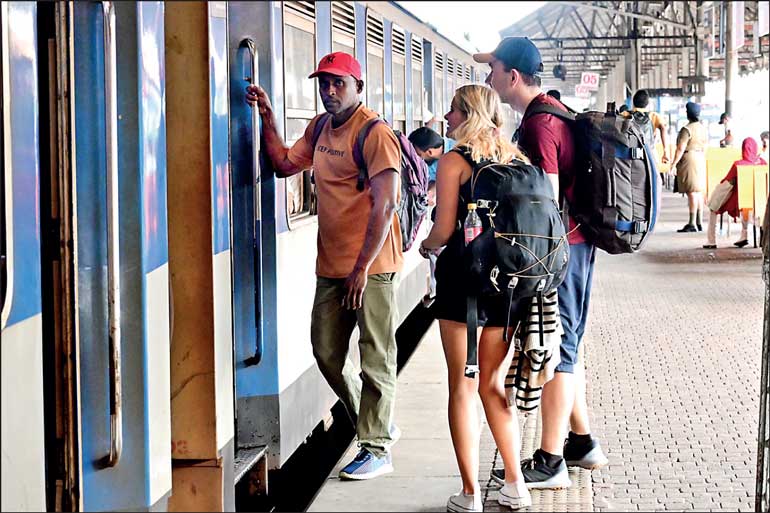
Two tourists boarding a train at Fort Railway Station – Pic by Sameera Wijesinghe
 Sri Lanka’s tourism sector which is often hailed as the lifeline of rural economies has once again been struck by severe weather-related devastation. For more than four decades, our industry has endured a relentless cycle of man-made and natural crises from civil conflict and the Easter Sunday attack to the pandemic, economic collapse, and the recent floods. Yet, despite every setback, tourism has always risen through the extraordinary resilience of its people and its investors.
Today, the biggest casualties are not just the hotels and resorts but the hundreds of thousands of Sri Lankans who rely on tourism for their daily income. The industry’s multiplier effect is immense. Every room occupied supports livelihoods across transport providers, farmers, craft makers, excursion operators, small restaurants, local shops, airport staff, guides, and countless families in remote villages. When tourism suffers, an entire chain of rural economies collapses with it.
Investors under unprecedented pressure
Among the hardest hit are genuine hotel investors, especially those who opened properties around 2017, just before the series of national shocks began. They invested with good intentions, often in disadvantaged rural areas, with the aim of uplifting local communities and contributing to the national economy.
These investors have been battered repeatedly through no fault of their own. Many took loans based on stable tourism forecasts that never materialised due to repeated crises. Today, they face aggressive banking actions such as parate execution, despite being responsible, committed, and transparent borrowers.
It is critically important that these investors are not treated as defaulters, but as essential partners in national recovery. Their properties support thousands of indirect livelihoods, and if forced into liquidation, the long-term damage to Sri Lanka’s tourism fabric will be severe and irreversible.
Banks must create a special category for these investors, separate from habitual defaulters, and offer restructuring, grace periods, and revival-focused financial solutions. The nation cannot afford to lose them.
Immediate steps to sustain tourism in the current context
Even amidst localised disruptions, Sri Lanka remains safe and enjoyable for tourists. Immediate PR campaigns, digital messaging, and global travel advisories must highlight that normalcy has returned in most areas.
 Media interviews with current visitors across age groups and nationalities will build confidence internationally.
Clean-up operations, infrastructure repairs, and reinstatement of access to beaches and transport networks must be prioritised.
Temporary concessions such as electricity tariff rebates, VAT deferrals, and emergency working capital are essential for affected hotels.
A comprehensive future development plan for Sri Lanka tourism
Sri Lanka has the natural and cultural assets to become one of the top tourism destinations in Asia. What has been missing is a stable, long-term, multi-dimensional development strategy that looks beyond crisis management. The following pillars outline a renewed national roadmap:
1. Transform Sri Lanka into a high-value experience-driven destination
Instead of competing on price, Sri Lanka must focus on high-yield segments that stay longer and spend more.
Key initiatives:
2. Strengthen infrastructure and regional connectivity
A successful tourism industry requires predictable, world-class infrastructure.
nPriority actions:
Upgrade domestic airports and introduce low-cost inter-regional air connectivity (Mattala–Koggala–Sigiriya–Batticaloa).
Modernise railway services for scenic journeys (Colombo–Kandy–Ella, coastal lines, and cultural triangle routes).
Enhance highways linking tourist regions, ensuring safe, flood-resilient transportation.
3. Develop tourism clusters and industrial zones
To decentralise tourism and uplift rural economies:
 Identify 10–12 tourism development zones (East Coast, North, Tea Country, Wildlife Belt, Cultural Triangle, and lesser-known coastal towns).
Create investment-friendly clusters offering land banks, tax incentives, infrastructure support, and streamlined approvals.
Promote community-owned enterprises that benefit local families directly.
4. A national policy for investor protection
Tourism investors, especially SMEs and mid-sized hotel owners, must be safeguarded from systemic shocks.
5. Digital transformation and smart tourism
To compete globally, Sri Lanka must embrace digital innovation.
Strategic shifts:
6. Nature conservation and climate-resilient tourism
Tourism cannot prosper without protecting our environment.
Actions:
7. Upskilling the workforce for global competitiveness
People are the heart of Sri Lankan hospitality.
Key measures:
 nIntroduce a national certification framework for guides, drivers, and tourism service providers.
8. Strengthening global branding and year-round promotion
Sri Lanka›s global presence must be bold, strategic, and consistent.
Strategies:
A national duty to protect tourism and its investors
Sri Lanka’s tourism sector is not just about hotels, it is about sustaining the livelihoods of millions and supporting the stability of regional economies. Protecting genuine investors who have supported the industry for decades is essential for ensuring long-term growth.
At this crucial moment, we call upon the Government, policymakers, the banking sector, and industry leaders to unite behind a strong, future-focused national tourism strategy that protects investors and empowers communities.
Sri Lanka has risen after every setback and with decisive action, our tourism industry will rise once again, stronger and more resilient than ever.
(The author is the Managing Director of The Sooriya Resort and Spa. He is also the Chairman of Red Apple Travels and Holidays Lanka Ltd., Chairman of Serene Travels Ltd., former President of The Hotels Association of Sri Lanka and Chairman of the Asian Council on Tourism).




