Friday Oct 02, 2026
Friday Oct 02, 2026
Thursday, 1 October 2026 00:02 - - {{hitsCtrl.values.hits}}
By Subhashi Tania de Silva
There was a time when a very hot day was simply a very hot day. You opened a window. You drank more water. You looked for a little shade and carried on with the business of the day. In Sri Lanka, we have always known heat. We are a tropical island, after all. Hot afternoons are hardly news. But there is a difference between living with heat and living with increasing heat. That distinction is beginning to matter. The most worrying thing about Sri Lanka’s heat story may not be that temperatures are rising. It is that we are becoming rather good at ignoring what those rising temperatures are doing. The warning arrives on the telephone. We read it, perhaps glance at the sky, complain that it is unusually hot and go to work anyway.
We have mistaken familiarity for safety
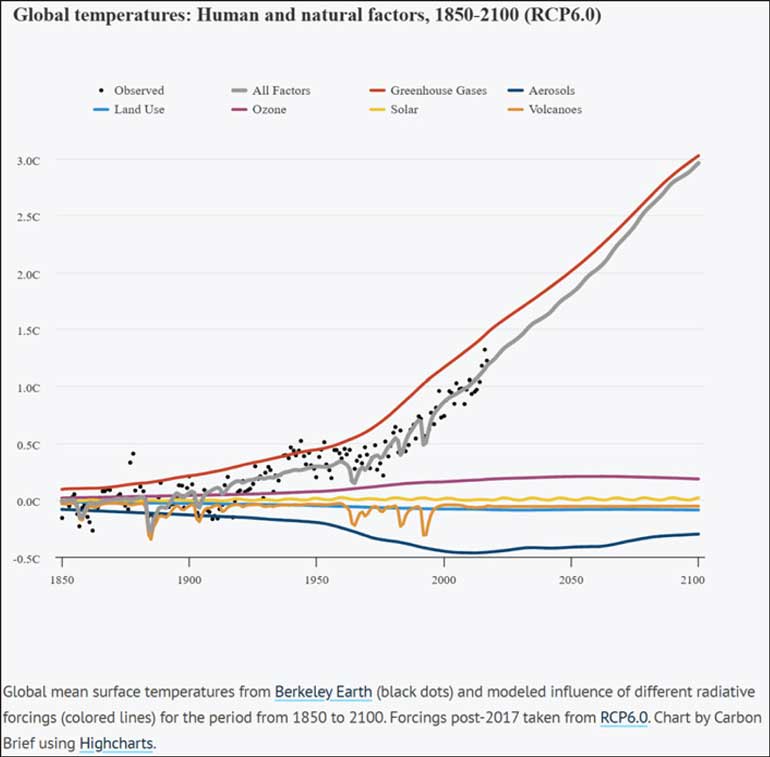
The World Meteorological Organisation says the world has just experienced its eleven warmest years on record. Its assessment places 2025 among the three warmest years ever recorded, at about 1.43°C above the 1850-1900 average.
The years immediately ahead offer little relief. The WMO’s Global Annual to Decadal Climate Update indicates that global temperatures are likely to remain at or near record levels between 2026 and 2030.
Those figures can sound remote. Sri Lanka makes them rather less so.
On 9 September, another heat warning was issued for parts of the North Central and Eastern provinces and several districts including Jaffna, Kilinochchi, Mullaitivu, Vavuniya, Kurunegala, Monaragala and Hambantota.
The warning referred not simply to the temperature on the thermometer, but to the temperature the human body could actually experience, reaching the Department of Meteorology’s “Caution Level”.
It is the sort of notification many of us have learned to swipe away. But a warning is not the same thing as protection. And “stay hydrated” is not particularly useful advice to somebody whose wages depend upon working outside.
The price of a hot working day
Consider the handloom weavers of Maruthamunai in Ampara. Their work takes place in small workshops and homes, environments in which hot weather can become considerably more oppressive.
Research by SLYCAN Trust found heat-stress conditions to be particularly severe between April and July. Some workers reduced their working hours because of the heat. Many workplaces had limited airflow, while air-conditioning was uncommon.
Workers reported excessive sweating, headaches and difficulty concentrating. That last detail is easy to overlook. Concentration is not an abstract luxury on a factory floor. It can determine whether a person works safely, whether a mistake is made and whether a day’s work can be completed. More importantly, reducing working hours has a financial consequence. For somebody paid for the work they complete, escaping the heat can mean earning less. A hot afternoon, then, is no longer merely a weather story. It is a wage story.
Eight in ten workers
The same lesson is emerging from Sri Lanka’s apparel industry.
A 2026 study involving 384 workers in small and medium-sized apparel enterprises in the Biyagama and Katunayake Export Processing Zones found that 81.25% reported heat stress. Workers described headaches, dehydration and reduced concentration. The researchers also associated diminished concentration with workplace injuries.
More than eight in ten. That is difficult to dismiss as an occasional inconvenience.
Heat can affect the safety of a workplace just as surely as faulty machinery or inadequate protective equipment can.
Yet we rarely speak about it with the same seriousness. Perhaps because heat has no broken machine to photograph. There is only the worker wiping their forehead, slowing down, drinking water and carrying on.
The people who cannot simply stay indoors
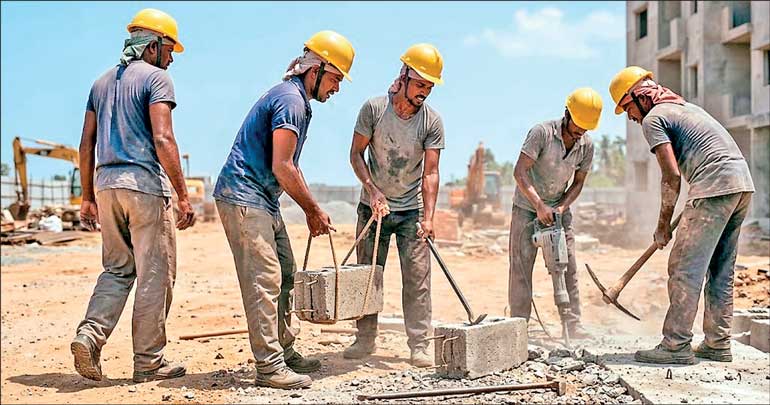
Public advice during a heat warning often sounds straightforward: avoid the hottest part of the day, remain indoors, drink plenty of water. For some people, this is sensible advice. For others, it is almost impossible. A farmer cannot simply abandon the field. A waste collector cannot leave the day’s rubbish uncollected. A construction worker cannot move a building site into the shade. A garment worker may have little control over when a production line stops. And a person living in a crowded home without adequate ventilation may not possess the luxury of a cool room.
The Biodiversity Project, Co-Director, practitioner and researcher focusing on health and climate justice, Kasumi Ranasinghe Arachchige, points to the wider human consequences. Heat can cause fatigue and heat stress, progressing to heat exhaustion and, in severe cases, heatstroke. It can also affect irritability, frustration and concentration. Those already living with chronic illnesses, disabilities or mental-health difficulties may face additional pressures. There is another cost which rarely appears in a temperature forecast. Care. When somebody becomes ill from heat, someone has to look after them. The burden of that unpaid care often falls upon women.
So the heat does not stop at the workplace. It follows people home.
When the seaweed stops growing
In the Northern Province, women involved in seaweed farming in Valaipadu and Pooneryn have described another side of the same problem.
Extreme heat affects both health and livelihood. A 2025 report documented lower harvests alongside symptoms including cramps, headaches, heat syncope and skin rashes. The chain is remarkably simple. Heat affects the body.The body affects the worker. The worker affects their livelihood. And livelihood affects the household.
This is how climate change often arrives in ordinary life. Not as one dramatic event, but as a series of small pressures which eventually become impossible to ignore.
Colombo is not spared
Nor is this merely a rural problem. Colombo has its own relationship with heat.
Concrete, asphalt and buildings absorb and retain heat. As vegetation and open ground disappear, densely built areas can become considerably warmer than their surroundings.
In informal settlements, the problem can be sharper still. SLYCAN Trust has documented heat exposure in Colombo’s informal settlements, where dense infrastructure, concrete surfaces and limited greenery compound the effects.
Its case study recorded maximum temperatures of 36°C in 2024, with temperatures in the study area around 3°C above historical averages.
For a person living in a crowded home with little ventilation, the heat may not disappear when the sun does.
And that brings us to a part of the story we often forget.
The heat does not always go away after sunset
The body needs time to recover. If nights remain unusually warm, that recovery becomes harder.
Poor sleep leaves a worker tired before the next day’s work has even begun. Concentration suffers. Mood can change. Physical performance can decline.
This is particularly important during prolonged periods of heat. One exceptionally hot afternoon is difficult. Several hot days followed by warm nights are something else. The body does not experience climate change as an annual average.
It experiences it hour by hour.
The thermometer is not telling the whole story
There is another complication. Humidity. The human body cools itself largely through the evaporation of sweat. When the air is already saturated with moisture, evaporation becomes less effective. This is why a temperature reading alone can be misleading.
The question is not simply how hot the air is. It is how difficult it is for the human body to get rid of that heat.
“Research from the University of Ruhuna has identified emerging heatwave hotspots in Sri Lanka and examined the relationship between extreme heat, rainfall deficits, atmospheric moisture and land-atmosphere feedbacks.” shared Kasumi Ranasinghe.
Sri Lanka’s climate is not controlled by one switch. Monsoons, humidity, rainfall, the surrounding ocean, land conditions and natural climate variations all interact. El Niño can influence temperature and rainfall from one year to another. But natural variation should not become an excuse for overlooking the larger trend. These natural influences are operating on a planet that has already been substantially warmed by human activity.
This is not simply a tropical island being tropical
Sri Lanka did not create the climate crisis. Its contribution to global greenhouse-gas emissions is tiny compared with that of the world’s largest emitters. Yet Sri Lanka is still exposed to the consequences. That is one of the uncomfortable injustices of climate change. The person with the least control over global emissions
may also have the fewest resources with which to protect themselves. A wealthy household can install air-conditioning. A small farmer cannot manufacture rain. A factory worker cannot necessarily switch off the production line. A low-income family may have nowhere cooler to go. Climate change does not create inequality. It has a habit of making existing ones worse.
And then there is the wildlife
The heat story does not end with people.
In September 2026, tourist access to core areas of Yala National Park was temporarily restricted amid severe drought and water shortages, with concerns over heat-stressed wildlife and the need to maintain access to water.
There is something almost absurdly simple about the crisis. Animals need water. Forests need water. People need water.
When the supply becomes scarce, there is no technological trick which can make the basic requirement disappear.
Sri Lanka’s wildlife is therefore part of the same heat story.
The elephant searching for water and the farmer watching a reservoir fall are not entirely separate stories. Both are living with a changing climate.
Nature was doing the cooling for us
Sri Lanka has, however, been given some of the finest cooling infrastructure imaginable. It grows. Forests. Wetlands. Mangroves. Trees. Healthy soils. Waterways.These systems shade land, retain water, cool surroundings, protect coastlines and provide refuge for biodiversity. They are often treated as scenery. They are not scenery. They are infrastructure. When we remove vegetation, fill wetlands and cover the ground with concrete, we remove some of the natural systems which help us withstand heat. Then, later, we spend money attempting to engineer our way out of the problem. Nature had been providing the service for free.
What we do not count, we do not see
There is another difficulty. We still do not know enough about what heat is costing Sri Lanka. Heat-related illness and deaths, lost working hours, reduced productivity, crop losses, school disruption, sleep disturbance and impacts on wildlife have not been documented with the same consistency as floods, landslides and cyclones.
Research and reporting have begun to fill some of the gaps, particularly since 2024. But a country cannot properly prepare for a danger it cannot properly measure.
How many workers become ill during extreme heat? How many hours of labour are lost? How many crops fail? How many people are admitted to hospital? How many schools change outdoor activities? How many animals are affected by water shortages? And how many people simply endure the heat at home without ever appearing in a statistic? These are not academic questions.They determine how seriously governments, employers and communities should respond.
A warning should be the beginning
Sri Lanka already knows how to issue warnings. The next question is whether those warnings are connected to action. Workplaces need heat-management plans. Schools need practical measures for hot days. Health authorities need stronger systems for recording heat-related illness. Outdoor workers need meaningful protection rather than advice which assumes they can simply stop working. Cities need shade, trees, ventilation and sensible planning. Farmers need reliable climate information and better water management.Communities need access to water.
And the people most exposed to heat need support which recognises that not everybody begins with the same resources.
A notification on a telephone cannot do all of this. It can only tell us that the problem has arrived.
Perhaps the most dangerous sentence is “it’s always been hot.”
Sri Lanka has always been hot. That is true. But it is not an argument against concern. The important question is not whether Sri Lanka has historically had hot weather.
It is whether extreme heat is becoming more frequent, more persistent, more humid, harder to recover from and more damaging to the people and ecosystems that depend upon the climate remaining within familiar limits.
We have adapted to tropical weather for generations.
The question now is whether our institutions, workplaces, cities, farms and communities can adapt quickly enough to a climate that is changing underneath them.
That is a very different proposition.
The warning we should stop ignoring
There will be another heat warning. Another afternoon when the sky turns white with glare. Another farmer will look towards a shrinking reservoir. Another worker will wipe sweat from their face and continue. Another family will struggle to sleep in a room that has not cooled. Another animal will search for water.And another notification will appear:Caution Level. We will read it. Then, quite possibly, carry on. That is the habit we need to break. Because the real story is not that Sri Lanka is becoming hot. The real story is that we are beginning to treat dangerous heat as ordinary. The thermometer cannot tell us what that complacency will cost. The worker who loses a day’s wages can. The farmer who loses a harvest can. The family who cannot sleep can. The animal searching for water can. Sri Lanka cannot change the world’s thermometer on its own. But it can decide what to do with the warning. The choice is not between panic and optimism. It is between paying attention now and paying a much higher price later. The heat has been speaking for some time. The question is whether we have become too accustomed to listening.



