Thursday Jul 16, 2026
Thursday Jul 16, 2026
Monday, 16 February 2026 02:27 - - {{hitsCtrl.values.hits}}
|
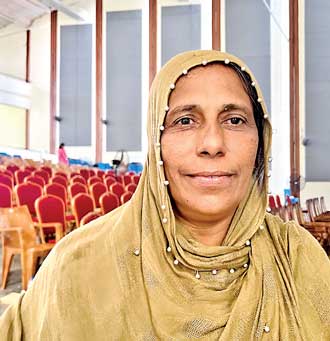
Fathima Ramsiya
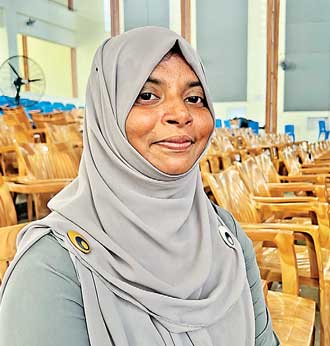
R. F. Risla
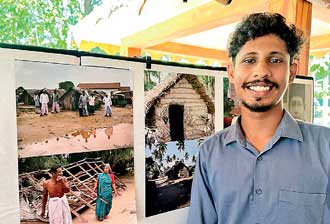
M. M. Safwan |
Text and Pix by Aanya Wipulasena
Inside a crowded hall at the Sri Lanka Girl Guides Association in Colombo 7, M. M. Safwan stood still, smiling politely with the attendees of a photography exhibition and screening of ‘Amid the Villus’ documentary . His family’s story is a part of the Saturday’s (14 February) event itself.
"Memories of the North”, marked a significant moment in the country’s post-war reflection. It was a space to witness the stories of the Northern Muslims who were forced to leave their homes within just hours in October 1990.
“This is the first time a memorial like this is happening in Colombo,” activist Shreen Saroor told the Daily FT.
“Portraying this truth is not very easy, it is challenging, but we did it. This is about coexistence and not about taking revenge. We portrayed this exhibition in such a way so that it promotes coexistence between the Tamils and the Muslims,” she said.
The display, however, is not entirely new. The exhibition was unveiled earlier in all five districts of the North where Muslims were evicted.
In October 1990, Fathima Ramsiya was at her home in Tharapuram, Mannar, when members of the LTTE made an announcement that would change the course of her life forever.
The announcement came over a loudspeaker mounted on a tractor, ordering Muslim families in the village to leave within two days. There was no explanation given and no guarantee of return, but Ramsiya and her family members knew they had to abide.
“We were told to leave our vehicles, including motorbikes, at a designated spot and hand over the keys,” Ramsiya, who was 18 years old at the time, remembers. They were also told not to take many belongings with them.
Ramsiya is one of the thousands of Muslims who were forcibly evacuated from their villages in the northern districts in 1990. Many families with just hours to evacuate, packed what they were allowed into shopping bags and made a journey that remains etched in their memory.
Lives changed forever
For Ramsiya, that day in October marked not just the loss of her family home but also her identity and dreams of becoming a sportswoman.
“There was so much joy in my village. After school, a group of us girls would go into the forest to collect firewood and fruits. There was also a swing tied to a big tree. We would take turns riding. We were very happy,” she said.
She said from time-to-time army officers and members of the LTTE would visit the village.
“We were most scared of the army because we didn’t understand the language,” Ramsiya said.
When the announcement came of the mass eviction, she was not scared. She thought her family would return to the village soon.
“We didn’t even pack much. I think we took some clothes for the children and some food. We left everything behind,” she recalls.
However, the journey was relentless. With the roads destroyed in the ongoing war, the families had to take boats towards Kalpitiya. Torrential rains battered them, delaying the journey by a few days.
“They boats couldn’t come. We sat on the beach for days till the boats could finally come to take us,” Ramsiya said, adding that this was particularly hard for the women.
The women who were menstruating sat on the sand because their clothes were soaked through. To make matters worse they had to wait till night to relieve themselves in the forest.
For those who cooked, it was a different battle of its own.
“I remember my sister trying to make food for us, but the flour just washed away in the rain while she was kneading it,” Ramsiya said.
When they finally made their journey to Kalpitiya, her family decided to go to Colombo from there.
“We never bathed in public areas, and in Colombo we had to wait in queues to use the washrooms. Many women, who never worked before, went to countries like Kuwait and Saudi Arabia as housemaids. I couldn’t continue my education, and in a couple of years after leaving our home, I got married and moved to Kandy,” she said.
She regrets not packing the certificates she got from school sports events, that day in October 1990.
Fragments of the past
At the photo exhibition displayed in Colombo, M. M. Safwan, a young graduate at the National Institute of Social Development Studies, stood by an image of his mother and grandfather.
The image depicts his mother, Marliya, and grandfather standing next to a collapsed wooden hut. Marliya has a smile on her face, but her reality was much dire. Hers is a story of attempting to rebuild life from scratch against all odds.
When his mother and her family were evicted from her home in Mannar they settled in Puttalam. After the end of the war in 2009 their families were resettled in Kollamkulam.
“This photo was taken just after a flood in the area. This was our house in Kollamkulam. It was destroyed in the flood,” Safwan said.
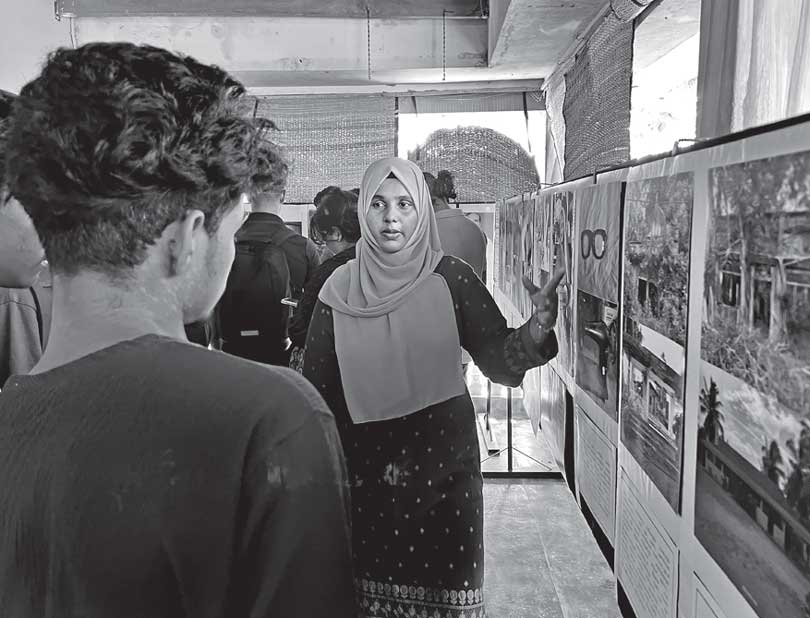
The exhibition depicted photos of Muslim and Tamil families that lived together in harmony before the mass eviction. The display consisted of common shrines villagers prayed at, of a Muslim man who served alongside the LTTE, and pottery that was unearthed after the Muslim families returned to their villages. A photo of a Muslim couple who left abruptly and returned when the Muslim families came back.
A receipt, on display, that was handed over to a family who was forced out of their home on 29 October 1990 reveals what they managed to take with them- one and half pound sovereign of gold, Rs. 3000 in notes, two dresses, a bicycle, one pot, and a watch.
Safwan says the exhibition showed what his mother had to go through. “When we were hungry, we would demand for food. When we needed shoes for school, we asked that from our mother too. I now understand the pressure she should have gone through. She lost her home and she had to find food to feed us. She was helpless.”
Safwan says he feels sad thinking about what his mother went through. He is hopeful for the future. “We need more engagement from all communities. To heal we need to look at the history,” he said, adding that his generation has an opportunity to work towards reconciliation.
In Colombo, Safwan stood proud. “I think we were able to display a true history to the next generation. I am extremely happy we are able to tell these stories here today.”
A call for apology and reconciliation
Last year, in a commemorative event held in Jaffna, the North-East Coordinating Committee (NECC), which organised the event called for a formal apology to the Muslims who had been expelled in 1990.
“Apology is fundamental for reconciliation and co-existence. It is the political and social obligation of the side who committed the wrong to apologise from the affected side and remorse for it. On the other hand, it is the right of the affected side to expect apologies from the side that committed wrong against them,” the NECC said in a statement.
The NECC stressed that Tamil leaders and communities must actively support the northern Muslims’ resettlement, reparations, and cultural revival. They called this a historic responsibility and a duty to stand with their displaced neighbors and ensure justice and remembrance.
The road ahead
R. F. Risla, member of the Jaffna Municipal Council, said the biggest issue the once evicted Muslim families face, even after over three decades, is proper housing and land ownership.
“Many still live on rent,” she said, adding that this must be a priority.
Ramsiya says that events like these are important to heal. “Our stories should be acknowledged. We need to have an official commemoration in October to remember our journey when we were evicted,” she says.
Next, the organising team of ‘Memories of the North’ plans to do a virtual archive of the photographs as only a portion of the images made to the exhibition. “This memory is getting lost because that generation is dying now. We want to capture that image of Muslims and Tamils coexisting in the North prior to 1990,” Saroor said.