Wednesday Oct 07, 2026
Wednesday Oct 07, 2026
Wednesday, 11 March 2026 00:22 - - {{hitsCtrl.values.hits}}
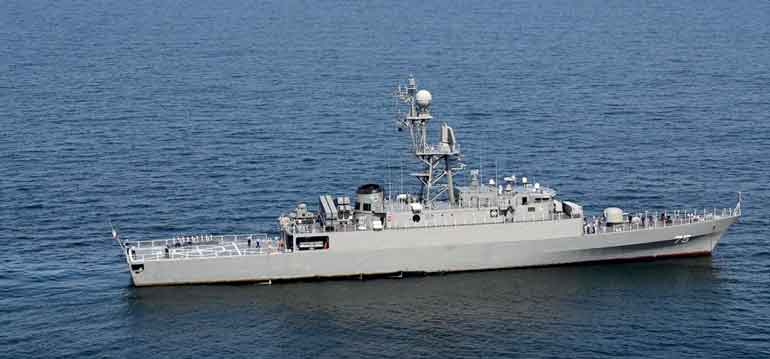
Islamic Republic of Iran Navy frigate IRIS Dena (75) – File photo
By Shanika Sriyananda
 |
| Former Chief Hydrographer and Joint Chief Hydrographer to the Government Rear Admiral (Retd.) Y.N. Jayarathna |
A US submarine torpedoing the Iranian warship - the IRIS Dena - in the Indian Ocean (IO) about 19 nautical miles off Sri Lanka killing at least 87 unarmed Iranian sailors and enabling Sri Lanka Navy (SLN) to rescue 32 of its sailors in international waters have raised the importance of the island nation investing on more in maritime surveillance.
Former Chief Hydrographer and Joint Chief Hydrographer to the Government Rear Admiral (Retd.) Y.N. Jayarathna who spoke about the need of investing in maritime surveillance, oceanographic monitoring and boosting naval capabilities to face future naval warfare, told the Daily FT in an interview that the recent incident of US submarine’s attack on the Iranian warship was an eye-opening incident for all States in the IO region.
However, he claimed that due to maritime blindness in statecraft, Sri Lanka had not invested in maritime surveillance and Sri Lanka’s statecraft since its independence had failed to see the strategic role the island nation can play.
“All governments and political leaders are responsible for the status today,” he claimed.
Jayarathna, who initiated Marine Spatial Data Infrastructure (MSDI) architecture, was instrumental in setting up the Mean Sea Level (MSI) for Sri Lanka.
He opined that as an island, Sri Lanka needed to stand on its feet knowing well about the Law of the Sea, circumstances and by taking bold and clear decisions when it comes to Sri Lanka to balance neutrality in the IRIS Dena incident while safeguarding its maritime security interests.
“Sri Lanka had done this earlier, in 1971 when then Government was firm on its action to permit refuelling facility for the Pakistan Air Force flights originating from then East-Pakistan,” he recalled adding that the SLN should have tracked the vessel movement of the IRIS Dena from India and such would have triggered the thought of possible risk to the vessel when Iran was attacked by US-Israel militaries.
Jayarathna said using Maritime Domain Awareness tools in proactive decisions would have alerted the risk but Sri Lankan and Indian navies have also failed on this aspect despite their boasted capabilities.
“These are skills that we need to develop by our own experiences and understanding,” claimed the former Chief Hydrographer, who is now working with the UN as an International Consultant for Undersea Cables lectures widely on Maritime Security and Ocean Affairs.
Following are the excerpts of the interview:
Q: The sinking of IRIS Dena south of Sri Lanka has drawn global attention. How significant is this incident for the security dynamics of the Indian Ocean region?
For Indian Ocean security dynamics, this is very significant and demonstrates the kind of effect in today’s global warfare. From the cold-war era, submarines from all global players have been present in the Indian Ocean under the waves in routine patrolling and task specific deployments but the sinking of an Iranian Frigate using a torpedo is surely an eye-opening incident for all States of the Indian Ocean region. This incident is significant because it is the first since World War II for the Americans to sink an enemy ship by torpedo, but since 1971 ships have been sunk on at least three (3) occasions by Pakistan (1971), UK (1982) and North Korea (2010).
Q: If a foreign naval vessel is struck in international waters close to Sri Lanka, what legal and operational responsibilities does Sri Lanka have under maritime law?
Legally, if foreign naval vessels request assistance due to hostile action or due to accidents or otherwise, the coastal State from whom the assistance requested is obliged to respond. If there are compelling reasons, the coastal state can also deny the requested assistance, and such are communicated through diplomatic channels.
All the oceans are divided into Search and Rescue Regions (SRR) by the 1974 Safety of Life at Sea (SOLAS) Convention and those vessels who need distress assistance irrespective of whether it is a merchant, fishing, naval, passenger, or an aircraft are to be assisted by respective MRCC (Maritime Rescue Coordinating Centre for ships and vessels, Air Rescue Coordination Centre for aircrafts) who handles the SRR.
If for any reason the MRCC is unable to assist even though the distress vessel is in its own SRR, the MRCC is responsible to coordinate with adjoining MRCC to provide assistance. Operationally, any Naval vessel that is in need of assistance will have to be responded to by the coastal state as a tradition and a courtesy.
Q: Sri Lanka intervened and took control of IRIS Bushehr after it signalled distress. How would you assess the SLN’s response from a humanitarian and operational standpoint?
IRIS Busher did not issue a distress call; it submitted a diplomatic note requesting for clearances for a port call indicating engine defect. By the time the IRIS Bushehr requested his defects, it is very clear that the vessel is very vulnerable thus naval action was centred on minimising life-risk onboard and placing the vessel under protective custody of the SLN within Sri Lanka’s territorial sea.
Q: With survivors from IRIS Dena rescued by the SLN, what are the standard international protocols when foreign military personnel are rescued at sea?
Firstly, it is to treat them, to ensure the possibility of loss of life and then to ensure that they are protected till they are repatriated under arrangements of the governments.
Q: Sri Lanka sits along one of the world’s busiest maritime corridors. Does this incident indicate that great power rivalries are increasingly spilling into the Indian Ocean’s operational space?
Yes, it is inevitable. All naval vessels if happened to be of belligerent parties stand to be attacked by means of submarines, cruise missiles (launched from enemy territory or from ship or submarine) or by suicide drones launched from opponent’s vessels. In today’s naval warfare the theatre of operation or combat is global.
Q: Caught in between an involvement of a US submarine and Iranian naval vessels, how should Sri Lanka balance neutrality while safeguarding its maritime security interests?
There is nothing to ‘balance’ here; as a coastal State one needs to stand on its feet knowing well the Law of the Sea, circumstances and by taking bold and clear decisions. Sri Lanka had done this earlier, in 1971 when the then Government was firm on its action to permit refuelling facility for the Pakistan Air Force flights originating from then East-Pakistan (modern day Bangladesh). It is important to demonstrate the credibility of the coastal State to the region and to the global arena, that we know what we are doing and we understand the circumstances as well. A clear strategic communication is all that you need in addressing to convey one’s intentions in these issues.
Q: Another Iranian vessel, IRINS Tomb, docked in India after technical issues. What does this reveal about regional naval communication and crisis management mechanisms?
IRIS Lavan berthed at Kochi under Indian Naval arrangements and IRIS Tonb is not involved in 2026. Indian authorities, after being alarmed by the sinking of the IRIS Dena granted port visit approval to IRIS Lavan (another supply ship) as this vessel is very vulnerable for another USN submarine attack.
Power rivalries spilling into the IO’s operational space is inevitable. All naval vessels if happened to be of belligerent parties stand to be attacked by means of submarines, cruise missiles or by suicide drones launched from opponent’s vessels. In today’s naval warfare the theatre of operation or combat is global
Q: From your experience as Sri Lanka’s former Chief Hydrographer of the SLN, how critical is maritime domain awareness and oceanographic intelligence in responding to incidents like this?
The Maritime Domain Awareness (MDA) is very much applicable as all MDA tools that SLN uses today are capable of tracking all vessels; naval or commercial in one way or another. Although there is no MDA tool to monitor the submarine; by analysing the circumstances the MDA would reveal the risk posed by each.
The SLN should have tracked the vessel movement of the IRIS Dena from Vizag (in India) and such would have triggered the thought of possible risk to the vessel when Iran was attacked by US-Israel militaries. This is about using the MDA tools for proactive decisions, and just as Sri Lankan and Indian navies have also failed on this aspect despite their boasted capabilities. These are skills that we need to develop by our own experiences and understanding.
Q: Could improving systems such as Marine Spatial Data Infrastructure (MSDI) strengthen Sri Lanka’s ability to monitor naval activity and maritime risks around the island?
MSDI is to serve for different purposes and not meant to track naval activities. Although it is a part of the MDA tools, by design, it is for planning and monitoring of maritime space. MSDI would indirectly be helpful in identifying maritime risks but not of the naval action, however when one has a clear understanding of all these tools from MSDI to MDA, you can read your maritime space for many applications.
Q: This entire saga shows that the Indian Ocean is entering a more volatile security phase, and what should smaller coastal States like Sri Lanka do to safeguard their maritime interests in terms of maritime preparedness, regional diplomacy, and protecting its strategic position in the Indian Ocean?
Firstly, the statecraft needs to grasp the essence of maritime affairs; without it it’s a State of maritime blind. This is where we are unfortunately despite years of various systems to better manage our maritime governance. Once you are consolidated on maritime governance through MDA and decision-making capacities, all other aspects of maritime preparedness, regional diplomacy and protection of strategic interest naturally come.
Q: Do you believe Sri Lanka needs greater investment in maritime surveillance, oceanographic monitoring, or naval capabilities?
Yes, due to maritime blindness in statecraft this island nation has not invested in this. And we depend on foreign donations, and refrain from committing ourselves through our national budget. Sri Lanka’s statecraft since its independence has failed to see the strategic role the island nation can play, and all governments and political leaders are responsible for the status today.
Q: Could incidents like this lead to calls for greater international regulation or monitoring of naval deployments in the Indian Ocean?
I do not think as these are what navies do in wartime, that they do not need any new regulations or protocols. However, for the Indian Ocean Region the regional institutions, more especially the Colombo Security Conclave might have to take some action to monitor extra-regional submarine activities and enhanced Underwater Domain Awareness procedures.
Q: Should there be stronger Indian Ocean naval communication frameworks to avoid misunderstandings or escalations involving foreign naval vessels?
Not necessarily as such systems are in place and have proven over the time. Just because of this torpedo incident there is no need for a regionally connected and arranged framework, as such is impossible to achieve due to the Indian Ocean region’s collaborative partnerships with extra-regional players.
Q: How important is cooperation between India, Sri Lanka, and other Indian Ocean states in maintaining maritime stability?
It is important and the torpedo attack only will refresh the need for better cooperation and collaborations, and such will eventually fade from the focus other than the regional institutional commitments.



