Wednesday Oct 07, 2026
Wednesday Oct 07, 2026
Friday, 5 December 2025 06:09 - - {{hitsCtrl.values.hits}}
 Severe floods and landslides triggered by Cyclone Ditwah have created a fast-evolving humanitarian emergency across Sri Lanka. As of 4 December, a Joint Rapid Assessment by the Disaster Management Centre (DMC) and UN agencies in Sri Lanka estimates that 1.8 million people have been exposed to flooding, including 362,939 children and 326,703 older persons.
Critically, the affected population also includes an estimated 450,000 women of reproductive age, 144,000 adolescent girls, and 19,513 pregnant women. Many of them now face disrupted health services, damaged facilities, and limited access to antenatal, postnatal, family planning, and emergency obstetric care, putting their health, safety, and well-being at urgent risk.
In emergencies like this, women and girls are disproportionately affected, facing heightened risks to their health, safety, dignity, and protection. The United Nations Population Fund’s (UNFPA) humanitarian mandate focuses on ensuring life-saving sexual and reproductive health (SRH) services, and preventing and responding to gender-based violence (GBV).
Against this backdrop, UNFPA Sri Lanka has activated a life-saving humanitarian response, collaborating closely with the Government, development partners, UN partners, and civil society to support the most affected, including pregnant women cut off from the essential care they need.
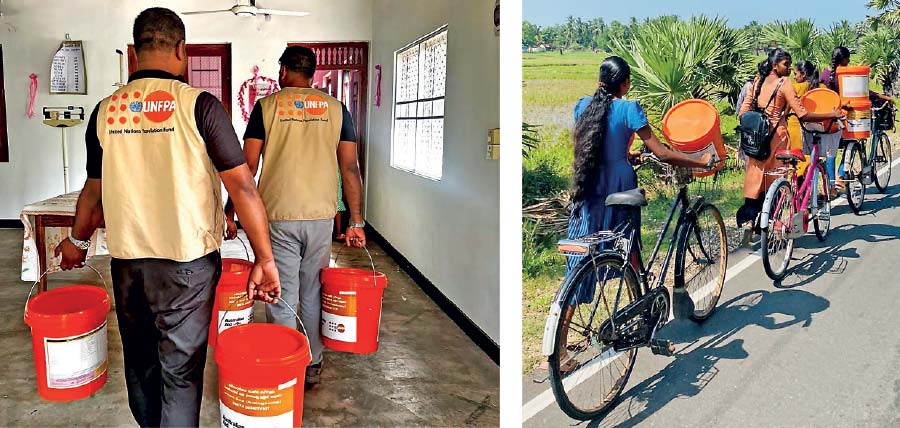
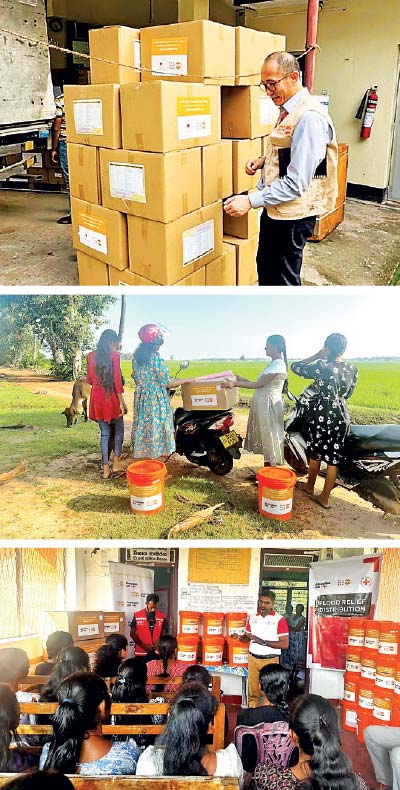
As part of urgent relief efforts, it has distributed 700 dignity kits to women and girls and 520 maternity kits to pregnant women in some of the worst-affected districts, including Batticaloa, Kurunegala, Puttalam, Badulla, Kandy, Nuwara Eliya, Colombo, and Gampaha.
These kits, supported by the Government of Australia through its Department of Foreign Affairs and Trade (DFAT) and the Government of Japan, contain essential items for mothers, babies and women including baby diapers, maternal clothes, underwear, sanitary napkins, flasks, towels, bed sheets, soap, toothpaste, mosquito nets, cot sheets, and buckets to protect the health and well-being of pregnant women during displacement.
Distributions were carried out through the Regional Directors of Health Services (RDHS) supported by the Health Ministry.
The UNFPA also facilitated awareness sessions for pregnant women and sessions on menstrual health for girls, so that they remain informed and protected even when the health system is under stress in collaboration with officials and staff from the Health Ministry.
The UNFPA is working closely with the United Nations High Commissioner for Refugees (UNHCR) to distribute kits for refugees and asylum seekers affected by floods and landslides. Additionally, UNFPA staff have also been deployed to the DMC to support Joint Rapid Assessment efforts.
The UNFPA will be conducting GBV Safety Verification assessments in the Gampaha District to examine security, hygiene, sanitation, safety concerns, and reporting pathways for cases of GBV, ensuring evacuation centres are safer for women and girls. Coordinated efforts are being carried out with the Women and Child Affairs Ministry, Family Health Bureau, Sri Lanka Police, and the GBV Forum to strengthen referral pathways for survivors of GBV.
Cyclone Ditwah has left hundreds of thousands in urgent need, but women and girls face the greatest risks. The UNFPA will continue scaling its life-saving response, ensuring that every woman and girl has access to critical health services, safety, dignity, and protection, no matter how challenging the conditions.
The UNFPA remains committed to reaching the most vulnerable swiftly, safely, and with dignity, leaving no one behind.



