Tuesday Sep 22, 2026
Tuesday Sep 22, 2026
Tuesday, 22 September 2026 06:11 - - {{hitsCtrl.values.hits}}
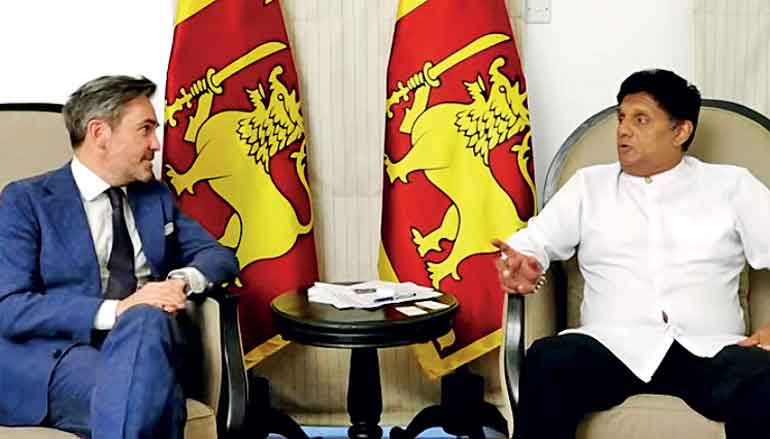
UN Resident Coordinator in Sri Lanka Marc-André Franche (left) with Opposition Leader Sajith Premadasa
UN Resident Coordinator in Sri Lanka Marc-André Franche said the country’s legislative process is developed in a closed manner, warning that laws are frequently drafted without adequate technical or public input, in a discussion with Opposition Leader Sajith Premadasa, a video of which Premadasa has released.
Franche said the biggest challenge was not only a matter of democratic process, where laws are developed solely between the Ministry, the Legal Draftsman, and the Attorney General, but also that laws often end up badly written as a result.
He cited the Online Safety Act (OSA), enacted under the previous Government, as a case in point. “One could have a debate about the substance, and if this is good or bad, but it’s also a very, very bad law, because it is absolutely unimplementable,” he said, adding that those who drafted it knew very little about the internet.
Franche said this was not an isolated case but a pattern across Sri Lanka’s legislative process, and called for greater political input and broader stakeholder engagement in drafting laws.
Drawing on his experience in Canada, he said Parliamentary Committees there are obligated to bring in all stakeholders affected by a law before it is passed. Using the OSA as an example, he said this would mean hearing from internet companies, journalists, Police, and groups representing young people and women, all of whom would testify and have their input formally recorded.
On the 22nd Amendment, Franche said any change to a country’s Constitution requires the broadest possible consultation, given that it alters the fundamental law of the country. “A constitution should not be changed every week,” he said, adding he hoped Sri Lanka would strengthen consultation in both its legislative and constitutional processes.
Franche said the UN had not engaged directly in the 22nd Amendment process, noting it was a matter the country had undergone independently. He referred to a letter sent by the UN Independent Expert on the independence of the judiciary to the Government, which raised three concerns drawn from international experience: the importance of consultation, the design of transitional measures for those presently serving under existing arrangements, and the issue of conflict of interest where affected individuals are required to rule on changes affecting themselves.
Franche said he had met the Justice Minister, who highlighted precedents in Sri Lanka where the Supreme Court had ruled on matters affecting its own members. He said he hoped the Special Rapporteur’s opinion would add useful elements to the public debate.




