Thursday Nov 26, 2026
Thursday, 26 November 2026 06:13 - - {{hitsCtrl.values.hits}}
By Amira Cader
|
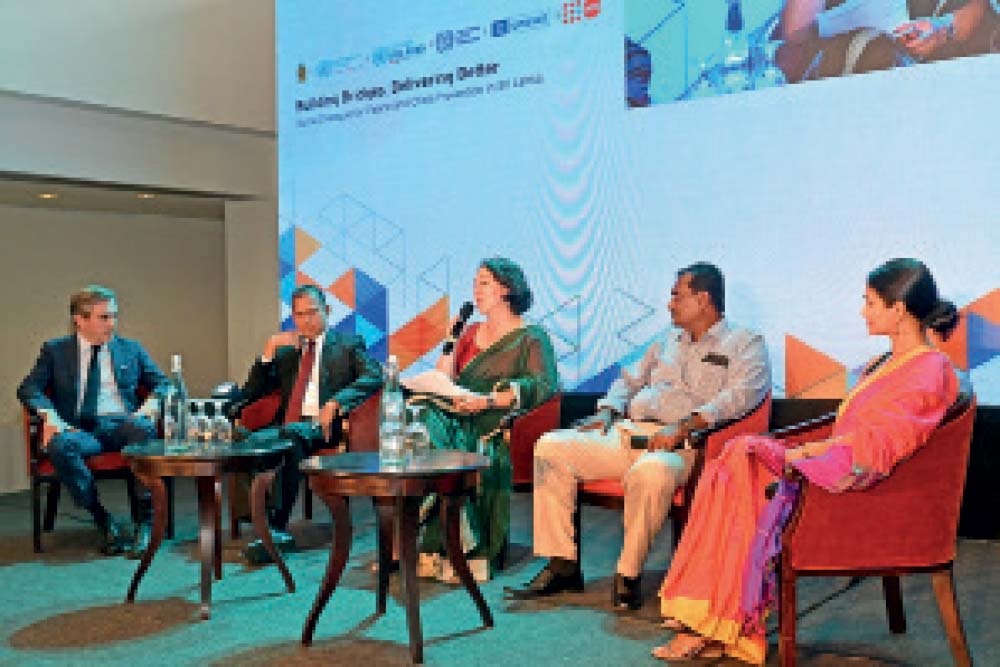
From left: UN Resident Coordinator in Sri Lanka Marc-André Franche, Public Administration, Provincial Councils and Local Government Ministry Secretary S. Alokabandara, UNESCO Regional Office for South Asia Chief of Sector and Program Specialist Eunsong Kim (Moderator), Uva Workers Development Foundation Founder Vadival Anthony, and MAS Holdings Gender Equality Head Thanuja Jayawardene – Pic by Lasantha Kumara |
Sri Lanka’s economic crisis brought more than financial hardship. It also placed pressure on workplaces, public institutions and relationships within communities, highlighting the need for stronger dialogue to address grievances, prevent disputes and rebuild trust.
Against this backdrop, a two-year initiative by the United Nations and the Government of Sri Lanka has sought to make social dialogue a practical tool for strengthening institutions, improving workplace relations and promoting social cohesion.
The Social Dialogue for Peace and Crisis Prevention in Sri Lanka project, implemented by the International Labour Organisation (ILO), the United Nations Educational, Scientific and Cultural Organisation (UNESCO) and the United Nations Population Fund (UNFPA), with funding from the UN Sri Lanka SDG Fund, concluded its activities at Cinnamon Grand Colombo yesterday.
The initiative brought together Government, employers, trade unions, civil society organisations and communities, creating opportunities for people to raise concerns and have a say in decisions affecting their lives.
UN Resident Coordinator in Sri Lanka Marc-André Franche said the project had helped move relationships between workers, the State and communities away from confrontation towards constructive dialogue.
He recalled that the initiative was conceived during the economic crisis, when public institutions were under considerable pressure. Between 2021 and 2023, around 2,700 labour-related registrations were recorded in sectors including postal services, railways, health and energy, highlighting the need for effective mechanisms to address workplace concerns before they escalated.
One of the project’s major achievements was the establishment of a structured national framework for dialogue covering approximately 1.4 million public-sector employees. Described as the first framework of its kind in South Asia, it operates through 82 workplace forums, seven sectoral forums and a National Public Sector Dialogue Forum.
Franche said more than half of the disputes raised through workplace forums had been resolved locally without escalation. He also highlighted a reduction in public-sector protests from 51 in 2022 to eight in 2025, alongside the wider economic recovery.
A wage dispute at Sri Lanka Railways, resolved through dialogue before developing into a strike, was cited as an example of how early engagement could prevent disruptions to essential services.
He stressed that industrial disputes affect not only workers and employers but also public services and economic activity, potentially affecting investor confidence. As Sri Lanka continues its recovery and public-sector reforms, trusted channels for discussing issues such as wages, working conditions and administrative changes will become increasingly important.
Gender equality and workplace safety were also important areas of the initiative. More than 1,400 public officials across 72 workplace forums in six ministries received training on addressing gender equality, safety and dignity at work.
The Postal Department is developing a gender-responsive action plan, while the Ministry of Transport has introduced mandatory gender and safety training for public transport workers.
In the private sector, 25 companies and 350 employers engaged with trade union representatives through the project, with support from the Employers’ Federation of Ceylon, the UN Global Compact Network Sri Lanka and the National Labour Advisory Council.
The initiative also focused on strengthening grievance mechanisms, preventing workplace sexual harassment and encouraging women’s participation in leadership.
Discussions at the closing event highlighted why gender equality requires more than policies against discrimination and harassment. Organisations need to examine recruitment, promotions, training and leadership opportunities to understand the barriers that continue to limit women’s progress.
Addressing unconscious bias, providing regular training and creating safe channels for employees to raise concerns were identified as important steps. Workplace policies, participants stressed, must be supported by action, open communication and management commitment.
The project also extended its work to communities, particularly groups that are often left out of decision-making.
With UNESCO working alongside the Centre for Poverty Analysis, the Coalition for Inclusive Impact and World Vision Lanka, 33 community forums were supported across Gampaha, Badulla and Batticaloa.
More than 180 forum members received training to better understand policymaking processes and communicate community priorities to district-level officials.
The forums enabled people from fisheries, plantation and agricultural communities to raise concerns directly with public authorities. In Batticaloa and Jaffna, discussions also brought attention to longstanding issues, including land rights and language access affecting Tamil-speaking communities.
Policy briefs on these concerns were presented to parliamentary sectoral committees, with further engagement involving relevant ministries continuing.
A key highlight of the closing event was a panel discussion titled ‘Dialogue in Action: Reflecting on the Impact of Social Dialogue’, moderated by UNESCO Regional Office for South Asia Chief of Sector and Program Specialist Eusong Kim.
The panel featured UN Resident Coordinator Marc-André Franche, Public Administration Ministry Secretary S. Aloka Bandara, Vadivel Anthony and MAS Holdings Women Go Beyond Head Thanuja Jayawardena, bringing together Government, UN and private-sector perspectives.
The discussion focused on how social dialogue could support public-sector reforms, improve workplace cooperation and strengthen social cohesion.
Particular attention was given to ensuring that public servants have opportunities to express their concerns and participate in decisions affecting their working conditions, especially as administrative reforms continue.
The private-sector perspective highlighted the need to address workplace attitudes and unconscious bias that can limit women’s opportunities, while strengthening systems through which employees can report concerns and seek fair solutions.
Franche said differences of opinion should not automatically be treated as a problem. In a diverse society, disagreements are inevitable, but institutions must provide spaces where people can express different views, challenge prejudice and work towards solutions.
He also pointed to the need for wider public consultation in policymaking, including the national budget process, stressing that meaningful participation should go beyond formal parliamentary discussions.
He explained that the United Nations’ role was not to dictate what Sri Lanka should do, but to facilitate discussions, create opportunities for engagement and bring international expertise in mediation and negotiation.
Looking ahead, Franche identified the forthcoming expiry of plantation company estate leases, covering approximately one-fifth of Sri Lanka’s arable land, as an opportunity to address longstanding inequalities and improve employment opportunities for plantation workers.
He also stressed the importance of ensuring that women and young people remain involved in decision-making and that community platforms and institutional mechanisms continue beyond the project’s lifespan.
Another important message from the closing remarks was that the initiative’s contribution went beyond the forums, training programs and activities established over two years. The trust, relationships and shared understanding developed between Government, employers, workers and communities were equally important.
The speakers expressed appreciation to the Public Administration Ministry for its leadership and coordination, as well as to the trade union partners, development organisations, participating institutions and communities.
Although the project has formally concluded, its work is far from over. Its success will ultimately depend on whether the dialogue mechanisms become part of everyday institutional practice and continue to give people a meaningful voice.
For Sri Lanka, the challenge now is to keep those conversations going. Lasting peace is not built simply by avoiding disagreements but by creating the trust and understanding needed to address them together.