Saturday Sep 19, 2026
Saturday Sep 19, 2026
Saturday, 19 September 2026 00:00 - - {{hitsCtrl.values.hits}}
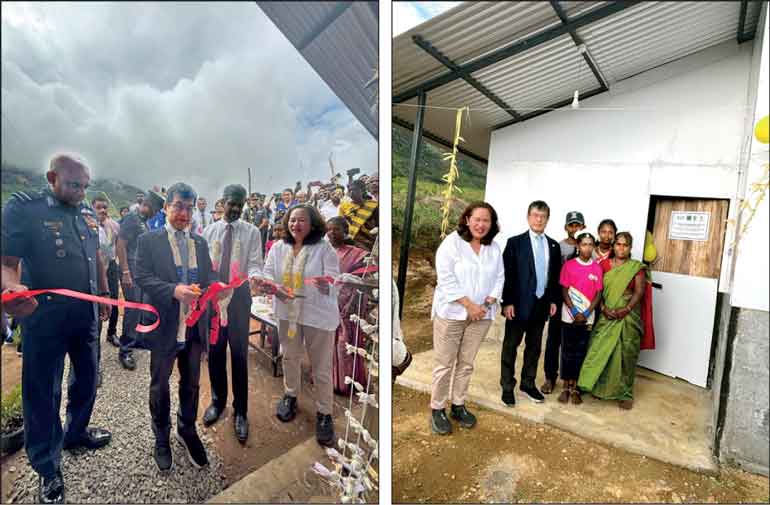
The International Organisation for Migration (IOM) and the Government of Japan, in partnership with the Government of Sri Lanka, on Thursday marked the handover of 63 of the 135 transitional shelters constructed for Cyclone Ditwah-affected families at an event in Rangalawatta, Kandy.
At the peak of the emergency, nearly 300,000 people were displaced, with many families losing their homes or being forced to relocate from high-risk areas. In response, through a Government of Japan-supported project, IOM facilitated the construction of 135 transitional shelters across Kandy, Badulla and Nuwara Eliya districts.
Kandy District Secretary (GA) Indika Udawatte said: “The Central Province was among the areas most severely affected by the cyclone, with significant impacts on housing and livelihoods. These shelters provide affected families with a safe place to recover and rebuild their lives.”
Implemented in line with the Government of Sri Lanka’s priorities and the United Nations Humanitarian Priorities Plan, the shelters were designed according to international standards and adapted to local needs.
The initiative was made possible through the generous support of the People and the Government of Japan, reflecting Japan’s longstanding commitment to supporting Sri Lanka’s recovery and resilience efforts.
Japanese Ambassador Akio ISOMATA said: “This project was realized by the close cooperation of stakeholders from different sectors, including the Sri Lanka Armed Forces and local communities. The spirit of cooperation that has emerged through this project will become an important asset for the community’s capabilities to prevent massive damage and to make a quick recovery in the event of natural disasters, including the potential future impacts of El Niño.” He further mentioned: “Japan intends to provide further assistance in areas such as reconstruction and reinforcement of roads, as well as disaster risk reduction, in addition to the ongoing assistance in building a Doppler Radar station in Puttalam to strengthen weather forecasting capabilities and early warning systems. Let us continue our efforts to ‘Build Back Better’ together, not only physically, but also in the cooperative spirit of disaster preparedness.”
Since the onset of the disaster, IOM has worked closely with national and local authorities to provide life-saving assistance and support early recovery. Under the same project with Japan, IOM distributed 3,000 essential household kits and 1,000 shelter repair toolkits, alongside the construction of transitional shelters – reaching over 20,000 people.
IOM Sri Lanka and the Maldives Chief of Mission Kristin Parco said: “Over the past months, we have met families who lost not only their homes, but also their sense of certainty about the future. Today, these shelters represent an important milestone. IOM will stand with families as they recover, restore their livelihoods and strengthen their resilience for the future.”
Building on these recovery efforts, IOM and Japan will continue working with the Government of Sri Lanka and partners to strengthen disaster risk management, support vulnerable communities and help reduce the impacts of future disasters.




