Wednesday Oct 07, 2026
Wednesday Oct 07, 2026
Thursday, 15 January 2026 00:00 - - {{hitsCtrl.values.hits}}
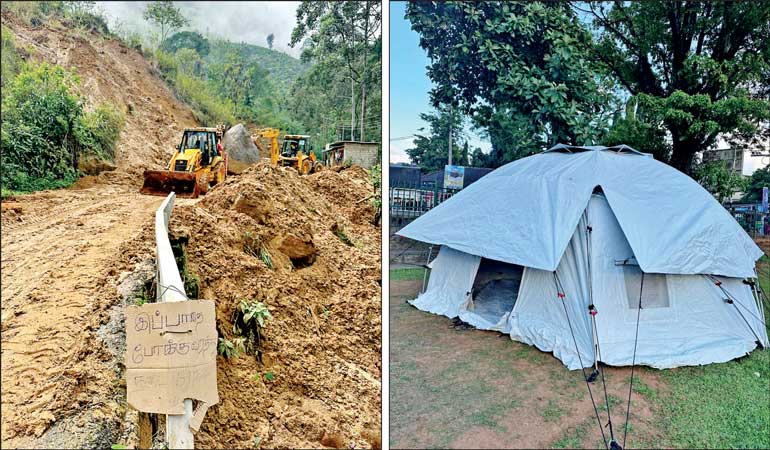
According to DMC data 99% of the shelters housing displaced families in all of the country are located in the five districts of hill country. Over 95% of the displaced families staying with friends and relatives are from these five districts. An overwhelming majority of these displaced people who are unable to return to their homes are families residing in the estates from the Malaiyaha community. After the disaster the country is moving on – return and rehabilitation work in many areas are happening at a fast pace. But that is not the case for many of the affected families from the Malaiyaha Tamil Community – The President and the Government should do better.
It is well known that heavy rains, floods, and landslides resulting from Cyclone ‹Ditwah› have severely affected the Hill Country. This disaster has particularly upended the lives of many Malaiyaha Tamils living in plantation areas. These people, who were already living on the edge of poverty and disaster risk, have been pushed into a dire situation.
While nature’s fury may be unavoidable, disaster studies show that its impact and the resulting misery are structurally produced based on pre-disaster socio-economic inequalities. Therefore, it is no surprise that this disaster has most heavily affected the marginalised Malaiyaha people in the hill country areas.
There are complications and challenges for the Malaiyaha Tamil community in accessing the various relief schemes announced by the Government and recovering from this disaster. Key causes include a lack of priority accorded to resolving the issues of this community by the Government, lack of policy guidance from the top levels of the Government, a general lack of experience among Government administrators in providing relief to plantation people, obstacles faced by plantation residents in accessing Government services, and most importantly a lack of clarity regarding their land rights. The Government’s lack of attention to these have emerged as major problems and bottlenecks for relief and reconstruction work in the hill country.
Lack of policy clarity and transparency on land identification process and relief eligibility is also causing serious concerns among the families affected in the plantation areas.
1.The Malaiyaha Civil Collective for Reconstruction asks the Government to treat affected people with dignity
a. Response should not restore the Malaiyaha families in the plantations to the same vulnerabilities but bring them to the mainstream by building back better.
b. Clear official communication on relief, rehabilitation and reconstruction is necessary and they being in Tamil also is essential
c. Involve the community in consultations and as active participants of their recovery effort. Publish the process for community consultations.
d. Refrain from shifting them around with short notice or without notice from shelters to shelters
2. Issue clear statement of policy clarifying Government’s position regarding the housing rights and land rights of Malaiyaha Tamil community living in state, RPC and private estates and ensure official authorisation of this policy position. It should address the below:
a. Treat them in par with other citizens of this country and adhere to the constitutional guarantee of non-discrimination.
b. Short term disaster response should not contradict/compromise the long term demands of the community for “secure land rights and integration to the mainstream under new villages.” Apartments/multi-storey dwellings that deprive the land rights of people who have been living in these estates for generations are not acceptable.
c. Transitional shelter arrangements should be linked to long term permanent housing solutions that takes into consideration the social-economic attachments of the community
d. Clarify how and when affected people in the plantation areas will be able to access the Rs. 5 million for housing and Rs. 5 million for land announced by the President.
e. The President should appoint a multi-stakeholder committee with a clear mandate and short time frame consisting of relevant Government, opposition, regional plantation companies and civil society representatives to identify land options for housing and durable solutions.
f. All Decisions should be after structured community consultations based on clearly laid out options.
g. Do not use the Indian Housing Project for Ditwah disaster response. Indian housing should be available to all the long term residents in the plantations as originally envisaged. The Indian Housing Project should not discriminate between worker and long-term non-worker residents in the plantation areas
3. Additional personnel and arrangements are essential to expedite relief work in the hill country regions. State mechanisms should reach out directly without using intermediaries like RPCs or PHDT in delivering relief, rehabilitation and reconstruction assistance
4. Flexibility in eligibility criteria and certification is essential in order for the families living in the estates from accessing Government announced relief schemes
5. The Government must take responsibility and allocate sufficient funds to repair and reconstruct damaged plantation community infrastructure – and bring them into the national mainstream.
The Malaiyaha Civil Collective for Reconstruction calls for a common action front to protect the land and housing rights of the disaster affected population and Malaiyaha community. We recognise and appreciate the general agreement and many efforts towards this end by political, civil and academic leaders.



