Tuesday Sep 15, 2026
Tuesday Sep 15, 2026
Thursday, 29 January 2026 05:17 - - {{hitsCtrl.values.hits}}
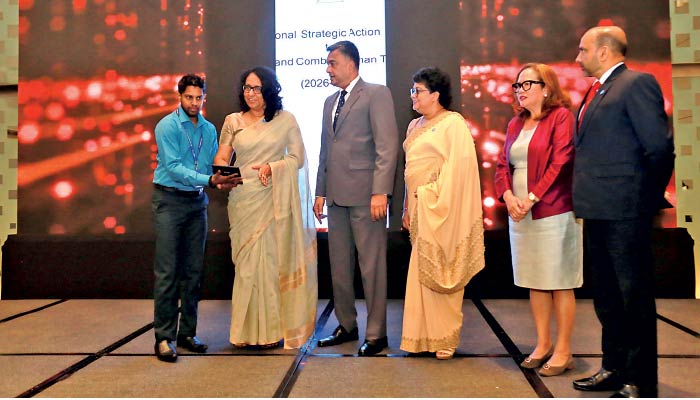
The National Anti-Human Trafficking Task Force (NAHTTF) yesterday officially launched the National Strategic Action Plan to Monitor and Combat Human Trafficking (2026-2030), reaffirming Sri Lanka’s strong commitment to eliminating all forms of human trafficking and strengthening coordinated national responses.
The launch was held under the patronage of Prime Minister Dr. Harini Amarasuriya. The event was also attended by Defence Ministry Secretary and NAHTTF Chair Air Vice Marshal (Retd.) Sampath Thuyacontha, International Organisation for Migration (IOM) Chief of Mission in Sri Lanka and Maldives Kristin Parco, and members of the NAHTTF representing 23 key Government entities, along with representatives of the diplomatic community, UN entities, and Civil Society Organisations (CSOs).
Dr. Amarasuriya said: “Caring for trafficking survivors in Sri Lanka requires a holistic, gender-sensitive, and survivor-centred approach that addresses both immediate protection and long-term recovery. This includes safe shelter, medical care, and trauma-informed psychological support, with particular attention to women and girls who experience more severe and gendered forms of violence, alongside legal assistance, economic empowerment, and skills development to prevent re-trafficking.”
The five-year Action Plan was unveiled under the leadership of the Defence Ministry, in its capacity as NAHTTF Chair, the national multi-stakeholder mechanism responsible for strategic guidance, coordination, and oversight of counter-trafficking efforts in Sri Lanka.
Air Vice Marshal (Retd.) Thuyacontha said: “As Chair of the NAHTTF, we remain firmly committed to safeguarding the dignity, safety, and security of all individuals. This National Action Plan reflects our shared responsibility to prevent and combat trafficking in persons through coordinated and sustained action. By raising public awareness, strengthening intersectoral collaboration, and ensuring accountability, we are working towards a Sri Lanka where exploitation has no place, perpetrators are brought to justice, and survivors receive the comprehensive protection and support they deserve.”
Developed with technical support from the IOM, the National Strategic Action Plan 2026-2030 establishes a unified national framework to prevent human trafficking, protect and assist victims, strengthen law enforcement responses, and enhance accountability. The plan draws on extensive consultations with the NAHTTF, CSOs, frontline responders, and international partners.
It builds lessons from previous action plans and aligns with international standards, addressing emerging challenges such as cyber-enabled trafficking and the misuse of digital platforms and artificial intelligence (AI) for recruitment and exploitation.
Parco said: “For over a decade, the IOM has worked alongside the Government of Sri Lanka, and is honoured to have supported the development of this Action Plan and strengthened national systems. The result is a plan that is both ambitious, practical, and grounded in global standards yet firmly rooted in Sri Lanka’s realities.”
“Together, with shared purpose, we are one step closer to eradicating human trafficking in Sri Lanka,” she added.
The Action Plan is structured around four key pillars:
The IOM will continue to work in close partnership with the Government of Sri Lanka and the NAHTTF to support the effective implementation of the National Strategic Action Plan to Monitor and Combat Human Trafficking (2026-2030). The organisation supports all counter-trafficking and victim protection efforts that will strengthen national and district-level mechanisms, ensuring comprehensive support for front-line responders and providing protection, return, and reintegration services for survivors of internal and cross-border trafficking.




