Wednesday Jun 03, 2026
Wednesday Jun 03, 2026
Wednesday, 28 January 2026 00:00 - - {{hitsCtrl.values.hits}}
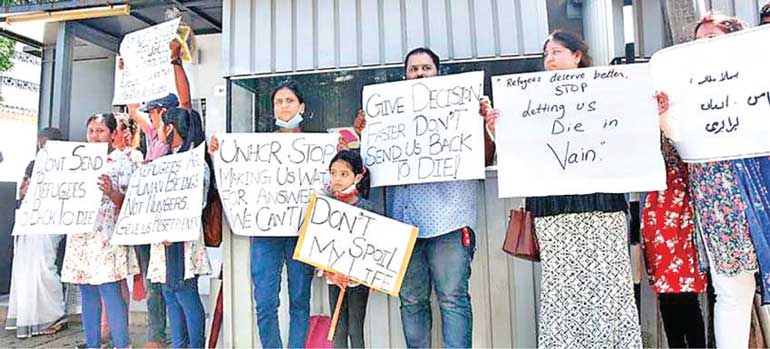
The CIVICUS Monitor has recently announced in a new report that the main civic space violations across the Asia-Pacific include the detention of protesters and activists.
The report, People Power Under Attack 2025, assesses civic space conditions in 198 countries and territories, looking at citizens’ ability to exercise their freedoms of assembly, association and expression.
In Sri Lanka, where civic space is rated as ‘repressed’, the authorities have continued to use counter-terror laws and target activists, journalists and protesters.
In March 2025, Mohamed Rusdi, a 22-year-old Muslim youth, was detained under the country’s draconian Prevention of Terrorism Act (PTA), for his activism on Palestine. He was held under a detention order, signed off by the Sri Lankan President Anura Kumara Dissanayake, before being released on bail.
Activists from the North and East were targeted. An ethnic Tamil youth activist was arrested and remanded in May 2025 following a false complaint by a Sinhala Buddhist monk involved in the construction of a controversial temple in Periyakulam, Trincomalee District. In the same month, the Counter Terrorism Investigation Division (CTID) summoned Vasuki Vallipuram, a well-known women’s rights activist and Coordinator of the Women Life and Rights Association – Kilinochchi, for interrogation. In September 2025, the Counter Terrorism and Investigation Division (CTID) summoned Tamil activist K. Sinthujan of Trincomalee - linked to the Tamil National People’s Front (TNPF)- for questioning for the second time in two months.
The OHCHR also reported that the surveillance apparatus, especially in the north and east, has remained largely intact. OHCHR observed continued patterns of surveillance, intimidation and harassment of families of the disappeared, community leaders, civil society actors, especially those working on accountability for enforced disappearances and other conflict-related crimes, land seizures, environmental issues, and those working with former combatants in Sri Lanka’s north and east.
Journalists remain at risk. In April 2025, while reporting at the Kuliyapitiya Magistrate’s Court, Fazir Mohamed, the Secretary of the Young Journalists Association and a reporter for the Satahan media, was obstructed by police officers working there and dragged out of the courtroom. In May 2025, photojournalist Lahiru Harshana was allegedly forced to remove a photograph of President Dissanayake, which had been published on his personal Facebook page, due to external pressure to do so by the President’s Media Division. In August 2025, the counterterrorism police summoned photojournalist Kanapathipillai Kumanan for questioning. Based in Sri Lanka’s Northern Province, Kumanan is president of the Mullaitivu Press Club, and a human rights defender, who documents violations against Tamil civilians by security forces in the heavily militarised north and east of the country.
Protests were also targeted. In March 2025, police arrested 27 student activists, including Madushan Chandrajith, the convener of the Inter-University Students’ Federation (IUSF), during a protest held in front of the Ministry of Health in Colombo against the recruitment process for state services. In August 2025, a court resumed proceedings against 19 Tamils, including local traders and youth from Mallavi, who participated in the Pottuvil to Polikandy protest march, a landmark peaceful demonstration calling for Tamil rights and justice in 2021.
In September 2025, protests in Mannar to stop a wind farm construction was violently dispersed by the police. Several protesters were hospitalised, including priests and female demonstrators reportedly beaten by the police. Police filed a case in the Mannar Magistrate’s Court against nine protesters, including three who were injured in the assault. Nearly 3,000 individuals who were arrested in the aftermath of the Aragalaya protests have unresolved cases and some remain in police custody.
Asia Pacific ratings
In the Asia-Pacific region, CIVICUS Monitor researchers found the majority of countries seriously restricted civic space. More than 85% of the population of the region lives in ‘Repressed’ or ‘Closed’ countries.
In Asia, seven countries and territories – Afghanistan, China, Hong Kong, Laos, Vietnam, Myanmar and North Korea are rated as ‘Closed’. Nine countries are rated ‘Repressed’ while six countries are in the ‘Obstructed category’. Civic space in South Korea and Timor-Leste are rated ‘Narrowed’ while Japan and Taiwan are the only two countries rated ‘Open’ in the Asia region.
In the Pacific, the civic space situation is more positive with seven countries rated ‘Open’. Five rated ‘Narrowed’ while Papua New Guinea and Nauru remain in the ‘Obstructed’ category.
Detention of protesters and activists
The most alarming trend across Asia-Pacific in 2025 was the mass detention of protesters and activists. People took to the streets to demand democratic reforms, fight corruption, call for climate justice, and show solidarity with Palestine. In response, states deployed their security forces to arrest and detain protesters in at least 18 countries.
In Indonesia, thousands were rounded up during nationwide protests against military law revisions in March and again during mass demonstrations in August. In the Philippines, police arrested hundreds, including children, during anti-corruption rallies. Arrests of protesters also occurred in Australia, India, Malaysia, Pakistan, Timor-Leste and beyond, where peaceful assembly was treated as a threat rather than a right.
“Governments are criminalising dissent on a massive scale. Peaceful protest is being painted as a crime, and those who dare to speak out and mobilise are paying with their freedom,” said Josef Benedict, CIVICUS Monitor’s Asia-Pacific researcher.
Authorities also targeted human rights defenders in at least 15 countries, using sweeping defamation, anti-terrorism and national security laws to jail activists on baseless or fabricated charges, especially in countries like China, Vietnam and Thailand. Reports of torture, ill-treatment and even deaths in custody emerged from Myanmar and Afghanistan, while transnational repression, where states pursue activists beyond their borders, intensified across the region by the authorities in Hong Kong and Cambodia.
Censorship and digital repression
Governments in at least 14 countries used censorship to silence dissent, blocking news portals, banning publications, and imposing internet shutdowns. China continues to operate one of the world’s most sophisticated censorship regimes, while Pakistan and India escalated digital restrictions by blocking thousands of social media accounts and YouTube channels. In Southeast Asia, Singapore and Malaysia deployed sweeping laws to suppress online content, while Vietnam and Indonesia restricted critical media.
“Censorship is being weaponised to keep citizens in the dark. From blocking news sites and social media channels to banning books, governments are rewriting reality to suit their narrative, and anyone who challenges that risks arrest,” said Benedict.
Countries of Concern: Indonesia and Pakistan
In Indonesia, civic space has sharply deteriorated under President Prabowo Subianto. The country, rated “Obstructed”, saw mass protests in March and August met with violent crackdowns, leaving thousands detained, including children, and reports of intimidation in custody. Human rights defenders face harassment, surveillance and criminalisation, while media outlets covering protests have been threatened. In Papua, longstanding grievances over rights abuses and resource exploitation continue to fuel unrest, with the government responding with force rather than dialogue, a clear slide toward authoritarianism.
In Pakistan, rated “Repressed”, authorities have intensified crackdowns on activists, journalists and opposition movements. Baloch defenders face arbitrary arrests and terrorism charges, while the Pashtun Tahaffuz Movement has been banned. Digital repression is escalating: social media platforms blocked, internet shutdowns around rallies, and thousands of accounts removed. Journalists risk prosecution under harsh cybercrime laws, and protests by the Pakistan Tehreek-e-Insaf party are criminalised, all pointing to a government determined to silence dissent and tighten its grip on power.




