Thursday Oct 15, 2026
Thursday Oct 15, 2026
Tuesday, 5 May 2026 00:04 - - {{hitsCtrl.values.hits}}
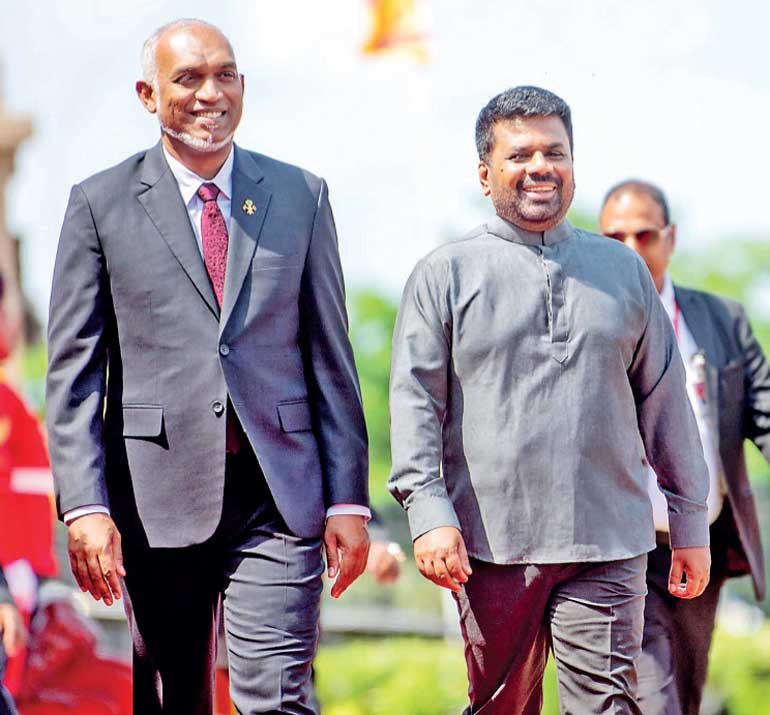
Marking 61 years of diplomatic relations, Sri Lanka and Maldives yesterday moved to significantly deepen bilateral ties, with President Anura Kumara Dissanayake and President Dr. Mohamed Muizzu overseeing the exchange of seven Memoranda of Understanding (MoUs) covering sectors ranging from defence and education to tourism, sports, health, and archiving.
The agreements were exchanged at the Presidential Secretariat in Colombo following formal bilateral talks between the two leaders, held after a ceremonial welcome accorded to President Dr. Muizzu during his ongoing State visit to Sri Lanka.
President Dissanayake described the visit as a milestone moment in a relationship built not only on formal diplomacy but on centuries of historical, cultural, and people-to-people ties.
He said Dr. Muizzu’s visit, coming as both nations mark 61 years of formal diplomatic relations established in 1965, reflects “the strong partnership, mutual trust and longstanding friendship” between the two neighbours.
The two leaders held wide-ranging discussions aimed at expanding cooperation across economic, social, cultural, and security sectors.
Speaking at a joint press conference, Dissanayake said the visit represented “a new phase” in Sri Lanka-Maldives relations and underlined the depth of the relationship. “Sri Lanka and the Maldives are two beautiful countries that respect each other. They are nations of warm and hospitable people,” he added.
He noted that while formal diplomatic ties began on 26 July 1965, historical connections stretch back much further, citing references in the Mahavamsa.
Dissanayake also highlighted the economic importance of the Maldives to Sri Lanka, noting that among South Asian Association for Regional Cooperation (SAARC) nations, the Maldives remains Sri Lanka’s third largest export destination.
“This is a testament to our longstanding people-to-people ties and friendly bilateral relations,” he said.
A key outcome of the visit was the exchange of seven cooperation agreements designed to institutionalise collaboration across critical sectors.
The MoUs included tourism cooperation between sri lanka and maldives, archival cooperation between the two national archives institutions, teacher training and professional development cooperation, sports and youth development cooperation, counter-terrorism and defence cooperation, defence education cooperation involving General Sir John Kotelawala Defence University, and academic cooperation involving University of Colombo and Maldivian health authorities.
The breadth of the agreements suggests an effort by both Governments to broaden cooperation beyond traditional diplomatic engagement into institutional and sector-specific partnerships. Economic cooperation emerged as a central pillar of discussions.
During the joint press conference, President Dissanayake invited Maldivian investors to explore opportunities in Sri Lanka across sectors including, information technology and artificial intelligence (AI); fisheries and agro-processing; tourism and leisure, as well as real estate and urban infrastructure.
Dissanayake also expressed optimism over the Maldives–Sri Lanka Business Forum scheduled for today (5), noting he expected “many fruitful partnerships” to emerge.
Dr. Muizzu echoed that economic cooperation was a major focus of discussions and said both sides were committed to creating a more investor-friendly environment.
“We are committed to expanding trade and investment flows, creating a more enabling and investor-friendly environment, and unlocking new business opportunities.”
Dr. Muizzu also disclosed that the Maldives is exploring the potential establishment of a Bank of Maldives presence in Sri Lanka and plans to introduce premium Maldivian fisheries products to the Sri Lankan market.
At the same time, he acknowledged the need to address trade imbalances between the two countries to ensure a “more balanced, equitable and mutually beneficial” economic relationship.
As Indian Ocean island nations, both leaders placed strong emphasis on maritime cooperation. Dissanayake said Sri Lanka welcomed proposals from the Maldives on fisheries collaboration and noted Sri Lanka’s interest in expanding cooperation in the boat-building industry. Dr. Muizzu reaffirmed the importance of sustainable fisheries management and marine resource protection, while also highlighting continued defence and maritime cooperation.
“As island nations, our future is inseparable from the Indian Ocean.”
The two leaders also reaffirmed their commitment to ensuring regional maritime routes are not exploited for illicit activities, underlining a shared security agenda.
Security cooperation featured prominently during the talks, particularly in counter-terrorism and maritime security.
Dissanayake said both nations, positioned along critical Indian Ocean sea lanes, face common threats and must work together to safeguard regional stability.
Dr. Muizzu thanked Sri Lanka for its support through joint exercises, training, and capacity building, signalling continued defence collaboration between the two countries.
Climate diplomacy was another major agenda item, with both leaders stressing the existential threat climate change poses to small island nations. Dissanayake said Sri Lanka and the Maldives discussed working more closely in international forums to advocate for stronger global climate action. Dr. Muizzu said both nations agreed on stronger environmental cooperation and collective action for climate resilience.
“Climate change remains an existential threat to both our nations.”
In a significant symbolic gesture, Dissanayake announced that Sri Lanka has allocated land in Colombo for the Maldivian High Commission, with the Maldives reciprocating by allocating land for Sri Lanka’s High Commission in Malé.
Both Governments are now working to finalise the necessary agreements. The move signals a long-term commitment to institutionalising bilateral engagement.
Tourism also emerged as a natural area of collaboration.
Dissanayake noted that the Maldives’ tourism success positively impacts Sri Lanka, with many international travellers opting for Sri Lanka–Maldives twin-destination holidays. He also highlighted the strong air links between the two countries and the growing potential for maritime connectivity and expanded aviation partnerships.
Closing the joint press conference, Dr. Muizzu said the visit marked “the beginning of a new and dynamic chapter” in bilateral relations. “Together, we will continue to build a partnership that delivers real results for our people and contributes meaningfully to the Indian Ocean region,” he added.
The visit follows Dissanayake’s own State visit to the Maldives in July 2025, which marked the 60th anniversary of diplomatic relations, and signals a deliberate effort by both Governments to convert historic ties into deeper economic, strategic, and institutional cooperation.




