Tuesday Oct 06, 2026
Tuesday Oct 06, 2026
Friday, 22 May 2026 00:04 - - {{hitsCtrl.values.hits}}
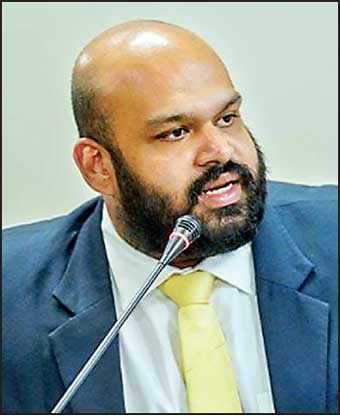 |
| ITAK MP Shanakiyan Rasamanickam |
Illankai Tamil Arasu Kachchi (ITAK) MP Shanakiyan Rasamanickam yesterday called on the Government to address the longstanding issue of Tamil political prisoners and prolonged detentions under the Prevention of Terrorism Act (PTA), arguing that Sri Lanka cannot apply different standards of justice to former Janatha Vimukthi Peramuna (JVP) militants and Liberation Tigers of Tamil Eelam (LTTE)-linked detainees.
In a statement shared on ‘X’ following his intervention in Parliament yesterday, Rasamanickam noted he had raised concerns directly with the Justice Minister regarding prolonged detentions, delayed legal proceedings, and the need for political and humanitarian solutions for prisoners who have spent decades behind bars.
“Today in Parliament, I raised the long-standing issue of Tamil political prisoners and prolonged detentions under the PTA before the Minister of Justice,” he said.
The MP noted that the Justice Minister had requested two weeks to provide an official response to the questions submitted in Parliament.
Rasamanickam said he had urged authorities to seriously consider Presidential pardons and broader political resolutions for detainees who have spent nearly three decades in prison.
“I also called for serious consideration to be given towards Presidential pardons and political resolutions for prisoners who have spent decades behind bars, with some having now spent nearly 30 years in prison,” he said.
Drawing comparisons with the State’s approach towards those linked to the southern JVP insurrections, Rasamanickam argued that Sri Lanka had previously embraced rehabilitation, amnesty, reintegration, and political accommodation in resolving past internal conflicts.
He pointed out that many individuals associated with the JVP, including former detainees and those who had received State pardons, now occupy senior positions in Government and public life.
“Many individuals associated with the JVP, including persons who were once imprisoned or pardoned by the State, today hold some of the highest positions in Government and public life,” he noted.
Rasamanickam questioned why similar discussions on reconciliation and reintegration could not take place in relation to Tamil prisoners who had already spent substantial portions of their lives in detention.
“If reconciliation, reintegration, and second chances were considered possible in one context, why cannot similar principles at least be discussed in relation to Tamil prisoners who have already spent decades in prison?” he asked.
The MP stressed that justice must be applied consistently regardless of ethnicity or political background.
“There cannot be duplicity in the application of justice. There cannot be one approach for JVP militants and another entirely for LTTE-linked detainees,” he said.
According to Rasamanickam, his parliamentary intervention focused on several key concerns including prolonged detention without timely resolution, delays in indictments and trials, equality before the law, fair review mechanisms, and the Government’s own manifesto commitments regarding political prisoners.
He also highlighted the impact prolonged detentions have had on families who have spent years waiting for legal or political resolutions.
“Many families have spent decades waiting for answers, while prisoners continue to live in uncertainty despite already losing a major part of their lives behind bars,” he said.
Rasamanickam argued that meaningful national reconciliation requires the State to address unresolved issues surrounding political detainees with fairness and consistency.
“A country that genuinely seeks reconciliation must be willing to address these issues with fairness, consistency, and political courage,” he said.
The MP pledged to continue pursuing the matter in Parliament until what he described as “meaningful progress” is achieved.



