Monday Sep 28, 2026
Monday Sep 28, 2026
Monday, 28 September 2026 04:06 - - {{hitsCtrl.values.hits}}
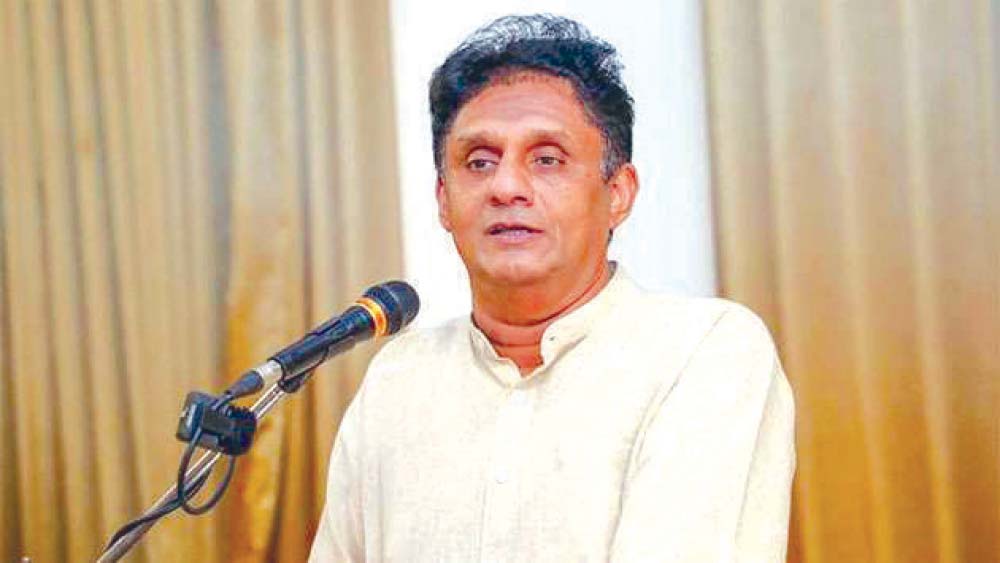
Opposition Leader Sajith Premadasa
Opposition Leader Sajith Premadasa has called for an urgent plan to successfully face the worst weather and climate change in view of the El Niño and La Niña.
“Because weather and climate conditions change rapidly, creating droughts in one region and heavy rainfall in another, there is a negative impact on public life. As a country, we must examine this matter with continuous dedication and keen attention. Many experts point out that predictions carry inherent uncertainty, as forecasted events may or may not occur. Under these circumstances, stated that it is most appropriate to prepare plans assuming the worst possible scenario will unfold,” said the Opposition Leader while addressing the Parliamentary Forum on Climate Change, which is co-chaired by Professor L.M. Abeywickrama and himself.
Since Prof. Abeywickrama was unable to attend, MP Lal Premanath joined as the Acting Co-Chair of the Forum.
Premadasa stated that the Parliamentary Forum on Climate Change was able to predict El Niño and La Niña conditions beforehand. He stressed that the country’s preparedness must be built with close attention and vigilance to the potential impacts of four major phenomena: El Niño, La Niña, ENSO, and the Indian Ocean Dipole (IOD).
El Niño and La Niña are currently affecting the entire world
Highlighting the global impact of these conditions, the Opposition Leader noted that weak monsoon rains in India have negatively affected its agricultural sector. In Indonesia, a prolonged dry period triggered severe fires that caused massive destruction. In Peru, over 1.2 million people are predicted to be affected, while Nepal recently suffered severe flooding and extensive damage due to disaster conditions.
Stressing that Sri Lanka must consider every sector that can be impacted by El Niño and La Niña, Premadasa said information must be gathered in advance so that necessary measures can be taken as soon as risks emerge. These conditions can impact water resources and reservoirs, affecting drinking water, irrigation, environmental needs, and power generation. Equal attention must be given to agriculture, food security, and managing human risks posed by droughts and landslides.
Attention should also be focused on coastal and fishing communities, energy generation, wildlife, and biodiversity.
Given the uncertainties created by El Niño, La Niña, ENSO, and the IOD, the country must prepare on the premise that impacts could be severe. The Opposition Leader emphasised that the Government, non-Governmental organisations, and civil society must collectively determine how to face these challenges.
The country needs a new disaster management mechanism
The existing disaster management structure and program are no longer sufficient to meet new challenges. The Opposition Leader proposed that Sri Lanka adopt a new mechanism focused on integrated responses and advance preparation to minimise damage, citing the disaster management model of India’s Odisha state as an example.
He also noted that the concept of multidimensional poverty was identified through a UN Development Program (UNDP) report released two years ago, marking the first time the legislature focused attention on multidimensional poverty.
The meeting also brought together distinguished experts from UN agencies to examine the potential impacts of El Niño on Sri Lanka’s agriculture and food security. Food and Agriculture Organisation (FAO) Senior Agriculture Specialist Dr. W.M.W. Weerakoon delivered a comprehensive presentation that provided the basis for an in-depth technical discussion. Valuable perspectives and expert insights were also contributed by FAO Assistant Representative Nalin Munasinghe, FAO/Anticipation Hub’s W.G. Winson Gnanatheepan, UNDP Team Leader – Climate and Environment Dr. Buddhika Hapuarachchi, World Food Program (WFP) Deputy Country Director Robert Oliver, and UN Office of the Resident Coordinator Sri Lanka Resilience Window Coordinator Wagisha Perera.
The meeting also featured a highly relevant and informative presentation by Prof. Rathnasiri Premathilake of the Postgraduate Institute of Archaeology (PGIAR), University of Kelaniya, on El Niño and La Niña Impacts on Summer Monsoon Rainfall in Sri Lanka. His research introduced an important historical and palaeoclimatic dimension to the discussion, drawing on radiocarbon-dated sedimentary sequences extending back approximately 46,000 years and biological indicators, including fossil pollen, to reconstruct past climatic and environmental changes. Evidence from sites including Horton Plains, Fa-Hien Lena, and Kabella Lena in the Runakanda–Sinharaja forest landscape provided a valuable long-term perspective on climatic variability and the influence associated with El Niño and La Niña conditions on Sri Lanka’s rainfall patterns and environment.




