Saturday Sep 05, 2026
Saturday Sep 05, 2026
Saturday, 5 September 2026 00:26 - - {{hitsCtrl.values.hits}}
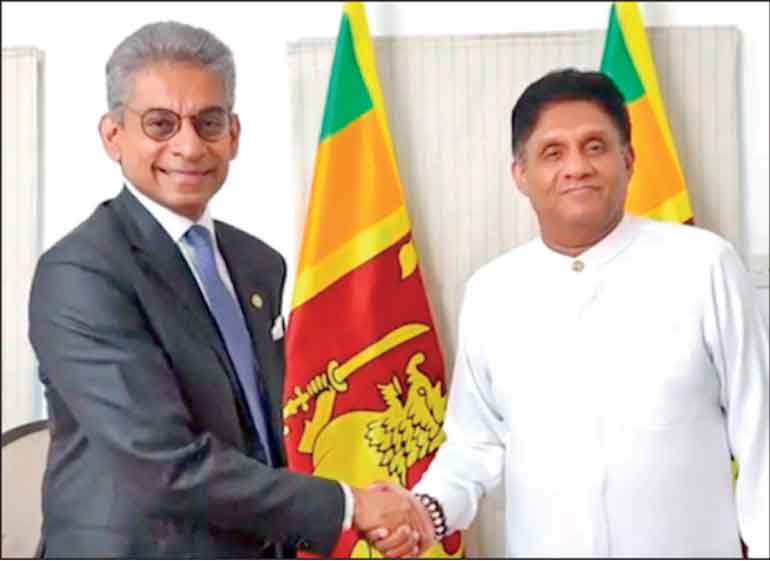
Commonwealth Lawyers’ Association President Steven Thiru (left) with Opposition Leader Sajith Premadasa
Opposition Leader Sajith Premadasa has called for a national dialogue on constitutional reform, proposing that Sri Lanka examine the establishment of a dedicated Constitutional Court or another specialised mechanism to review constitutional matters as part of longer-term institutional reforms.
Premadasa made the remarks following a meeting with Commonwealth Lawyers’ Association President Steven Thiru at the Opposition Leader’s Office in Colombo, where discussions centred on constitutional democracy, separation of powers, judicial independence, the rule of law and environmental justice.
He said constitutional institutions should be structured to function independently and credibly regardless of which political party holds power.
Premadasa said constitutional reforms should not be shaped around the immediate political interests of either the Government or the Opposition, but should retain legitimacy and provide safeguards for citizens and institutions when political power changes hands.
He said reforms affecting independent constitutional institutions required adequate safeguards, clear justification, transparency and meaningful consultation with the public and other stakeholders.
The discussions also covered the Commonwealth Latimer House Principles as an international benchmark for assessing the separation of powers among Parliament, the Executive and the Judiciary, as well as judicial independence, accountability and transparency.
Premadasa said Sri Lanka could examine, as part of longer-term constitutional reform and without interfering with ongoing judicial proceedings, whether the country required a dedicated Constitutional Court or another specialised constitutional review mechanism.
He said any such institution would require careful consideration of its powers, composition, appointment process, tenure, accessibility and relationship with the existing Supreme Court and Court of Appeal.
The meeting also focused on strengthening the environmental rule of law, with Premadasa referring to a policy commitment contained in Section 14 of the Environmental Charter 2.0 presented during the 2024 presidential election to establish a specialised environmental court or tribunal.
He expressed interest in examining the experience of other Commonwealth jurisdictions to determine whether an environmental court, tribunal or hybrid model would be best suited to Sri Lanka to strengthen environmental law enforcement, environmental justice and the resolution of environmental disputes.
Premadasa stressed that constitutional reform should be a continuous, transparent and consultative process, saying the real test of an institutional arrangement was whether it remained secure and legitimate when political power changed hands.
“Judicial independence is not a privilege of judges, but a safeguard for the people and the constitutional system of government,” he said.



