Wednesday Sep 30, 2026
Wednesday Sep 30, 2026
Wednesday, 30 September 2026 00:07 - - {{hitsCtrl.values.hits}}
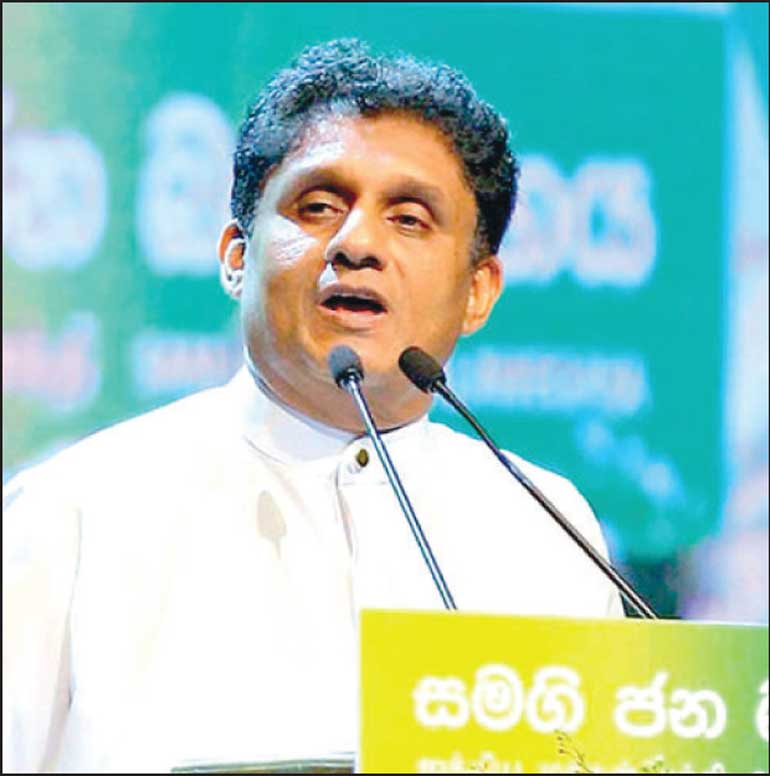
Opposition Leader Sajith Premadasa
Opposition Leader Sajith Premadasa yesterday accused the Government, the Central Bank of Sri Lanka (CBSL) and the Department of Census and Statistics (DCS) of painting a misleadingly positive picture of the country by using survey data up to a decade old to depict poverty.
In a special statement, Premadasa said the Sri Lanka Socio-Economic Data 2026 report, released on 28 September, used recent data for macroeconomic indicators, trade, prices, government finance, debt, labour and tourism, but relied only on 2016 to 2019 data for household income and expenditure, poverty, housing, energy use and food consumption.
He said the selective use of old data on poverty, inequality and living standards was a deliberate attempt to mislead the country’s 22 million citizens. He called on the President, the Government, the CBSL and the DCS to account for the discrepancy, warned them against dismissing it as a printing error, and said he was ready for an open debate on the matter.
Premadasa said no proper Household Income and Expenditure Survey (HIES) had been conducted and the poverty line had not been accurately identified since the country went bankrupt. He questioned whether the Budget, scheduled for 12 November, 2026, would be based on flawed data, and rejected as false the Government’s position that a person could live on Rs. 17,315 a month.
Citing a 2026 World Bank report, he said Sri Lanka’s poverty rate stood at 65.4% under the World Bank’s $ 8.30-a-day poverty line, which he put at Rs. 2,724, with 33% of households facing acute food insecurity. He said the rate was projected to ease only marginally to 63.4% by 2028.
Premadasa demanded that a revised report based on accurate data be presented before the Budget.
The Sri Lanka Socio-Economic Data report, now in its 49th volume, is an annual compendium published by the CBSL Statistics Department. It collects figures produced by other agencies, each table carrying its source, and each section can only be as current as the survey behind it.
The sections Premadasa criticised, covering household income, expenditure, housing, energy use, poverty and food consumption, are all sourced to the DCS HIES. The latest survey rounds shown are 2016 and 2019. The DCS conducts the HIES once every three years, and the survey provides the income and expenditure data used to measure living conditions. Unless a new round is published, these tables cannot be updated. The CBSL’s 2023 and 2025 editions carried the same HIES tables, with the poverty headcount ratio series ending at 2019 in 2023, and the 2025 edition citing HIES 2016 and 2019 as sources.
The DCS carried out a fresh HIES in 2025, covering 25,000 households. It was the first since 2019, as the survey was skipped during the economic crisis. Its results, the first post-crisis measure of household income and poverty, have yet to be released.



