Saturday Sep 26, 2026
Saturday Sep 26, 2026
Friday, 25 September 2026 00:02 - - {{hitsCtrl.values.hits}}
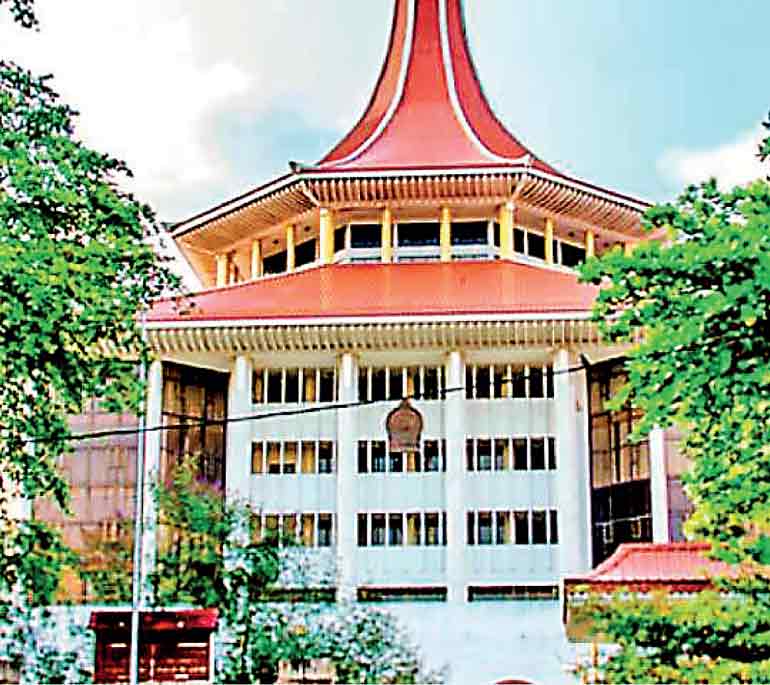
The Supreme Court, in its Determination on the 22nd Amendment to the Constitution Bill, devoted a section of its reasoning to the pressures judges face from political and public criticism, warning that about “a particular threat to judicial independence which should concern us”, attacks on the judiciary which risk eroding the public trust on which the rule of law depends.
The Supreme Court has determined that the 22nd Amendment to the Constitution Bill, which raises the retirement age of Supreme Court judges to 67 and Court of Appeal judges to 65, does not require approval by the people at a referendum under Article 83 of the Constitution, and can be enacted with a two-thirds parliamentary majority alone. Yesterday in Parliament, Opposition lawmakers criticised the Determination and attacked the Chief Justice ahead of its public protest today against the 22nd Amendment.
In its Determination, submitted to Parliament on Tuesday, the Supreme Court addressing the Petitioners’ argument that increasing judges’ retirement age could be perceived by the public as an interference with judicial independence, the Bench, comprising Chief Justice P. Padman Surasena and Justices Achala Wengappuli, Arjuna Obeyesekere, Sampath B. Abayakoon, and K.M. Gihan H. Kulatunga, said public criticism, however strong, should not deter judges from doing what they believe is right.
Citing its own earlier decision in Hettiarachchi vs. Seneviratne, Deputy Bribery Commissioner and Others (No. 02), the Court said: “That the case may be of great interest to the public, or even sensational, is beside the point. As far as a court of law is concerned, there are no unimportant matters. The status and position of the persons before us, whether as petitioners or respondents, are of no consequence.”
The Bench invoked Lord Denning’s words in Ex parte Blackburn: “Exposed as we are to the winds of criticism, nothing which is said by this person or that, nothing which is written by this pen or that, will deter us from doing what we believe is right.” It added: “Our pulses do not beat any faster either because of the persons before us or because of public comments by any person.”
The Determination went further, quoting at length from a speech titled ‘Without Fear or Favour: Judicial Independence, Past, Present and Future,’ delivered on 22 June by King’s Bench Division of England President Dame Victoria Sharp.
In the extract cited by the Court, Dame Victoria said judges face pressure “from all quarters: from the Executive branch of the State, from the Media, from the general public and of course from the litigants themselves,” and that “depending on the decision made, we can be excoriated as ‘out of touch’ or attacked as dangerously radical.”
She said social media had amplified this dynamic, noting that “keyboard warriors frequently express themselves in very strong terms, which can be picked up and amplified by those with particular agendas to pursue,” contributing to “a proliferation of echo chambers, social media influencers, and confirmation bias.”
“There is a particular threat to judicial independence which should concern us: that is, the growing tendency for politicians and the press to attack in intemperate and even vituperative terms judges who have given decisions with which they disagree. Newspapers all too often respond to an unpopular decision with personal attacks on the judges concerned.”
Dame Victoria added that judges “must accept strong criticism, even unfounded criticism,” and that one of the attributes expected of an independent judge is “the moral courage to make decisions which will be unpopular with politicians or the media or the public.”
The Bench also cited her observation that the real harm from unwarranted attacks on judges “is not any hurt to the judge’s feelings; it is that they undermine that respect for the judiciary without which the foundations of the rule of law are undermined.”
“We can only reiterate that the judiciary of this country consists of men of courage and men of wisdom who have always and who will always maintain the independence of the judiciary under varying circumstances,” the Bench said.




