Tuesday Oct 06, 2026
Tuesday Oct 06, 2026
Saturday, 27 June 2026 01:40 - - {{hitsCtrl.values.hits}}
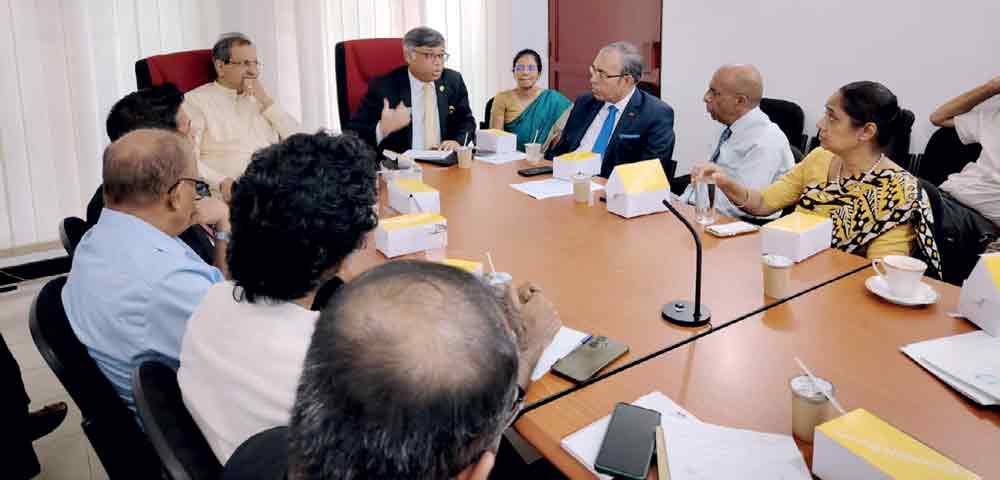
SAARC Secretary General Ambassador Md. Golam Sarwar has appealed to SAARC member states to engage more proactively with each other to overcome the present difficulties facing the regional body and to reignite SAARC.
Noting that “there remains great opportunity for regional unity to take centre stage,” he said: “While immediate bilateral priorities often demand close attention, an inspiring momentum is emerging as visionary leadership across the region works to keep broader cooperation at the heart of the conversation. When member nations champion this collective vision together, they can successfully elevate the dialogue around shared progress, ensuring that deep, meaningful regional integration remains a vibrant and lasting priority for all.”
SG Sarwar, who was on a visit to Sri Lanka, made these observations when he addressed the ‘5th RCSS Strategic Dialogue’ hosted by the Regional Centre for Strategic Studies (RCSS) in Colombo on 24 June 2026 on the theme, “Reigniting SAARC: Achievements, Challenges and Way Forward.”
Moderated by RCSS Executive Director Amb. Ravinatha Aryasinha, the event sought to examine the current state and future potential of SAARC and regional cooperation within South Asia.
During his address, SG Sarwar detailed the significant contributions of SAARC over nearly four decades, reflecting on its role as an “irreplaceable beacon of hope” for the region’s two billion people. He provided an update on the ongoing activities of specialised regional centres, specifically highlighting the SAARC Cultural Centre in Sri Lanka as a vital node of technical expertise driving a practical, bottom-up approach to regional problem-solving.
Highlighting the organisation’s commitment to academic integration, the Secretary General stated that nothing epitomises the spirit of “knowledge without borders” more powerfully than the establishment of the South Asian University (SAU).
He described the university as a “visionary investment in our collective intellectual capital” that fosters a shared regional consciousness by building a “living bridge of mutual trust and academic collaboration” that transcends political boundaries. SG Sarwar further pointed to active cooperation currently taking place among states at the functional level, such as the recent ministerial conference in Colombo, which focused on ending violence against children.
In a powerful conclusion, SG Sarwar reframed the current dialogue around the organisation’s future, inviting the audience to appreciate the irreplaceable foundation built over the last four decades. Rather than looking at it with pessimism, he championed SAARC as the region’s premier vehicle for cooperation. He concluded with a call to action, asserting that the true path forward lies in uniting efforts to build a “much stronger, more empowered, and thoroughly revitalised SAARC.”
The subsequent dialogue included the participation of former SAARC Secretary General and RCSS Board Member Amb. Esala Weerakoon; former Executive Director of RCSS Prof. Gamani Keerawella; SAARC Secretariat Director Amb. Waruna Wilpatha; Ministry of Foreign Affairs Director General (South Asia) and former SAARC Secretariat Director Varuni Muthukumarana; and SAARC Cultural Centre (SCC) Director Dr. Kaushalya Kumarasinghe, alongside a distinguished group of diplomats, academics, policy experts and media personalities.
The discussion explored the fundamental concept of a “South Asian identity,” questioning whether the region should be defined as a purely geographical, cultural or historical entity. It was argued that for regionalism to truly flourish, the association must evolve from being state-centred to embracing a “People’s SAARC” approach, fostering a shared ideology that takes the grand philosophy of integration out of conference halls and directly into the hearts of the rural landscape.
This vision is being actively promoted through “decolonising” standard academic frameworks, as practised at the South Asian University, to view regional challenges through a South Asian lens rather than through external conceptual models.
On the economic front, the dialogue addressed the challenge of intra-regional trade, noting that member states often produce similar goods, which can lead to competition.
To overcome this, it was suggested that SAARC serve as a platform for new collaborative frontiers, such as a “SAARC Mineral Policy” to address critical minerals and regional green technologies.
The discussion further emphasised the need for mutual recognition agreements, particularly in pharmaceutical manufacturing, and the necessity of a sustainable “Blue Economy” to protect regional natural resources for future generations. Participants highlighted that the region should be viewed as a collective destination for investment, leveraging its massive market to attract global capital.
To navigate the current geopolitical impasse, the dialogue highlighted the urgent need for a collective shift from “political exceptionalism to functional regionalism”. This strategy advocates the purposeful insulation of core sectors, including climate action, disaster response and energy, to ensure they remain “immune from diplomatic turbulence”.
It was observed that SAARC remains an “indispensable institutional anchor”, providing a neutral platform for policymakers and experts to maintain engagement through informal diplomacy even during periods of bilateral tension. It was emphasised that SAARC, rather than being seen as an ‘engine’ for regional cooperation and integration, which would require the sustained political will of all member states, could more meaningfully serve as a ‘catalyst’, drawing inspiration from the institutional foundations of similar regional organisations.
Further, misconceptions regarding the cost of the association were addressed. It was noted that the investment required to maintain SAARC is minimal compared to its strategic value, with its entire annual budget being less than the operating costs of some individual diplomatic missions in the region.



