Tuesday Aug 25, 2026
Tuesday Aug 25, 2026
Tuesday, 25 August 2026 07:20 - - {{hitsCtrl.values.hits}}

Prime Minister Dr. Harini Amarasuriya, Speaker Dr. Jagath Wickramaratne, WFD Sri Lanka Country Director Sanjay Vignaraja, Women and Child Affairs Minister and WPC Chair Saroja Paulraj
In Sri Lanka, as in many countries, unpaid and under-supported care responsibilities continue to fall disproportionately on women, creating barriers to employment, entrepreneurship, and economic advancement.
Research shows that while Sri Lankan women and girls achieve high educational standards, nearly 75% of working-age women are excluded from the labour force, primarily due to caregiving responsibilities.
Strengthening social care systems including childcare, elder care, disability support, and other care services can help unlock economic opportunities, reduce inequalities, and contribute to more sustainable and equitable development.
According to the International Labour Organisation (ILO), every dollar invested in the care sector in Sri Lanka produces a return of $ 7.76.
In this context, investing in the care economy is increasingly recognised as both a social imperative and a strategic economic policy that can drive inclusive growth, increase labour force participation, and improve the wellbeing of families and communities. Parliament has a crucial role to play in financing the care economy.
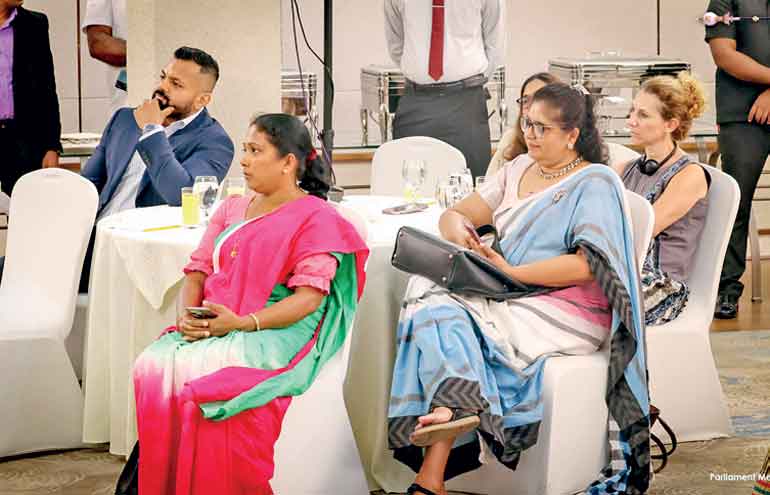
Westminster Foundation for Democracy (WFD), together with the Women’s Parliamentary Caucus (WPC) in Sri Lanka, organised a roundtable discussion, bringing together key parliamentarians with an interest in economy and finance, gender, and social care, government officials, civil society representatives, researchers, and diplomats. The session aimed to build understanding and exchange ideas on how barriers for growth can be removed through a gender analysis of the economy and the budget and agree on an action plan to ensure that this is included in the next government budget in a tangible and targeted way.
As Women and Child Affairs Minister and WPC Chair Saroja Paulraj pointed out: “Our goal is to bridge the gap between social care policy and national fiscal allocation. As parliamentarians across party lines and committee leadership, our duty is to ensure that a robust gender analysis is embedded into economic policies and national budgets.”
The role of the parliament and the caucus
During the discussion, it was agreed that parliament, and specifically the WPC, had an important role to play in financing the care economy in Sri Lanka. This included using women’s lived experiences and research to build a solid evidence base; leading inquiry into care services to help women enter the labour market; working across committees with allies to focus attention on this issue and start a public conversation; presenting evidence-based legislation to the parliament; and reviewing the national budget with a gendered lens and championing gender-responsive budgeting.
In her keynote address, the Prime Minister Dr. Harini Amarasuriya, highlighted that care is not a private matter, but a social responsibility. She noted that it was an economic issue and a matter of public policy.
“If we want more women to participate in all aspects of society, and we want greater autonomy for women to make choices, and if we want to make our society truly inclusive, then we must create the social infrastructure that makes that possible […] Investment in care should not be seen simply as expenditure. Affordable and accessible childcare, quality early childhood education, eldercare services, support for persons with disabilities and stronger social protection systems can create benefits across society, including the economy.”
Dr. Amarasuriya went on to highlight the responsibility of parliament in financing such policies.
“Gender-responsive budgeting needs to become a meaningful part of our approach to public finance. We need to understand how budget decisions affect women and men differently, and whether public investment is helping to address or reinforce existing inequalities.”
Three strategic allocations
As noted by the Speaker Dr. Jagath Wickramaratne, parliament’s role in financing the care economy requires three strategic allocations: firstly, investing directly in care infrastructure, early childhood development, elderly care system and social protection mechanism that alleviate the unpaid care burden; secondly, legislative reforms strengthening legal frameworks that afford workplace protections, champion fair work standards, and foster work environments where care responsibilities do not penalise employees; and thirdly, an inclusive economic matrix integrating the care economy into policy discussions and national accounting so that fiscal choices actively promote gender equity and social wellbeing.
Recommendations
The discussion also highlighted key recommendations from research institutes and civil society organisations. These included: allocating national fund for a regular time-use survey to quantify unpaid care work; institutionalising sustainable funding mechanism for assistive devices; funding pilot after-school programs for children in low-income schools, so women are able to remain in the formal workforce; and scaling up the elder care centres pilots across all districts to reduce women’s care burden.
Pix courtesy: Parliament of Sri Lanka