Thursday Oct 15, 2026
Thursday Oct 15, 2026
Tuesday, 24 March 2026 03:32 - - {{hitsCtrl.values.hits}}
 |
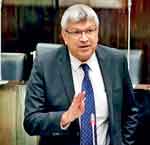 |
| TNA MP Shanakiyan Rasamanickam | Justice Minister Harshana Nanayakkara |
Tamil National Alliance (TNA) MP Shanakiyan Rasamanickam pressed the Government in Parliament on missing persons, accountability and delays in investigations, while Justice Minister Harshana Nanayakkara responded with detailed data on ongoing efforts, including expansion of the Office on Missing Persons (OMP), funding allocations and progress on mass grave probes.
Rasamanickam on Friday said concerns raised by victim communities remain unaddressed more than a year into the Government’s term. “Your Government, your President has been in power for a year and six months and most of these concerns haven’t been addressed,” he told the House.
He brought up the matter In light of the UN Human Rights Council 61 Core Group statement on Sri Lanka, which calls for credible accountability, strong independent institutions, and meaningful engagement with OHCHR, and noting that victim communities, particularly families of the disappeared, have rejected domestic mechanisms and continue to call for credible international investigations
Rasamanickam questioned the absence of a unified database of missing persons and raised concerns over delays in the Chemmani mass graves investigation, stating that remains had been unearthed without visible progress in forensic analysis. He also challenged the Government’s refusal to engage with international accountability mechanisms and questioned how prosecutions would be pursued domestically.
Responding, Justice Minister Harshana Nanayakkara said the Government is working with available records and acknowledged inconsistencies in data. “I can only say what’s on the record from 2009 is 2,764,” he said, noting that figures differ across Presidential Commissions, the Lessons Learnt and Reconciliation Commission and the OMP.
He said the absence of a consolidated database has been a longstanding issue due to fragmented institutional records, but noted that data from multiple sources has now been consolidated into a temporary database, with plans to establish a comprehensive system with international technical support.
On mass graves, Nanayakkara said 19 sites have been identified, with investigations ongoing at several locations including Colombo, Mullaitivu, Mannar, Batticaloa and Trincomalee. He said Rs. 19 million has already been allocated for the Chemmani excavation, with the site under joint protection and work being carried out under court supervision using forensic and archaeological standards.
The Minister said technical support has been obtained from the International Committee of the Red Cross, including training for more than 40 excavation officers and additional advanced training programs involving 60 participants to strengthen forensic capacity.
On the OMP, Nanayakkara said nearly 100 staff have been recruited to strengthen operations and that Cabinet approval has been granted to expand its mandate to include cases beyond 2000. He said Rs. 375 million has been allocated for a special project involving 75 inquiry panels.
He said the OMP plans to complete investigations into 5,000 cases this year, with a further 6,000 targeted next year, aiming to address the backlog within two years.
Nanayakkara also outlined progress on reparations, noting that as at 31 December 2025, a total of 4,456 claimants had received payments, while 31 collective reparation programs have been implemented benefiting 1,523 individuals.
On accountability, he reiterated that the Government will not engage with external mechanisms. “Sri Lanka has not accepted the Sri Lanka accountability project as it constitutes an external initiative that is counterproductive to the ongoing domestic reconciliation process,” he said.
He maintained that accountability would proceed under domestic law. “Missing person is a crime. Killing is a crime. Whatever the crime, the local criminal law will be applied equally to everybody,” he said, adding that further legal measures could be introduced if required.
Nanayakkara said international assistance would be utilised for technical expertise, but enforcement would remain domestic, with the Government aiming to deliver outcomes through a structured process over the coming years.
Rasamanickam, in a follow-up, questioned the Government’s reliance on incomplete domestic data while rejecting externally compiled evidence and raised concerns over the absence of a clear judicial mechanism for accountability.




