Thursday Oct 15, 2026
Thursday Oct 15, 2026
Thursday, 4 December 2025 06:26 - - {{hitsCtrl.values.hits}}
|
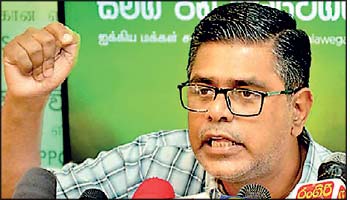
SJB MP Mujibur Rahman
|
|
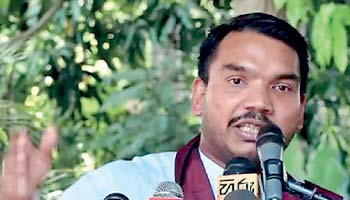
SLPP MP Namal Rajapaksa
|
Samagi Jana Balawegaya (SJB) MP Mujibur Rahman yesterday called for a Parliamentary Select Committee to investigate the Government’s preparedness for Cyclone Ditwah, arguing that the administration failed to act despite clear early warnings. He also challenged the legality of the Rebuilding Sri Lanka Fund, claiming it bypassed established disaster management laws and oversight mechanisms.
Speaking in Parliament, Rahman said there was continuing uncertainty over whether the Government had been properly informed about the approaching cyclone.
“The Director General of the Meteorology Department stated on 12 November that a cyclone was approaching, and international media like BBC and CNN reported rainfall of up to 500 mm,” he said, adding that the public was still waiting for an official explanation of what information was available to the Government and when.
Rahman argued that the administration showed no visible preparation before 27 November. He said that while no country can prevent natural disasters, authorities have a responsibility to prepare for them. “All we want to know is whether the Government had a plan to contain the damage,” he said. “They did not.”
He stressed that large parts of the country had suffered severe losses, with entire villages destroyed by landslides and floods, and that the death toll was still not fully known.
“This is a critical moment for the country, so we need to find out who is responsible and who should be held accountable,” he said. He argued that Parliament must establish responsibility and identify gaps in preparedness so that future disasters can be managed with fewer casualties.
Rahman also criticised the establishment of the Rebuild Sri Lanka Fund, asserting that it conflicts with the Disaster Management Act, No. 13 of 2005. The Act, he said, already provides a framework for mobilising, managing, and auditing relief and reconstruction funds, including specifying the composition of committees responsible for disaster response. “When there is a law passed by this legislature, the President cannot use executive powers to create parallel structures that circumvent it,” he said.
He questioned the composition of the new Joint Committee, noting the absence of disaster-management specialists, medical professionals, engineers, and even the Auditor General.
He added that it included no women and no representation from communities affected by the disaster. Some members, he said, were simultaneously engaged in legal disputes with State bodies over matters ranging from Customs processes to renewable-energy projects.
Rahman pointed to past failures in managing disaster-related funds, citing examples such as Helping Hambantota, the fund created under former President Gotabaya Rajapaksa, and the Red Star Tsunami fund. These experiences, he said, reinforced the need to rely on the statutory mechanisms already in place rather than ad-hoc structures.
He also criticised the Government’s use of emergency regulations following the declaration of a State of Emergency on 28 November.
While the President told the country the move was intended to expedite rescue and relief work, Rahman said some senior figures had simultaneously called for action against individuals who criticised the Government on social media.
“What they cannot do under normal conditions, they are attempting to do under the cover of a State of Emergency,” he said, describing this as a worrying development.
Joining the debate, Sri Lanka Podujana Peramuna (SLPP) MP Namal Rajapaksa also called on the Speaker to establish a Parliamentary Select Committee to examine claims that the recent destruction caused by severe weather could have been averted.
Speaking in Parliament, he said the public discourse had split into two narratives, with some blaming the Government for failing to take preventive action while the Government, in turn, was directing responsibility towards State officials.
“Two contrasting positions have emerged. One side argues the Government should have acted earlier, while the Government now accuses officials of failing in their duties. A Deputy Minister has also attempted to shift the responsibility onto the bureaucracy. We therefore request the Speaker to appoint a Parliamentary Select Committee to carry out a transparent investigation into what went wrong,” he said.